

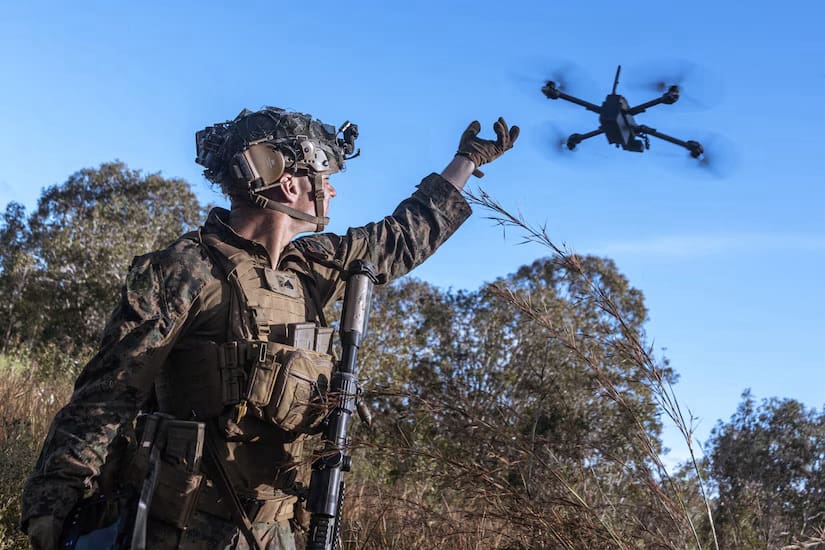
The War Department requested information earlier this week to gauge industry’s willingness and ability to make some 300,000 drones quickly and inexpensively — a concrete effort by Secretary of War Pete Hegseth to directly meet the “drone dominance” goals laid out by the president.
On June 6, President Donald J. Trump signed the “Unleashing American Drone Dominance” executive order outlining how the United States would up its drone game in both the commercial and military sectors, including how it would deliver massive amounts of inexpensive, American-made, lethal drones to U.S. military units to amplify their combat capabilities.
Hegseth followed up in July with the “Unleashing U.S. Military Drone Dominance” memorandum, in which he laid out his plan for how the department would meet the president’s intent.
Part of the secretary’s plan included participating with other parts of government in building up the nascent U.S. drone manufacturing base by approving hundreds of American products for purchase by the department, powering a “technological leapfrog” by arming combat units with the very best of low-cost American-made drones, and finally, training as the department expects to fight.
“Next year I expect to see [drone] capability integrated into all relevant combat training, including force-on-force drone wars,” the secretary said.
At that time, Hegseth said, he had already advanced American drone dominance by stripping away regulations that hindered the military’s adoption of small drones and shifting the necessary authorities away from the department’s bureaucracy and into the hands of unit commanders.
“This was the first step in the urgent effort to boost lethality across the force,” Hegseth said in a video posted today to social media.
Now the War Department is moving out in a new way on the drone dominance initiative, Hegseth said.
“The second step is to kickstart U.S. industrial capacity and reduce prices, so our military can adequately budget for unmanned weapons,” the secretary said.
He noted that, with help from Congress, the department will initially focus on small attack drones.
“Drone dominance is a billion-dollar program funded by President Trump’s Big Beautiful Bill,” Hegseth said. “It is purpose-built on the pillars of the War Department’s new acquisition philosophy: a stable demand signal to expand the U.S. drone industrial base by leveraging private capital, paired with flexible contracting built for commercial companies, founded by our best engineers and entrepreneurs.”
A stable demand signal means the War Department will make concrete plans to buy lots of drones, on a regular schedule, over a long period of time. When that happens, American industry will step up to the plate to satisfy the department’s needs, including by investing in and building out its own capacity to produce in the long term.
The request for information released to industry this week spells out a plan that’ll begin early next year, when the department will, over the course of two years, and within four phases, offer $1 billion to industry to build a large number of small unmanned aerial systems capable of conducting one-way attack missions.
The first of those four phases, called “gauntlets,” runs from February to July 2026. During that time, 12 vendors will be asked to collectively produce 30,000 drones at a cost of $5,000 per unit, for a total of $150 million in department outlays.
Over the course of the next three gauntlets, the number of vendors will go down from 12 to five, the number of drones ordered will increase from 30,000 to 150,000, and the price per drone will drop from $5,000 to $2,300.
“Drone dominance will do two things: drive costs down and capabilities up,” Hegseth said. “We will deliver tens of thousands of small drones to our force in 2026, and hundreds of thousands of them by 2027.”
Through the drone dominance program, $1 billion from the Big Beautiful Bill will fund the manufacture of approximately 340,000 small UASs for combat units over the course of two years.
After that, it’s expected that American industry’s interest in building drones as a result of the program will have strengthened supply chains and manufacturing capacity to the point that the military will be able to afford to buy the drones it wants, in the quantity it wants, at a price it wants, through regular budgeting.
Equipment is only part of the game, the secretary said. Doctrine — how the warfighter fights — is also critical.
“I will soon be meeting with the military services to discuss transformational changes in warfighting doctrine,” Hegseth said. “We need to outfit our combat units with unmanned systems at scale. We cannot wait. The funding provided by the Big Beautiful Bill is ready to be used to mount an effective sprint to build combat power. At the Department of War, we are adopting new technologies with a ‘fight tonight’ philosophy — so that our warfighters have the cutting-edge tools they need to prevail.”
Following the end of the Cold War, Hegseth said, U.S. defense spending dropped precipitously, and as a result, there was also a consolidation of defense contractors from hundreds to just dozens. The department, he said, budgeted for quality rather than quantity — and for 30 years got what it needed.
“However, we now find ourselves in a new era,” he said. “An era of cheap, disposable battlefield drones. We cannot be left behind — we must invest in inexpensive, unmanned platforms that have proved so effective.”
Drone dominance, he said, is how the U.S. will meet the drone challenge posed by other nations.
“One of my priorities is rebuilding our military,” Hegseth said. “We can’t do that by doing business the same way we have in the past. We cannot afford to shoot down cheap drones with $2 million missiles. And we ourselves must be able to field large quantities of capable attack drones.”
By C. Todd Lopez, Pentagon News
You can skip to the end and leave a response. Pinging is currently not allowed.
Read the full article here
