

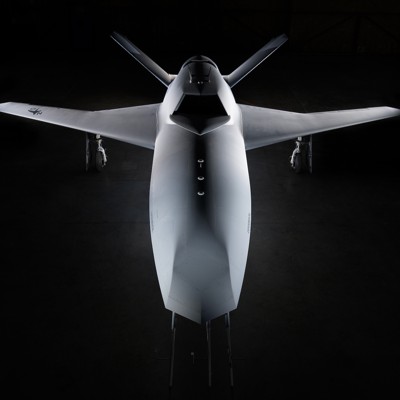
MOJAVE, Calif.—When Northrop Grumman lost its initial bid for the U.S. Air Force’s collaborative combat aircraft, the company went back to the drawing board. Now, it wants to fly a new prototype, called Project Talon, in the next nine months.
Project Talon—previously referred to as Project Lotus internally—builds on the company’s initial offering for the first increment of the U.S. Air Force’s collaborative combat aircraft program. But while CCA’s first increment is designed for air-to-air missions, Northrop developed Talon to handle a variety of missions, Tom Jones, corporate vice president and president for Northrop Grumman Aeronautics Systems, told reporters Wednesday.
“What we learned is we took a high side compliant engineering organization and taught them a different way of thinking about innovation. Innovation is not always about the subsystem that performs the highest,” Jones said. “We’re still extremely good at making something very complex. So this was really about broadening that paradigm to what it means to be a high performing engineering, aviation, development, and manufacturing organization to encompass all aspects of it.”
The prototype aircraft took about 15 months to build with Northrop’s subsidiary Scaled Composites, and goals of lowering costs while speeding up manufacturing to produce aircraft faster.
Northrop was able to reduce Talon’s build time by almost a third, and cut the aircraft’s number of parts in half compared to previous designs. Jones wouldn’t divulge more details about how much cheaper Talon is versus the company’s initial CCA offering, but said rethinking materials and dropping the aircraft’s weight by about 1,000 pounds were critical.
“If you set the requirements and say the most important requirements are affordability and schedule…Your engineers are now focused on optimizing a different problem,” Jones said. “If you get affordability, you get lower weight. If you get lower weight, guess what? You get better performance. You get longer range, or shorter runways, higher speeds…The low weight is good.”
The unveiling comes a few months after Lockheed Martin’s Skunk Works announced its multipurpose CCA competitor drone, Vectis, and its plans to fly it in 2027. It also comes after the Navy awarded contracts earlier this year to Anduril, Boeing, General Atomics, Lockheed Martin, and Northrop Grumman to develop the service’s CCA drones.
CCA development has hit several milestones this year, including the first test flights of General Atomics’ and Anduril’s robot wingmen. Shield AI also announced a CCA contender aircraft. International interest in the program is also on the rise, especially as European countries look to increase their defense budgets.
The Air Force could spend nearly $1 billion on CCAs in the next few years—if it gets the requested $111 million for the program in 2026 along with the $678 million in budget reconciliation funds spread over five years.
Read the full article here
