

Even as the Pentagon designs new tactics and tech based on lessons from Ukraine—like the new attack drones it is testing—some say the United States is still undervaluing its relationship with Kyiv.
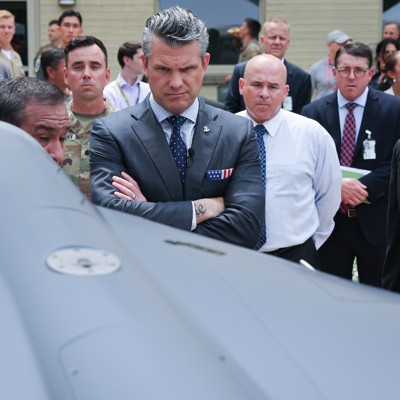
Take the Low-Cost Unmanned Combat Attack System, or LUCAS, a one-way attack drone modeled on wrecked Russian Shahed-136s recovered by Ukrainian troops. Developed by Arizona-based SpektreWorks, the LUCAS appeared earlier this year in a Pentagon courtyard display of new programs funded by DOD’s research and development office. Officials touted LUCAS’ open architecture, which simplifies its use in surveillance, reconnaissance, and communication with other drones. A poster quoted Donald Trump: “I’m talking about something for $35,000 to $40,000, we can send thousands of them up…They’re very good, too. Fast, and deadly. Horrible, actually, when you look at what’s happening with Russia and Ukraine.”
CENTCOM has now deployed a squadron of LUCAS drones for one-way attack missions and, along with the Army, is testing it for other types of operations. A CENTCOM official said tests had been going on for weeks in several locations, but declined to confirm what a foreign intelligence official at one of the sites told Defense One: that several of the drones had veered off course, blown up upon launch, or even failed to launch at all. CENTCOM did say such reports were not characteristic of the broader effort.
What CENTCOM’s efforts show is a new devotion to in-theater testing of drones that are cheap enough to acquire in numbers that could overwhelm enemy air defenses.
A second CENTCOM official said cheaper drones allow experiments that sometimes result in (still not officially confirmed) crashes—just the sort that lawmakers and commanders have long said should be the norm across the military.
Such incidents are what “fail fast and cheap actually looks like,” the second official said.
But the LUCAS, a clone of an Iranian-designed drone mass-produced in Russia, also shows that the U.S. military is behind Ukraine and its adversary in its ability to acquire and improve the most important weapons of future wars.
“If you asked me three to four years ago if we would have seen any one country’s ability to launch 500 to 600 one-way attack drones in a 24-hour period, I don’t know that I would have told you ‘yes.’ So what that just highlights is the rapid advancement of technology and capability,” Brig. Gen. Curtis King of the 10th Army Air and Missile Defense Command said during a recent U.S. Army counter-drone demonstration in Germany.
On the U.S. side, however, years of concerted effort have resulted only in limited deployments. The LUCAS does not represent an innovation on drone design so much as a “threat emulator,” as its manufacturer describes it. The very existence of LUCAS, based on wrecked Shaheds recovered in Ukraine, shows how important the country is to U.S. drone efforts.
Ukrainian engineers are also showing the way forward in developing counter-drone defenses: cheap systems like the interceptor drones they built to down Shaheds, not the expensive anti-air missiles provided by the United States.
Ukraine is even outpacing the Pentagon in 3D-printing drones near the front lines—an area of focus for the U.S. Army’s FlyTrap experiments. One military leader at the November event said studying Ukraine has become the “homework assignment” he gives his soldiers: “They go find out what’s been utilized in Ukraine, and then they come back, they teach us, and then we try to apply [that to] our training.”
What’s needed now is even closer connections between U.S. troops and companies and their Ukrainian counterparts, several people said. One soldier at the FlyTrap event said that what he would find most beneficial is more actual face-to-face interaction and instruction from Ukrainians.
While a handful of U.S. companies are working directly with Ukrainian forces to develop drones and other gear, those relationships are often very specific to the individual units and startups, the foreign intelligence official said, adding that Kyiv has been seeking to expand this cooperation into a broader relationship between the Ukrainian and U.S. defense industries. Such a relationship would allow Ukraine to quickly share battle damage assessments and similar data with the United States.
This would enable U.S. firms to spot new opportunities. It would also help them spot the kinds of flaws that have rendered many U.S. drones sent to Ukraine—as the foreign intelligence official put it—“duds.” One well-publicized example is the Skydio drone, which Ukrainian operators struggled to use amid Russian GPS jamming. In October, Skydio announced that it would work with a data company, Armada, to equip the drones to better operate in “disconnected, contested, or emergency environments.”
The performance of most U.S.-made drones in Ukraine “has gotten worse” in the past year, said one former Ukrainian military official who now works with the Ukrainian government to procure drones and counter-drone tech.
One big reason is that the United States lacks enough testing ranges where drones in development can fly against Russian-level electronic warfare—because jamming affects cell-phone signals. No jamming was used, for example, at the U.S. military’s August T-REX experiments in Indiana.
So U.S. companies, including some of the biggest, often ask frontline Ukrainian units to test their arms and gear. But the U.S. firms don’t offer much in return for these services, said one U.S. defense contractor who works with Ukrainian companies. In effect, they treat the beleaguered troops like unpaid interns, even as they quietly acknowledge that they are falling behind.
The foreign intelligence official said political and business leaders in other parts of Europe, such as the United Kingdom, Norway, Estonia, and beyond, were far more likely to perceive the value of partnership with Ukraine.
U.S. political leaders could help Ukrainian and U.S. companies to work together. In July, Ukrainian President Volodymyr Zelensky said Donald Trump appeared prepared to do just that, proposing a deal for the United States to buy Ukrainian drones as part of broader conflict negotiations.
But the mood at the White House has since shifted. In October, the Wall Street Journal reported, a Russia official promised Trump’s envoy Steve Witkoff and son-in-law Jared Kushner that profits would follow if the U.S. pressed Ukraine to stop fighting. The following month, U.S. military leaders told Ukrainian counterparts that their fighting position was ultimately unsustainable, that Russia was preparing to increase its attacks, and that the U.S. defense industry would not be able to keep up with Ukraine’s needs for key air defense systems. Army Secretary Dan Driscoll and others encouraged Kyiv to accept large parts of a 28-point peace plan that would cede Ukrainian land and constrain European help.
The growing Ukrainian unease appears likely to forestall closer cooperation and trust.
“Ukrainians are terrified of rocking the boat,” said the foreign intelligence official. He likened the current Ukrainian mood toward the U.S. as being like “an abusive relationship where even the slightest whimper could set off a tirade and get people killed.”
Read the full article here
