

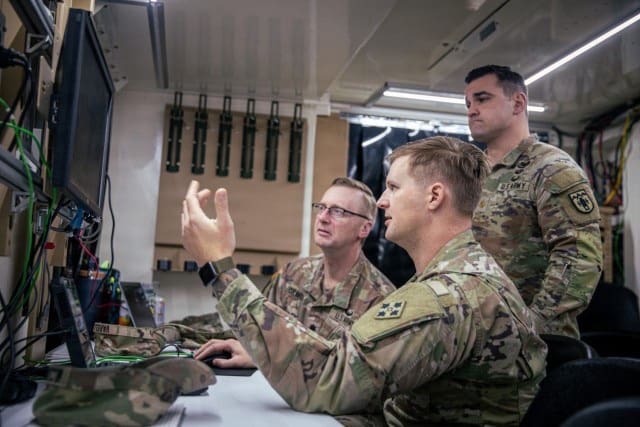
ABERDEEN PROVING GROUND, Md. — There are no algorithms in foxholes – yet.
While the U.S. Army has applied emerging artificial intelligence tools to streamline processes across the enterprise — most recently with the rollout of the Department of War’s new generative AI website, GenAI.mil — the impact of AI on the tactical edge Soldier and commander is still taking shape.
With the help of industry experts and Soldier experimentation, however, the Army is building a blueprint for algorithmic warfare at the edge across technology, training, concepts, procurement, and ethical implementation. The potential of AI supporting command and control, C2 — using tools to rapidly process data, inform commanders’ decisions, speed the fires kill chain, and reduce the cognitive burden on Soldiers — is a major focus of ongoing operational prototyping of Next Generation Command and Control, NGC2, the Army’s priority effort to leverage rapid progress in commercial technology to deliver information across all warfighting functions.
The overarching goal of AI for C2, leaders said, is to enable human decisions at machine speed.
“No other technology will have a bigger impact on future warfare than artificial intelligence,” said Brig. Gen. Michael Kaloostian, director of the Command and Control Future Capability Directorate, U.S. Army Transformation and Training Command. “The way we harness and adopt AI to support decision-making, and to make sense of what is expected to be a very chaotic battlefield in the future, will ultimately give commanders options to achieve decision overmatch.”
Applying AI at echelon — designing secure models for austere conditions, tailorable for specific missions and warfighting functions — was the focus of an industry workshop conducted earlier this month by the C2 Future Capability Directorate and Army Contracting Command-Aberdeen Proving Ground.
The market research event, with technical experts from a range of companies and Army organizations, produced feedback on how the Army can better leverage private sector innovation in AI for C2. Areas to maximize industry opportunities and expertise included prioritization of desired capabilities over time, as well as the availability and relevance of Army warfighting and training data that AI models can consume.
“Everybody sees private sector investment happening in AI, so where does the tactical Army fit in the AI market?” said Col. Chris Anderson, project manager Data and AI for Capability Program Executive Command, Control, Communications and Network. “The Army’s unique value proposition for industry is our data and access to warfighters.”
The workshop session also came on the heels of a request for information released on Sam.gov on Dec. 2, focused on gaining industry feedback on the emerging data architecture for NGC2. The Army securely shared the draft architecture on Sam.gov to foster transparency and invite industry ideas that will augment the current NGC2 prototype experimentation and designs underway with vendor teams supporting the 4th Infantry Division and 25th Infantry Division.
“The Army’s approach with Next Generation C2 has always been commercially driven, with industry as foundational partners,” said Joe Welch, portfolio acquisition executive for C2/Counter C2, and Executive Director, T2COM. “That means all of industry — not just our current team leads, but a large range of companies that can contribute to a thriving ecosystem. This RFI is another step in our commitment to sharing technical details and applying industry feedback as we move forward with NGC2.”
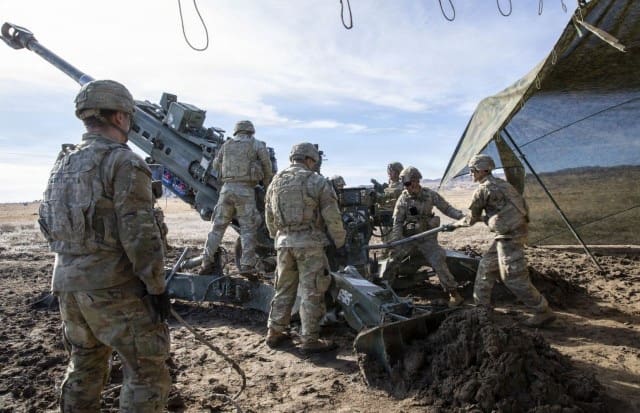
One challenge the Army and industry are jointly facing with AI implementation at the edge is that models are only as good as the data they can ingest and interpret. But available data, as well as computing and network resources required to process it, will vary widely depending on the tactical environment.
“For AI at the strategic level, that’s almost entirely unconstrained by store and compute,” Anderson said. “Down at the foxhole, it’s an entirely different story.”
Because of that complexity, the Army is designing the NGC2 ecosystem to rapidly onboard new AI models, building on a common foundation but able to address new missions and environments.
“We’re looking to really provide an ecosystem so that model developers and Soldiers have the capability to fine-tune models at the edge,” Welch said. “When we say that the Army has specific model gaps that we need addressed, it will be a pipeline to very rapidly move that through.”
Another element of the Army’s roadmap is determining what algorithmic warfare capability is required by echelon, from Corps to company and below, informed by the data each unit needs to make decisions, Kaloostian said. The NGC2 prototyping underway with the 4th ID’s Ivy Sting and 25th ID’s Lightning Surge events is providing significant insight into those requirements, as well as the tactics, techniques and procedures for employing different AI applications, he said.
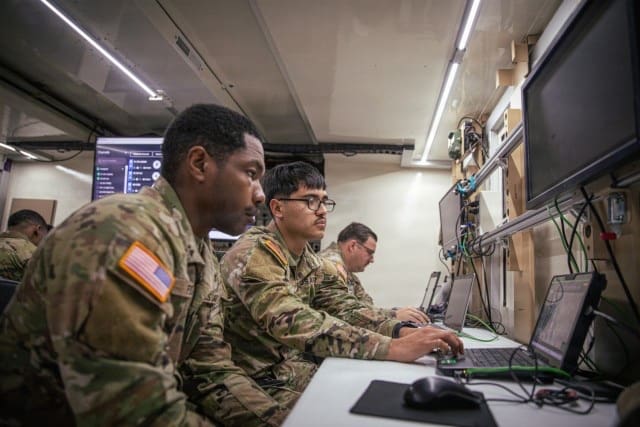
Even as technology and concepts rapidly evolve, the Army will maintain its ethical standards in using AI to support C2 decisions made by humans, leaders said. For example, during the 4ID Ivy Sting series at Fort Carson, Colorado, the division has trained AI models to review sensor data and rapidly recognize, process, and nominate targets. The commander reviews that information and decides whether to order a fire mission. At the staff level, AI can also reduce the time Soldiers spend sifting through and organizing data from a constantly expanding range of data sources and digital systems.
“A lot of what we’re looking to provide here is a reduction in the cognitive burden that comes with the use of a lot of digital tools,” Welch said. “Not just AI target recognition, but generalized AI capabilities are going to help lower that cognitive burden so that our Soldiers can focus on their core tasks to complete the mission.”
By Claire Heininger
You can skip to the end and leave a response. Pinging is currently not allowed.
Read the full article here
