

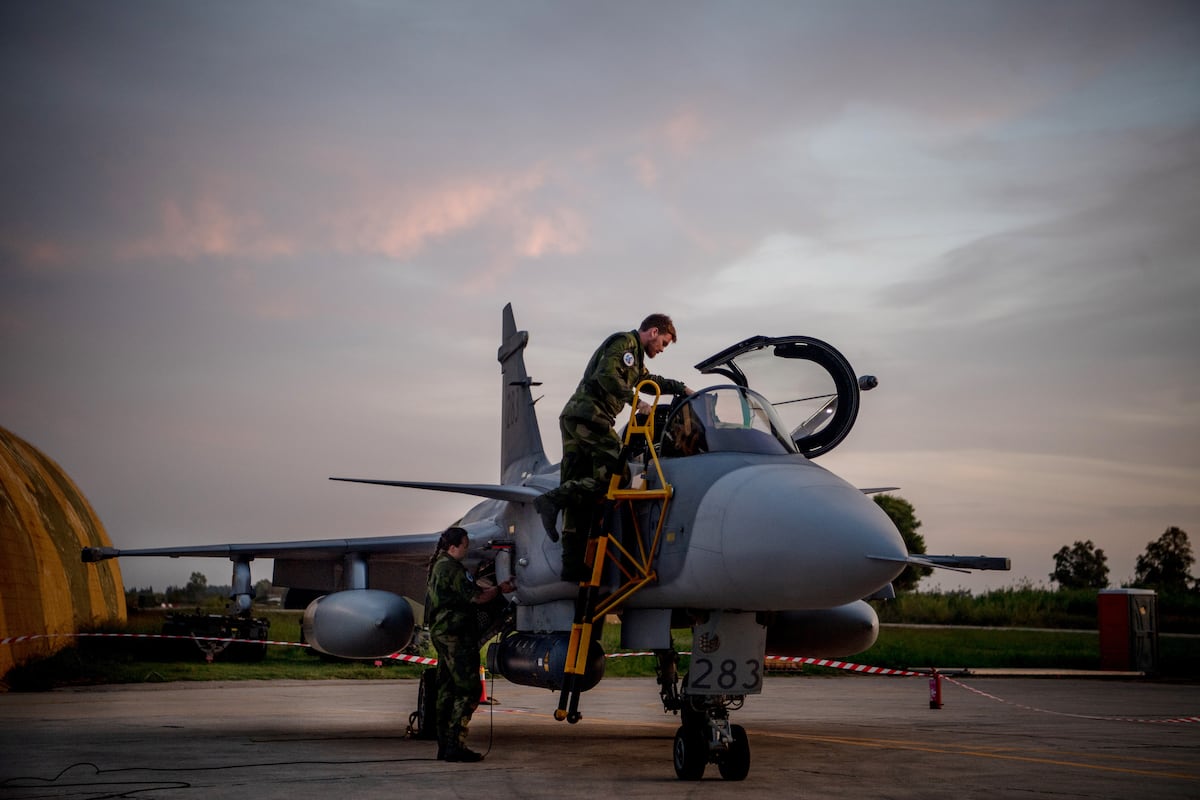
Maj. Gen. Jonas Wikman has served as commander of the Swedish Air Force since December 2022, overseeing a major modernization program for new combat capabilities while shaping the country’s new NATO membership. He leads more than 2,700 military personnel and a growing fleet of Gripen fighter jets, with a goal to operate 120 in total in the long-term, mixing older C/D models with new E variants. The Scandinavian country also plans to increase its defense spending by $2.9 billion in 2026, representing an 18% increase over 2025.
In an interview ahead of the new year, the air chief shared the status of Sweden’s future fighter program, the new electronic-warfare capabilities fitted on the Gripen E, the biggest threat to Swedish security, his priorities, and his take on Canada’s interest in buying the Swedish-made aircraft.
This interview was edited for length and clarity.
Where does Sweden currently stand regarding its future fighter program, in light of Saab being awarded a contract to continue a concept study to work on this technology? A year ago you said a loyal wingman or a combination of unmanned assets was being considered. What are your thoughts now?
When it comes to the overall direction of where we go with the next-generation fighter platform, we are still in the same process. We are still investing in the knowledge and flexibility to choose which option suits us best. What I can tell you is that we will be ready to answer at the political level regarding our viewpoint on what that looks like in the upcoming year. From there, I think we will have a good national standpoint on the way to move forward with the program.
When it comes to the unmanned question, one thing has increased – that is, our interest in fusing new knowledge into current capabilities and operations. We originally intended to explore and provide options to politicians, wait for a decision, and then move on to the next platform or system part of the collaborative fighter. We have realized that if new technology is developed during this process, we probably cannot wait that long to introduce other unmanned platforms.
To give you an example, we have the same idea when it comes to the development of the Gripen D version – whenever we develop a new capability or software for the E version, we make sure as fast as possible to also introduce it on the older variants as well.
At this point, could you rank the following options based on your preference or feasibility: developing a national fighter; joining a joint venture with other countries or companies; procuring an existing design and producing it under license in Sweden?
That is the question I have never been able to answer. Partly because our answer will be more complex than those three options. It will also not be graded like that. The result will likely be some kind of cooperation, some kind of national project that would combine different elements of each. We’ve also been tasked to ensure that all of those alternatives are available.
I could, as a person, answer you with my thoughts on it, but that would not be the correct way to move forward with the process.
We are still exploring all three on a principle level. One thing I have been worried about is that the program will be too platform-centric, but we [Sweden] have a history and culture of not doing so. There’s also considerations and an importance to be given to ground operations, command-and-control missions, and how well that will fit into the new platform.
Regarding the upgrades made to the electronic-warfare suite on the new Gripen E aircraft, what sort of capabilities are you most excited about?
We are very much looking forward to the EW spectrum technology on it, as I expect it will be the central strength of that aircraft. For us, these types of capabilities, both when it comes to protection and hiding, but also offensive ones, have been a very high priority.
The combination of the EW suite with multiple types of sensors working together, sharing and receiving both internal and external information across the network, and providing that to other platforms – very much like the F-35. I think we are in the same realm of operations. With the new capabilities, we can go deeper into battle and can affect the opponent in a more offensive way while also sending that data to a Global Eye and other shooters and sensors.
That is why we are eager to get such a capability, because it means we will be able to operate much closer to the threat. I think most people are underestimating the power we will get with the E version in that fight. I am looking for a sum of abilities, not a method, for example, the actual capability of not being detected and that can be reached in many ways — small radar cross-section, stealth features, EW suite. The E version has great capabilities in not being detected, spoofing, or affecting other sensors.
What is the biggest threat to Swedish security currently?
For us, we have our eyes, and I think we are on all levels quite clear that the threat to our security is Russia, for sure. We have a systematic kind of conflict between the collective West and Russia.
What is the biggest challenge the Air Force will tackle next year, and what are your priorities for 2026?
I don’t think we are struggling, but the pace to meet for our national capability development is definitely higher, and something we have to adapt to. Moving towards meeting the goal of reaching 3.5% of our GDP for core defense spending by 2030 means we have to, at the same time, keep a high level of operations nationally, but also as an ally. Our priority to be a net contributor to NATO is very high. That is why the Swedish Air Force and Navy conducted two operations this year in Poland and will also again deploy to Latvia next year.
We have to balance our air force resources and readjust our training so we can do operations and training while also simultaneously developing our own capabilities.
When we went to Poland, we had capability targets, and the fighter unit brought extra personnel and equipment and did some development work both in terms of air and ground operations. I think that is the correct way to go moving into the future because we are only one force.
Also exciting for 2026 is that we will be celebrating the service’s 100th anniversary.
You spoke about the NATO air policing missions the Gripen took part in earlier this year in Poland, which was a success for its first overseas deployment. During some of the missions, the aircraft was able to identify and engage very low and slow targets. Is this a mode of operation you are increasingly practicing?
Yes, but that is a bit of a complex question. One of the reasons is that we originally designed radars, the previous generation ones, so they wouldn’t detect those kinds of small moving targets. Going down to the operations in Poland, the second one we did included the protection of a very important logistics hub, which meant that those kinds of targets were present.
Here I am thinking of Shahed drones that were part of the mission set.
So we had to verify that we could successfully detect and engage these types of targets. We did a rapid verification program before deploying. It is not an easy mission, either from a tactical or technical standpoint.
They fly slow, which is the problem for us as we are not designed to fight small, moving targets to begin with. That means we need to train for it and make sure we have the technical capability to locate and strike them. That is what we did. Now we have verified that the Gripen and our forces can do it, and it is part of our capabilities [against Shahed drones].
What are your thoughts about Canada considering the prospect of acquiring the Gripen as its next-fighter jet instead of the F-35? Would you see a space for deeper cooperation?
I don’t really want to have any thoughts about that. I had a great conversation with the Canadian air chief and made sure we have all the information exchange necessary and the same understanding of the platform [Gripen]. It is their decision to make, and I respect all the components that are involved in it, whether that’s political, technical, or technological. It is not on my table at all.
If we are not talking about the procurement of fighter jets, I think certainly the future room for us [Canada and Sweden] to cooperate will increase. We are both engaged in the setting up of a new logistics headquarters in Enköping, Sweden [to support NATO’s Northwest Area of Operations], and that will be a common footprint that could be utilized to have a dialogue around the overlapping threat.
It’s a long distance between Sweden and Canada, but we have an interest in the same geography and share a lot of cultural and mindset similarities.
On both sides, we agree that it would be profitable to have closer cooperation between our air forces. Sweden’s introduction into NATO and that command will also mean we will meet each other on a more regular basis.
Elisabeth Gosselin-Malo is a Europe correspondent for Defense News. She covers a wide range of topics related to military procurement and international security, and specializes in reporting on the aviation sector. She is based in Milan, Italy.
Read the full article here
