

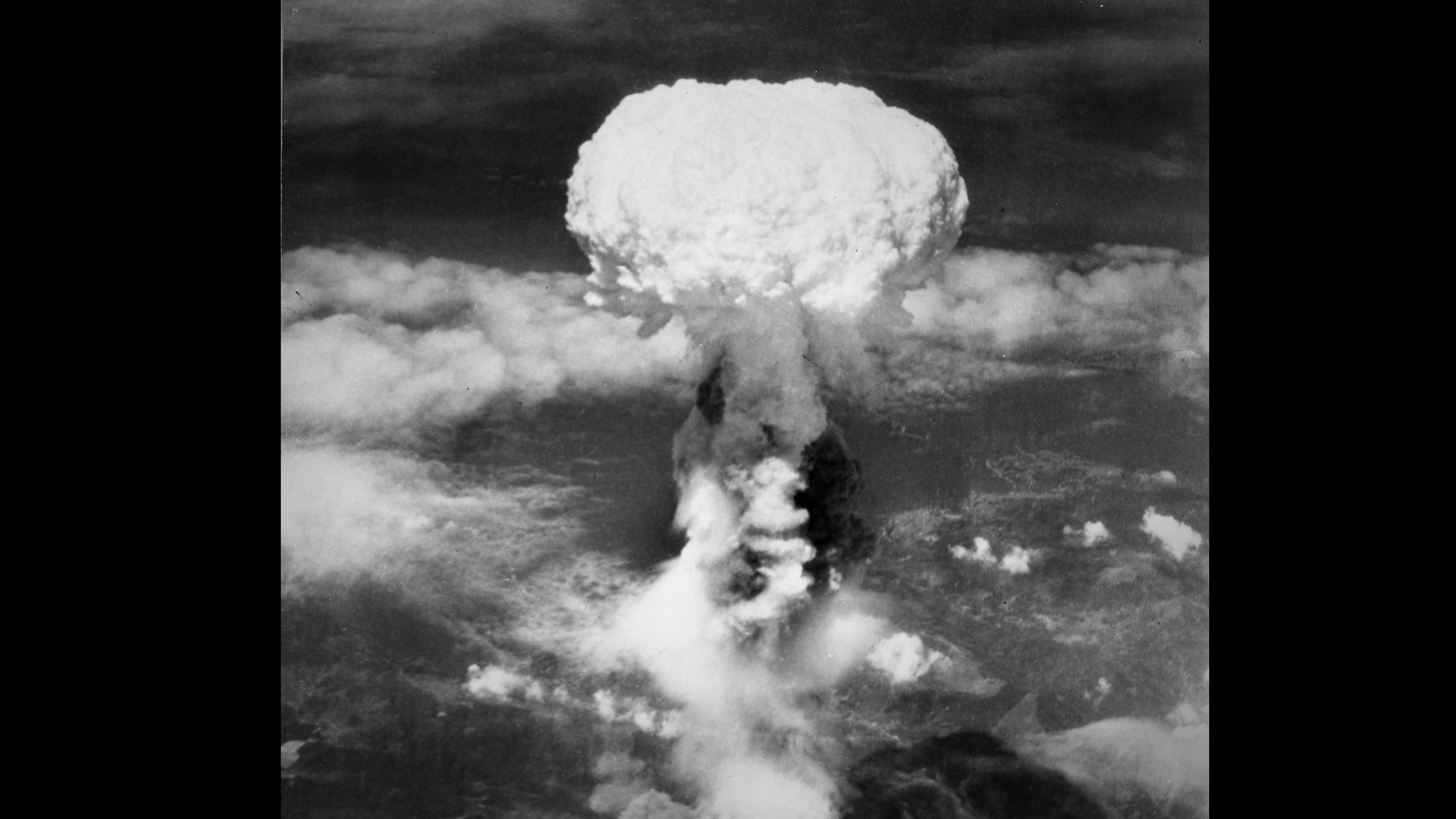
World War II dragged on, and Japan refused to surrender even when threatened with prompt and utter destruction. Germany had given up more than two months before, and the Japanese stood alone in their opposition to the Allies. An unconditional surrender ultimatum contained in the July 26, 1945, Potsdam Declaration promised prompt and utter destruction, yet it brought no response from the Japanese.
Japan had, for the most part, lost control of the airspace above the home islands. Tokyo was firebombed into ashes, and many other cities were badly damaged. The sea lanes in and out of Japan were closed, food supplies were nearly exhausted, and there was little industrial capacity left to continue the fight. American forces had taken Okinawa and were massing on the doorstep of the Empire. Despite this, the Japanese government was prepared to fight on, even if it meant sacrificing most of its population.

While all signs pointed to a massive, bloody invasion of the home islands, the Allies held a card the Japanese warlords did not expect. In 1945, terms like “uranium-enriched” and “plutonium implosion” were not household words anywhere on Earth. But they soon would be. On July 25, Acting Chief of Staff General Thomas T. Handy sent a letter to U.S.A.A.F. General Carl Spaatz authorizing the first use of the atomic bomb.
From: General Thomas T. Handy
To: General Carl Spaatz, Commanding General, United States Army Strategic Air Forces
- The 509 Composite Group, 20th Air Force will deliver its first special bomb as soon as weather will permit visual bombing after about 3 August 1945 on one of the targets: Hiroshima, Kokura, Niigata, and Nagasaki. To carry military and scientific personnel from the War Department to observe and record the effects of the explosion of the bomb, additional aircraft will accompany the airplane carrying the bomb. The observing planes will stay several miles distant from the point of impact of the bomb.
- Additional bombs will be delivered on the above targets as soon as made ready by the project staff. Further instructions will be issued concerning targets other than those listed above.
- Dissemination of any and all information concerning the use of the weapon against Japan is reserved to the Secretary of War and the President of the United States. No communiqués on the subject or releases of information will be issued by Commanders in the field without specific prior authority. Any news stories will be sent to the War Department for special clearance.
- The foregoing directive is issued to you by direction and with the approval of the Secretary of War and of the Chief of Staff, USA. It is desired that you personally deliver one copy of this directive to General MacArthur and one copy to Admiral Nimitz for their information.
Signed
Thos. T. Handy, General G.S.C. Acting Chief of Staff
The two atomic bomb attacks that followed have been the only use of nuclear weapons in mankind’s violent history. The power unleashed to end the war was the culmination of years of work by many of the greatest scientific minds of the age, and their deadly technological breakthrough was delivered by some of the most highly trained and brave airmen ever to fly. I searched through a mountain of official U.S. reports and commentary from 1945 to offer The Armory Life readers an accurate overview of the attitudes of the time, and the two fateful missions that changed the course of humanity.

The U.S.A.A.F. magazine “Impact” looked at a wide range of factors in the air assault on Japan, even beyond the atomic bomb missions. The September-October 1945 issue of Impact was appropriately stamped “Final Issue.”

The following testimony tells with stunning emphasis that Japan was utterly finished as a war-making nation before the first atom bomb was dropped. The most interesting and complete statement comes from Prince Higashi-Kuni, speaking before the Japanese Diet on 5 September:
“Following the withdrawal from Guadalcanal, the war situation began to develop not always in our favor. Especially after the loss of the Marianas islands the advance of the Allied forces became progressively rapid while the enemy’s air raids on Japan proper were intensified, causing disastrous damage that mounted daily.”
“Production of military supplies, which had been seriously affected by curtailment of our marine transportation facilities, was dealt a severe blow by this turn of the war situation, and almost insuperable difficulties began to multiply, beginning with the spring of this year. With the loss of Okinawa and the consequent increase in the striking power of the enemy’s air forces, even communications with the China continent were rendered extremely hazardous. As regards railway transport, frequent air raids, together with depreciation of rolling stock and equipment, brought about a steady lowering of its capacity and a tendency to lose unified control. Moreover, various industries suffered directly from air raids which caused huge damage to plants and lowered the efficiency of workmen. Finally, the country’s production dwindled to such a point that any swift restoration of it came to be considered beyond hope.”
On 14 September, Higashi-Kuni further said, “The Japanese people are now completely exhausted.” He estimated that there were 15,000,000 unemployed in the home islands, and called the Superfortress attacks the turning point in the war.

Rear Admiral Toshitane Takata, ex-Deputy Chief of Staff of the Japanese Combined Fleet, also saluted the B-29:
“Superfortresses were the greatest single factor in forcing Japan’s surrender. These planes burned out Japan’s principal cities, reduced military production by fully 50 percent and affected the general livelihood of the Japanese people.”
On March 9, 1945, more than 280 B-29 bombers struck Tokyo in a low-level night firebomb raid dubbed Operation Meetinghouse. The attack caught the Japanese by surprise, and the napalm incendiaries fueled the deadliest air raid of the war, with more than 100,000 people killed and nearly 16 square miles of Tokyo burned out. The raid was a terrible blow to Tokyo’s labor force and cottage industry, and even more devastating to Japanese morale. One of Tokyo’s district fire marshals, when interviewed by an IMPACT editor, stated: “After the first big incendiary attack I realized that our system of fire prevention was utterly helpless in stemming attacks of such magnitude.”

Live The Armory Life. The latest content straight to your inbox plus an automatic entry to each of our monthly gun giveaways!
The U.S.A.A.F.’s Strategic Bombing Survey determined that B-29s caused 330,000 fatalities and 806,000 injuries, and while the B-29 raids were crushing Japan’s industry and burning out her cities, Nippon’s militarists would still not relent.
Duality of Bombing Concepts
The 1996 U.S.A.F. publication “Piercing the Fog: Intelligence and Army Air Forces Operations in World War II” described the difficulty in balancing the B-29’s conventional bombings and the awesome potential of the atomic bomb: Sometime between the first and sixth of June 1945, President Truman and Secretary Stimson reaffirmed the intent to use the atomic weapons on Japanese targets, based mostly on the view of Stimson and a number of others that the weapon was necessary to avoid American casualties that would be sustained in the invasion of Japan. Stimson was, by this time, amid a conflicting duality of thinking. On the one hand, he had lectured Arnold on the problems associated with urban-area attacks, and he did not want the United States to gain, as he said, the “reputation of outdoing Hitler in atrocities.” On the other hand, he was concerned that the airmen might bomb Japan so well that “there would be no good background on which to use the weapon,” thus losing the opportunity of convincing the Japanese that further resistance was futile.
The Deadly Decision
I must admit, this portion of the research was difficult for me. Selecting a city to be destroyed must have been terrifying, soul-crushing work for thinking, feeling men tasked with serving their country in the direst circumstances. In preparing the atomic bomb for use, the right targets had to be selected. If the bomb was used at the wrong place, at the wrong time, its awesome impact would be compromised, and the war would go on. Even so, the target selection process seems quite clinical, theoretical, and scientific, with adjustments made on brutal human calculations. Yet, regardless of the emotions, then or now, the work had to be done.

This excerpt from the 1945 “Report from the Manhattan Engineer District” describes the target selection process:
The work on the selection of targets for the atomic bomb was begun in the spring of 1945. This was done in close cooperation with the Commanding General, Army Air Forces, and his Headquarters. Several experts in various fields assisted in the study. These included mathematicians, theoretical physicists, experts on the blast effects of bombs, weather consultants, and various other specialists. Some of the important considerations were:
A. The range of the aircraft which would carry the bomb.
B. The desirability of visual bombing in order to ensure the most effective use of the bomb.
C. Probable weather conditions in the target areas.
D. Importance of having one primary and two secondary targets for each mission, so that if weather conditions prohibited bombing the target there would be at least two alternates.
E. Selection of targets to produce the greatest military effect on the Japanese people and thereby most effectively shorten the war.
F. The morale effect upon the enemy.
These led in turn to the following:
A. Since the atomic bomb was expected to produce its greatest amount of damage by primary blast effect, and next greatest by fires, the targets should contain a large percentage of closely built frame buildings and other construction that would be most susceptible to damage by blast and fire.
B. The maximum blast effect of the bomb was calculated to extend over an area of approximately 1 mile in radius; therefore, the selected targets should contain a densely built-up area of at least this size.
C. The selected targets should have a high military strategic value.
D. The first target should be relatively untouched by previous bombing, in order that the effect of a single atomic bomb could be determined.

The weather records showed that for five years there had never been two successive good visual bombing days over Tokyo, indicating what might be expected over other targets in the home islands. The worst month of the year for visual bombing was believed to be June, after which the weather should improve slightly during July and August and then become worse again during September. Since good bombing conditions would occur rarely, the most intense plans and preparations were necessary to secure accurate weather forecasts and to arrange for full utilization of whatever good weather might occur. It was also very desirable to start the raids before September.
The Stage Was Set for the World to Change
The U.S.A.F. publication “Air Intel and the A-bomb” describes the specific cities targeted, along with the subterfuge used to disguise the selection process:
“To begin the target selection process, Major General Lauris Norstad (Chief of Staff of the 20th Air Force) sent a memorandum to General Samford at the JTG requesting specific data, phrasing his request to conceal both the bomb’s existence and the planning process then underway. Norstad’s memo gave a plausible reason for the inquiry, telling Samford to have his people assess several targets suitable for a 12,000-pound British Tallboy high-explosive bomb to be detonated at an altitude of 200 feet. In general terms, Norstad said that he wanted Samford’s people to select reasonably large urban areas, at least three miles in diameter, having high strategic value on the Japanese main islands between Nagasaki and Tokyo. Norstad added to his request a list of possible sites, including Tokyo Bay, Kyoto, Hiroshima, Nagasaki, Nagoya, Kokura, Sasebo, Yokohama, Kobe, Yawata, Shimonoseki, Yamaguchi, Kawasaki, Fukuoka, and Orabe.
The JTG was to eliminate cities previously destroyed by bombardment from consideration. Notably absent from Norstad’s request was the need for any information on defenses. Japanese aerial defenses were not one of the committee’s primary concerns, and those considerations it left almost entirely to LeMay and the operational mission planners in the Pacific. There was, throughout the selection process from the earliest date of the target committee’s meetings, the desire to strike a city yet undamaged. The reasons were twofold: to destroy a major military-related area in a single attempt that dealt the Japanese Army a heavy blow and then to give the Manhattan District’s engineers and physicists the chance to use the damage to compute the effects of the bomb’s detonation with more precision than previously possible. What the committee sought as much as a wartime target was a laboratory setting for an operational bombing raid of unprecedented proportions.
Once the target material had been collected by the JTG, three members of the committee, acting under cover of Norstad’s Tallboy request, visited the A-2’s offices to review the data and prepare a final list. Kyoto, Hiroshima, Nagasaki, Niigata, and Kokura emerged as the best candidates. Kyoto gained the most prominence because of its size, its industry, its location as a center of transportation, and the fact that many government and industrial leaders had evacuated there from other damaged cities. Kyoto was also attractive because of its topography. Lying in a bowl formed by mountains, the committee believed that the bomb’s energy would be better focused there than anywhere else. Hiroshima (est. pop. 350,000) was an “Army” city, the committee believed, as well as a major port. From the target information, the men concluded that the city contained large quartermaster supply depots, had considerable industry, and was the location of several small shipyards. Nagasaki (est. pop. 210,000) was the major shipping and industrial center of Kyushu. Kokura (est. pop. 178,000) had one of the largest Army arsenals and ordnance works and the largest railway shops on Kyushu, with large munitions storage areas to the south. Niigata (est. pop. 150,000) was an important industrial city, making machine tools, diesel engines, and heavy equipment; it was also a key port for shipping to and from the mainland.”
A Silverplate Group
As the Manhattan Project closed in on producing an atomic bomb, the U.S.A.A.F. already had a long-range strategic bomber to deliver it: The Boeing B-29 Superfortress. To prepare for the ultra-secretive mission, a special, self-sufficient B-29 group was created, the 509th Composite Group. Activated on December 17, 1944, at Wendover Field in Utah, the 509th was equipped with C-47 and C-54 transport aircraft, as well as special “Silverplate” B-29 bombers, uniquely modified to carry atomic bombs.

The 509th was commanded by 29-year-old Lieutenant Colonel Paul W. Tibbets Jr., most recently a B-29 test pilot. Tibbets was tasked with taking the 509th Group to a level of performance well beyond normal U.S.A.A.F. expectations. Bombing accuracy was of paramount importance. Radar operators and flight engineers were trained to rigid standards. Meanwhile, the pilots practiced nearly 180-degree turns after dropping dummy bombs, an aggressive new maneuver for Superfortress pilots. Because the Silverplate B-29’s were stripped down for higher performance, the 509th Superfortresses defensive armament was limited to their twin .50 caliber tail guns. To maintain operational secrecy, the group had its own Troop Carrier Squadron, Ordnance section, and Technical Service Detachment. Arriving on Tinian in June 1945, the 509th had about 50 military and civilian personnel of “Project Alberta” (a section of the Manhattan Project) attached to the group.

Throughout July and early August, the thirteen Silverplate B-29s of the “393rd Bombardment Squadron” flew an intense series of A-bomb mission rehearsals, including 37 sorties with conventional “pumpkin bomb” replicas of the “Fat Man” ordnance, and four sorties with “Little Boy” replicas. The missions were flown by three-plane groups at 30,000 feet — to stay above effective Japanese anti-aircraft fire and to convince the Home Defense squadrons that the small formations were not worth intercepting. Only one B-29 took minor damage during these test raids. Bombing accuracy was good, with 27 drops made visually and 10 made by radar.

After the Japanese government ignored the Allies’ July 26 call for unconditional surrender, the U.S. government moved quickly to deliver the atomic bomb. In compliance with the Quebec Agreement, America obtained the consent of the United Kingdom for the bombings, and General Thomas T. Handy, the acting chief of staff of the U.S. Army, ordered that atomic bombs be dropped on Hiroshima, Kokura, Niigata, and Nagasaki.
The Manhattan Engineer District report described the attacks:
Hiroshima, August 6, 1945: “A withering blast…”
Hiroshima was the primary target of the first atomic bomb mission. The mission went smoothly in every respect. The weather was good, and the crew and equipment functioned perfectly. In every detail, the attack was carried out exactly as planned, and the bomb performed exactly as expected. The bomb exploded over Hiroshima at 8:15 on the morning of August 6, about an hour previously, the Japanese early warning radar net had detected the approach of some American aircraft headed for the southern part of Japan. The alert had been given and radio broadcasting stopped in many cities, among them Hiroshima. The planes approached the coast at a very high altitude. At nearly 8:00 A.M., the radar operator in Hiroshima determined that the number of planes coming in was very small — probably not more than three — and the air raid alert was lifted. The normal radio broadcast warning was given to the people that it might be advisable to go to shelter if B-29’s were sighted, but no raid was expected beyond some sort of reconnaissance. At 8:15 A.M., the bomb exploded with a blinding flash in the sky, and a great rush of air and a loud rumble of noise extended for many miles around the city; the first blast was soon followed by the sounds of falling buildings and of growing fires, and a great cloud of dust and smoke began to cast a pall of dark ness over the city. At 8:16 A.M., the Tokyo control operator of the Japanese Broadcasting Corporation noticed that the Hiroshima station had gone off the air. He tried to use another telephone line to reestablish his program, but it too had failed. About twenty minutes later the Tokyo railroad telegraph center realized that the main line telegraph had stopped working just north of Hiroshima. From some small railway stops within ten miles of the city there came unofficial and confused reports of a terrible explosion in Hiroshima. All these reports were transmitted to the Headquarters of the Japanese General Staff. Military headquarters repeatedly tried to call the Army Control Station in Hiroshima. The complete silence from that city puzzled the men at Headquarters; they knew that no large enemy raid could have occurred, and they knew that no sizeable store of explosives was in Hiroshima at that time. A young officer of the Japanese General Staff was instructed to fly immediately to Hiroshima, to land, survey the damage, and return to Tokyo with reliable information for the staff. It was generally felt at Headquarters that nothing serious had taken place, that it was all a terrible rumor starting from a few sparks of truth. The staff officer went to the airport and took off for the southwest. After flying for about three hours, while still nearly 100 miles from Hiroshima, he and his pilot saw a great cloud of smoke from the bomb. In the bright afternoon, the remains of Hiroshima were burning. Their plane soon reached the city, around which they circled in disbelief. A great scar on the land, still burning, and covered by a heavy cloud of smoke, was all that was left of a great city. They landed south of the city, and the staff officer immediately began to organize relief measures, after reporting to Tokyo. Tokyo’s first knowledge of what had really caused the disaster came from the White House public announcement in Washington sixteen hours after Hiroshima had been hit by the atomic bomb.
Nagasaki, August 9, 1945: “Only for the last few seconds was the target clear…”
Nagasaki had never been subjected to large scale bombing prior to the explosion of the atomic bomb there. On August 1st, 1945, however, several high explosive bombs were dropped on the city. A few of these bombs hit the shipyards and dock areas in the southwest portion of the city. Several of the bombs hit the Mitsubishi Steel and Arms Works and six bombs landed at the Nagasaki Medical School and Hospital, with three direct hits on buildings there. While the damage from these few bombs was relatively small, it created considerable concern in Nagasaki and some people, principally school children, were evacuated to rural areas for safety, thus reducing the population in the city at the time of the atomic attack. On the morning of August 9th, 1945, at about 7:50 A.M., Japanese time, an air raid alert was sounded in Nagasaki, but the “All clear” signal was given at 8:30. When only two B-29 Superfortresses were sighted at 10:53 the Japanese apparently assumed that the planes were only on reconnaissance, and no further alarm was given. A few moments later, at 11:00 o’clock, the observation B-29 dropped instruments attached to three parachutes and at 11:02 the other plane released the atomic bomb. The bomb exploded high over the industrial valley of Nagasaki, almost midway between the Mitsubishi Steel and Arms Works, in the south, and the Mitsubishi-Urakami Ordnance Works (Torpedo Works), in the north, the two principal targets of the city. Despite its extreme Importance, the first bombing mission on Hiroshima had been almost routine. The second mission was not so uneventful. Again, the crew was specially trained and selected; but bad weather introduced some momentous complications. These complications are best described in the brief account of the mission’s weaponeer, Commander (now Captain), F. L. Ashworth, U.S.N., who was in technical command of the bomb and was charged with the responsibility of insuring that the bomb was successfully dropped at the proper time and on the designated target. His narrative runs as follows: “The night of our take-off was one of tropical rain squalls, and flashes of lightning stabbed into the darkness with disconcerting regularity. The weather forecast told us of storms all the way from the Marianas to the Empire. Our rendezvous was to be off the southeast coast of Kyushu, some 1500 miles away. There we were to join with our two companion-observation B-29’s that took off a few minutes behind us. Skillful piloting and expert navigation brought us to the rendezvous without incident. “About five minutes after our arrival, we were joined by the first of our B-29s. The second, however, failed to arrive, having apparently been thrown off its course by storms during the night. We waited 30 minutes and then proceeded without the second plane toward the target area. “During the approach to the target the special instruments installed in the plane told us that the bomb was ready to function. We were prepared to drop the second atomic bomb on Japan. But fate was against us, for the target was completely obscured by smoke and haze. Three times we attempted bombing runs, but without success. Then with anti-aircraft fire bursting around us and several enemy fighters coming up after us, we headed for our secondary target, Nagasaki.”
“The bomb burst with a blinding flash and a huge column of black smoke swirled up toward us. Out of this column of smoke there boiled a great swirling mushroom of gray smoke, luminous with red, flashing flame, that reached 10,000 feet in less than 8 minutes. Below through the clouds we could see the pall of black smoke that was ringed with fire and covering what had been the industrial area of Nagasaki. By this time our fuel supply was dangerously low, so after one quick circle of Nagasaki, we headed direct for Okinawa for an emergency landing and refueling.”
A Surprisingly Slow Ending
The death toll at Hiroshima was staggering. The city was destroyed, and estimates projected up to 160,000 deaths, most of them civilians. And still Japan did not surrender. The Nagasaki blast killed up to 80,000, again mostly civilians. Even so, some members of the Japanese Cabinet wanted to fight on. Mercifully, the Emperor gave his “sacred decision” on August 10th that Japan would accept the Allies’ surrender terms on one condition — that the surrender “does not comprise any demand which prejudices the prerogatives of His Majesty as a Sovereign ruler.” Hirohito would remain on the throne until January 1989, but World War II would finally end at that moment. Japan formally signed the instrument of surrender on September 2, 1945.

America’s leaders were amazed and horrified at the power they had unleashed. Despite this, there were plans for additional atomic attacks on Japan. Another “Fat Man” (plutonium) atomic bomb was prepared for use on August 19th, with three more of this bomb type being made available by September. President Truman pumped the brakes on an atomic rain of ruin. When it was determined that another strike could be readied on or about August 18th, General Marshall made it clear to all involved: “It is not to be released over Japan without express authority from the President.” The war itself was finally over, and the atomic bomb attacks played a decisive role.
Editor’s Note: Please be sure to check out The Armory Life Forum, where you can comment about our daily articles, as well as just talk guns and gear. Click the “Go To Forum Thread” link below to jump in and discuss this article and much more!
Read the full article here
