
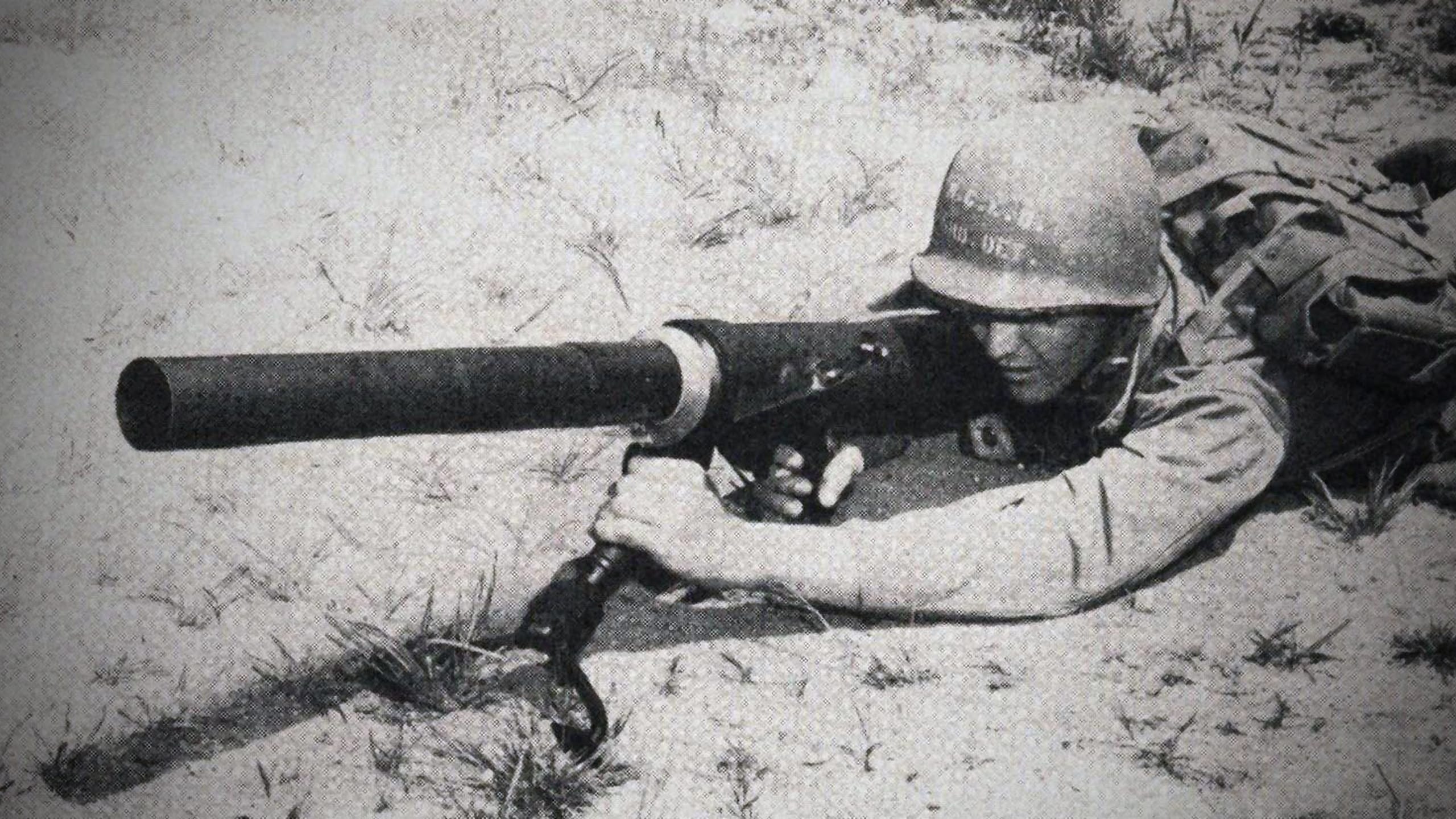
“Missed Peleliu because of that damn thing.” The old 1st Marine Division veteran massaged a spot on his upper chest and grimaced. “Told us we could fire that mortar from the prone and get direct fire into Jap bunkers. I was one of the first to give it a whirl. Broke my collarbone.”
He was talking about his experience with the Garrett 60mm shoulder-fired mortar, an innovative Allied response to tenacious Japanese defensive fortifications in the Pacific, that proved almost as damaging to friends as foe. “That thing kicked harder than a Missouri mule.”

The old vet remembered firing the innovative weapon in early the Fall of 1944 on Pavuvu in the Russell Islands, where his division had been sent to rest following combat on Cape Gloucester. “Guess I ought to be grateful, but it was hard to sit out the Peleliu scrap. And from what I heard, that shoulder-fired mortar was useless anyway.”
Shoulder-Fired Mortar — An Unsound Idea?
A 60mm mortar capable of direct fire? Minus the military standard bipod and baseplate? Who came up with that? Turns out it was a salty old Master Gunnery Sergeant named William “Billy” Garrett who was pondering arduous experience up against Japanese bunkers and other tenacious defensive positions earlier in World War II.

He reckoned standard high-angle mortar fire was ineffective against heavily reinforced enemy positions. Indirect supporting fire necessarily flew in an arc from muzzle to target, which meant most of their power was expended hitting the thick concrete roofs of many Japanese bunkers or pillboxes. What was needed was a direct-fire weapon that could be accurately aimed at apertures or windows, inflicting maximum blast and shrapnel effect on defenders inside.
The U.S. had the 2.36-inch Bazooka in most combat outfits, but it was a purpose-built, anti-tank weapon that was less effective against bunkers and other enemy hardpoints, particularly in the South Pacific where some Bazooka rounds failed to detonate in soft mud or foliage surrounding many targets. There was also a system of rifle grenades designed for direct fire against hardpoints, but Garrett knew grenades didn’t pack sufficient punch.

How about a 60mm mortar round carrying a full half pound of Composition B? That might do the trick, but the M2 60mm mortar was a high-angle-of-fire weapon. You couldn’t just pick up the tube and aim it like a rifle and launch a round at precise targets. Or could you?
Master Gunny Garrett began to tinker. He thought you could make a workable shoulder-fired mortar with the right mods and designs. He eventually came up with what the U.S. Bureau of Ordnance approved a year later as the Garrett 60mm Shoulder Mortar, Mark 1 Mod 0. The weapon descriptor on Ordnance Pamphlet 1257 carried his name, but Billy Garrett likely wished they’d omitted that credit after field reports began to come in from shaken or damaged users.
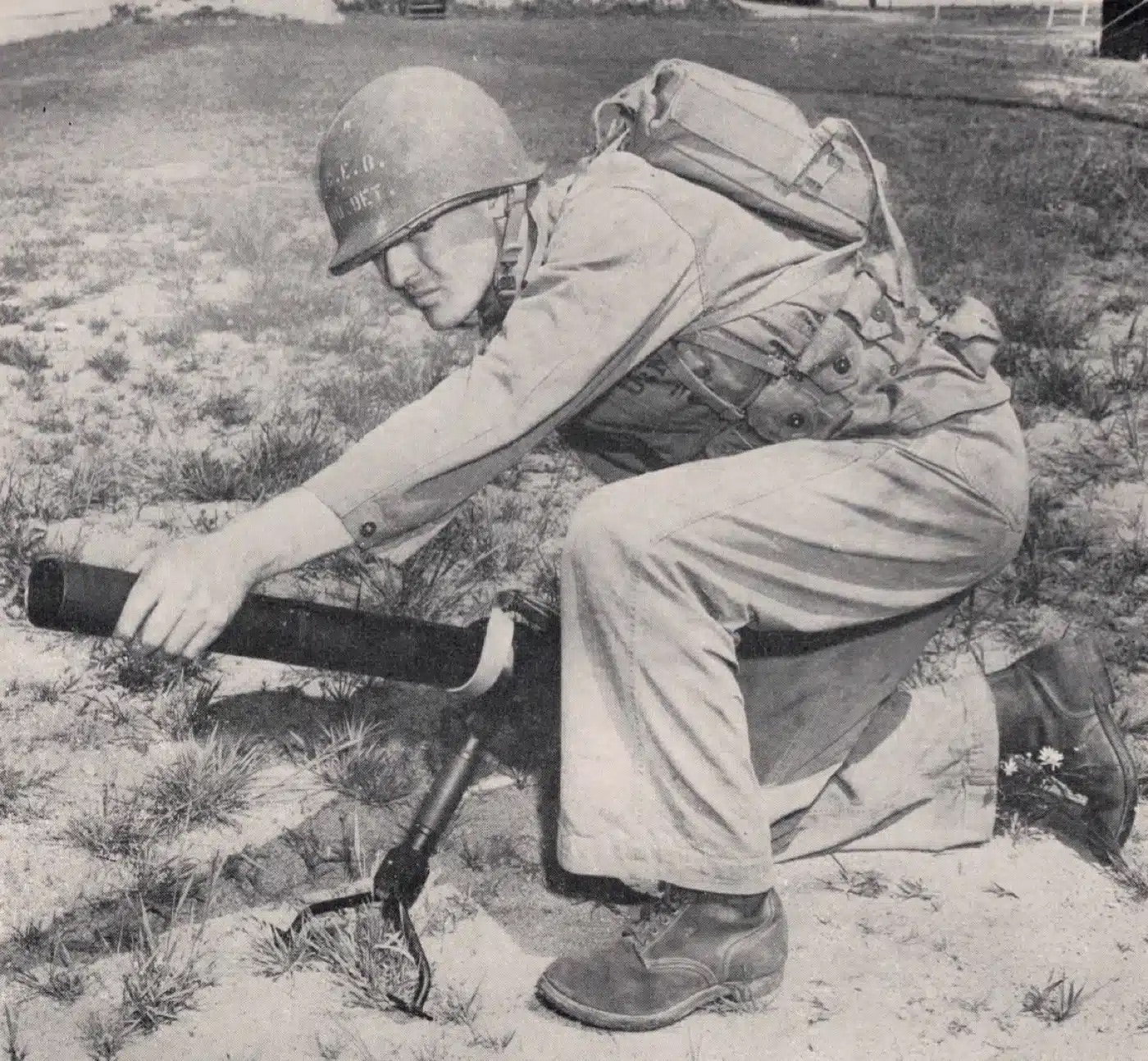
In tests at Aberdeen Proving Grounds, the Garrett mortar was able to produce hits on five-foot targets at ranges out to about 600 yards. That was apparently good enough for the Army, which adopted the weapon for combat use calling it the T-20 and giving credit to the inventor simply as “a member of the Marine Corps.”
Tech manuals were produced by both the Army and Navy, basically outlining how the weapon worked. It was described as adapted from the standard 60mm mortar and designed to be shoulder-fired by an individual soldier. It came equipped with a modified light machine gun mount and was intended for flat-trajectory fire against caves and pillbox openings.

Live The Armory Life. The latest content straight to your inbox plus an automatic entry to each of our monthly gun giveaways!
Here’s how the Bureau of Ordnance described the Mk 1 or T-20.
This weapon is of the recoil type, consisting of a 60mm mortar tube partly enveloped by a sleeve containing a spring recoil mechanism which absorbs the recoil and returns the tube to firing position. A trigger activated firing mechanism fires the standard HE 1149A2 shell with cartridge only, used in this weapon. Recoil of the mortar tube cocks the firing mechanism. The mortar is supported by a bipod with folding legs and has a rectangular shoulder pad attached to the rear end of the sleeve. A bar sight adjustable for elevation by means of a knurled knob is fastened to the left side of the sleeve.
The TM description includes this warning: It is recognized that the heavy recoil of this weapon places a severe strain on the operator. Can’t claim the poor devils who tried to employ the Garrett mortar weren’t warned.
In the Field
Training to use the new device by a gunner and assistant was fairly simple. Cock the weapon by pulling back firmly on the barrel sleeve until you hear a distinct click. Take your basic 60mm mortar round and strip away all the propellant increments. Then dump the round down the tube, which is elevated to insure the shell drops all the way to the bottom of the tube where it’s cartridge is positioned to be struck by the firing pin.

Take up a solid prone position, tuck that shoulder pad in tight, acquire a good sight picture and squeeze the trigger. There was no mention of saying a quick prayer prior to launch, but I’m betting most gunners tasked with firing the Garrett included it in their routine.
The U.S. Marine Corps’ first (and likely last) employment of the Garrett 60mm shoulder-fired mortar was on Peleliu in September 1944. After-action reports were less than complimentary. Here’s what the 1st Marine Division annex to the weapons used on Peleliu had to say about the Garrett:
Some of its parts proved not rugged enough for sustained use and had to be replaced nearly as often as the poor devils who were obliged to fire the contraption from their shoulders. Essentially its functions duplicated those of the bazooka. (However) it came to be considered less practical all around than the weapon it had been designed to replace. As presently constructed, they (shoulder mortars) are too heavy and certain parts are too weak. After firing two to four rounds, it is necessary to replace the gunner. Units feel that the shoulder mortar as now constructed is not of sufficient value to include it in the authorized weapons.
Conclusion
No mention is made in official or unofficial history about Marine mortarmen looking up Billy Garrett after the war to provide a knuckle sandwich after-action report of their own, but it probably happened. What was that saying about “the best of intentions”?
Editor’s Note: Please be sure to check out The Armory Life Forum, where you can comment about our daily articles, as well as just talk guns and gear. Click the “Go To Forum Thread” link below to jump in!
Read the full article here
