

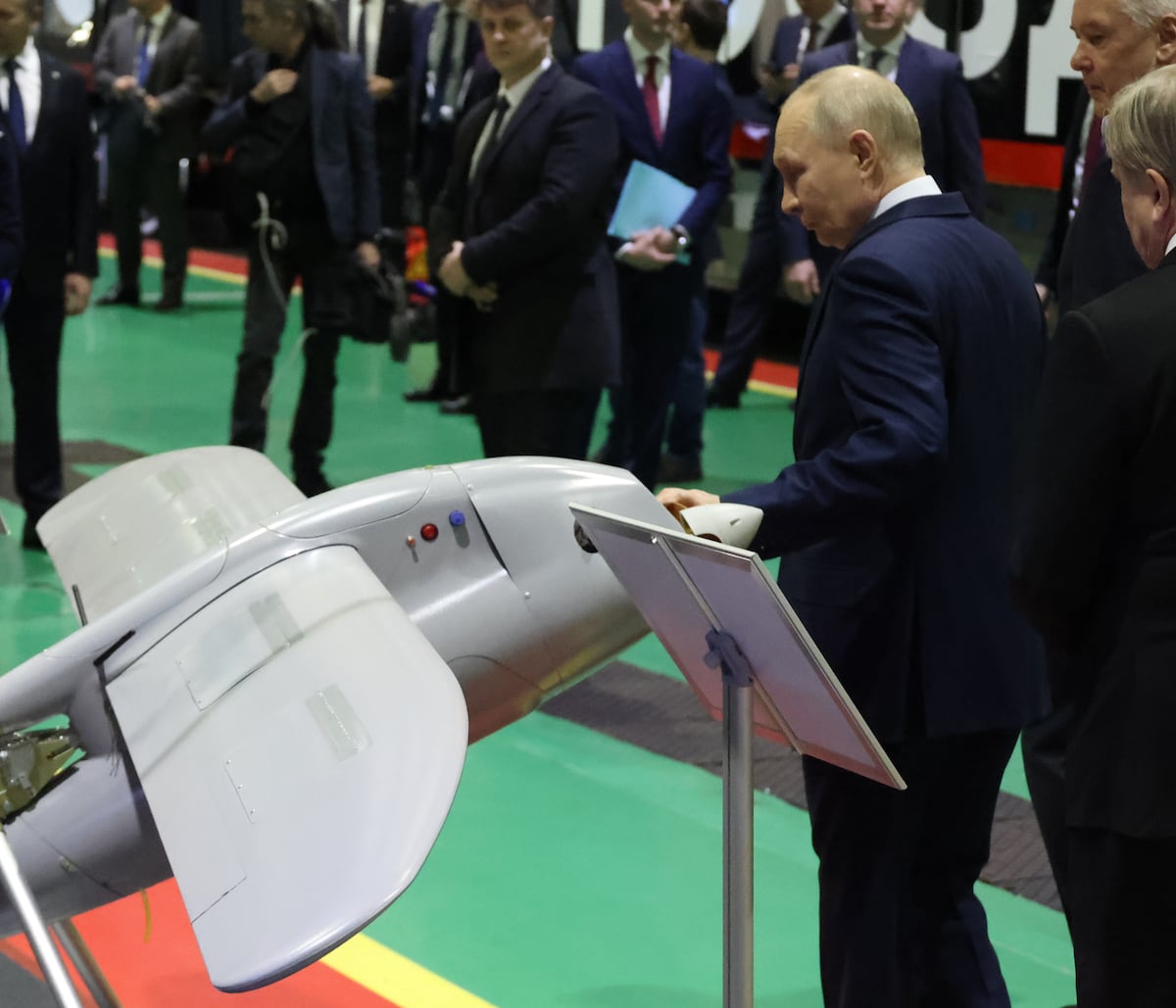
Russia’s drone manufacturers recently got a New Year’s present: the government incentivizing Russian companies to buy their technologies.
On Jan. 1, an order went into effect providing Russian companies with expanded income tax incentives for buying Russian unmanned aerial vehicles. For every ruble they spend on UAVs, those companies can deduct two rubles from their income taxes. On its face, it’s a pretty good deal, especially for those companies hoping to contribute to the state’s war machine.
But the reality, including what this means for Ukraine and the West, is more complicated.
Russia’s decade-plus domestic tech push shows that Russia can excel at software development but often fails miserably at hardware, yielding persistent efforts to steal Western technology components and growing dependence on buying Chinese ones. Even UAV-focused tax incentives are unlikely to fix that dynamic. At the same time, pushing Russian firms towards Russia’s UAV sector could help prop up those companies, supplying the cash to keep charging ahead. And it could ensure even fewer Russian firms can commercialize outside the security state’s reach —giving Moscow further leverage over technologies it can weaponize against the West.
Over the last decade, Russia has accelerated its push to promote a domestic technology sphere —one driving towards autarky and securitization. This mixed-success effort has sought to expel Western technology (seen as a foreign espionage threat) and build up Russia’s technology sectors. Since February 2022, Western sanctions have only catalyzed Russia’s technological isolation, both encouraging and forcing it to double down on domestic technology to mitigate its crumbling economy and keep fueling its war machine. This led to the creation of the high-tech tax incentive list in July 2023.
Enter this latest update to boost the Russian drone industry. It’s no secret that Russian UAVs have played a central role in the Putin regime’s full-scale, illegal war on Ukraine, and Ukraine’s defense against it, over the past four years. A January report from one of Latvia’s intelligence agencies estimated that drones are responsible for 70-80% of injuries and deaths on both sides of the war in Ukraine. Changes are rapid: Sam Bendett, a leading expert on Russian and Ukrainian UAVs, has assessed that Ukrainians and Russians are developing functionally distinct versions of UAVs and UAV defenses on innovation cycles ranging from two weeks to three months. Now, some battlefield UAVs are increasingly using AI models to chase and strike targets.
But where the components in Russia’s drones come from spells out precisely why Russia’s new policy may make little difference to Ukraine’s war effort and those in the West supporting it.
Not all Russian-used UAVs have entirely been, in components or design, Russian. The Kremlin’s security apparatus has smuggled countless microelectronics and other components from the West into the country’s military systems and machinery. Russia continues to buy more and more technology from China to funnel into its defense and technology base, including to support its UAVs. Even Russia’s most recent UAV battlefield innovations allegedly contain European, Chinese, and apparently US-made components — hardly symbols of Russian technological autonomy. Meanwhile, Iran remains a major global producer of attack UAVs and has played a significant role, both as a supplier and a teacher, in helping Russia bolster its drone manufacturing. Countries Russia could buy UAVs or UAV parts from, such as China and Turkey, have replicated Iran’s cheap, simple Shahed-136 design, too.
These trends are corroborated by a key lesson from Russia’s decade-plus domestic technology effort: Russia can excel in many ways at software development, such as building an alternative operating system to Microsoft Windows; however, it has failed time and time again, sometimes with embarrassing spectacle, to stand up domestic hardware manufacturing without significant informational or technological help from the outside. For the West, the tax incentive for UAV purchases may therefore be a better signal of the Kremlin’s intent — keep leveraging drones in all-out war on Ukraine — than of long-term self-sustainability. Hence, Ukraine, the European Union, and other players can keep putting pressure on Russia’s illicit procurement networks and on the other governments, including China and Iran, enabling its UAV innovations.
Simultaneously, the Russian government pushing Russian firms towards Russia’s UAV sector could help supply those companies with funds they will not get from, say, participating in the Western arms market or organically spreading into civilian marketplaces. Those additional revenues for large and small UAV developers alike could be meaningful, giving them the capital they need under early-day or stressful innovation cycles to keep retaining talent and (probably illicitly) acquiring the needed non-Russian tech. In response, the West may find itself trying to undercut Russian UAV efforts that hinge more on Russian domestic incentives further out of their reach. Limiting sales of Western UAV components to known Russian fronts, for example, is at least more in the power of Washington, London, Berlin, or Kyiv than trying to use sanctions and other tools to reach within Russia and shift internal market dynamics on wartime UAVs.
But perhaps the biggest strategic implication for the West may be the latest tightening of the Putin regime’s grip over technology in Russia. The Kremlin has spent decades continually bolstering its ability to capture and coerce domestic technology actors to do its bidding—or to at least stay in line. Especially since February 2022, however, it has become increasingly difficult for companies to seriously commercialize in Russia without turning to the military-industrial complex. That’s bad news for the West. Ventures whose capital needs are high up front are more likely to turn to the defense base for funding. Companies looking to sell internationally know they will need to not just bend the knee if asked but actively court Russian defense contracts.
And even though a tax incentive didn’t cause many Russian UAV firms to eagerly support the Putin regime’s slaughter in Ukraine, it certainly won’t encourage them to stop it.
Justin Sherman is the founder and CEO of Global Cyber Strategies, a DC research and advisory firm, an adjunct professor at Georgetown University, and the author of “Navigating Technology and National Security.”
Read the full article here
