

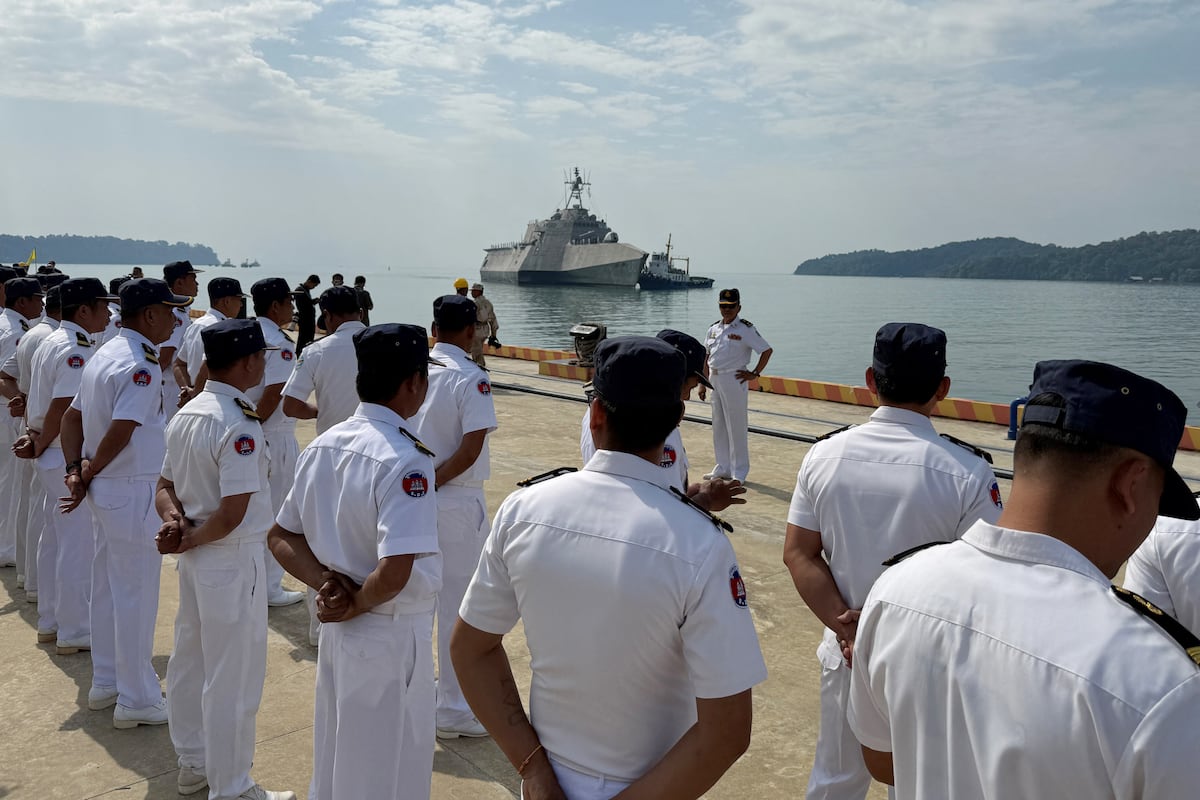
PHNOM PENH, Cambodia — After a U.S. warship visited the Chinese-built Ream Naval Base on the south coast of Cambodia last week, analysts warn the government here should brace for a response from Beijing.
The port call by the USS Cincinnati came amid a warming of relations with Washington after a decade of sour ties that took an unwanted toll on Southeast Asia, as Phnom Penh eschewed the West and embraced Beijing, its money, its influence and did its bidding.
“China will be quietly displeased and doubtful of Cambodia’s real intentions,” Deth Sok Udom, professor of international relations at Paragon International University in Phnom Penh, said. “But they are unlikely to voice that out openly.
“That said, it would be misleading to interpret this visit as a Cambodian strategic shift toward the U.S. at the expense of its relations with China, which continues to be a significant trade partner and investor to the Kingdom,” he added.
But Thai political commentator Pravit Rojanaphruk suggested Cambodia may have pushed too far in welcoming the Cincinnati at Ream which, he said, challenged China’s regional influence, raising the prospect of diplomatic and military repercussions.
“As China regards Cambodia and Southeast Asia as its backyard, it will likely respond to the encroachment of the U.S., not just diplomatically but militarily.
“We can expect China will try to neutralize U.S. influence in Cambodia and teach Cambodia a lesson or two in the months ahead, otherwise the U.S. might do something similar with Laos, which also has a special relationship with China,” he said.
The base
China rebuilt Ream within three years, tearing down U.S. funded facilities built by a dilapidated pier used as a supply stop. By early 2025, it boasted a 650-meter pier capable of docking warships, a 5,000-tonne dry dock, and a 1,000-tonne slipway with logistical facilities.
Satellite imaging by BlackSky noted in 2023 near-exact similarities between an angled deep-water pier at Ream and a Chinese military pier in Djibouti, capable of supporting all Chinese navy vessels including the Type 003 Fujian aircraft carrier.
The base itself covers 190 acres. But surrounding upgrades, including six-lane highways and a refurbished airport, extended its size.
“Cambodia’s receptivity to hosting China’s second overseas naval port increases Beijing’s strategic ability to project military power into the Indian Ocean,” said Craig Singleton, deputy director of the China Program at the Foundation for Defense of Democracies, in the BlackSky report.
As China invested billions of dollars in Cambodia, Phnom Penh emerged as Beijing’s steadfast ally and proxy within the Association of South East Asian Nations (ASEAN), a bloc which the West sees as a central-convener designed to balance great power rivalry in the Indo-Pacific.
Friends and proxies
Since 2012, Cambodia was China’s designated spoiler. It inflicted delay after delay upon the Code of Conduct (CoC) designed to manage maritime disputes between ASEAN and Beijing in the South China Sea, a perennial flashpoint in global geopolitics.
China viewed the CoC as a threat, preferring a divide-and-conquer strategy through negotiating territorial disputes with the 10 members of ASEAN on an individual basis.
According to Deth Sok Udom, the position effectively undermined the U.S. vision of a free and open Indio-Pacific.
In 2017 Phnom Penh ended joint U.S.-Cambodian Angkor Sentinel military exercises and later accused the Obama administration of backing attempts by opposition politicians to oust the then-Prime Minister Hun Sen.
A crackdown on all forms of dissent in the country ensued. Three years later, Cambodia again upset ASEAN and the West, this time by negotiating with the regime in Myanmar – where China covets sustainable deposits of rare earths – after the military seized power in a coup d’etat.
Relations then struck their lowest ebb after an American military attaché was invited to inspect Ream but denied full access, and Washington imposed an arms embargo on Cambodia in late 2021.
But there were concerns. Cambodia was too much in China’s camp, and that didn’t sit well with Hun Manet, a West Point graduate who was being groomed to take over the job as prime minister from his father Hun Sen in 2023.
“The U.S. has repeatedly expressed concerns about potential Chinese operations and future use of the naval base despite Cambodia’s denial,” Deth Sok Udom said.
“Hun Manet’s educational background in the West, most likely served as a factor for strategic considerations as to how much he could shift Cambodia’s foreign policy trajectory hitherto seen as deep in China’s orbit.”
Balancing act
Two Chinese corvettes rotate out of Ream, but to dispel claims the port was a Chinese base, Cambodia declared Ream open to all the world’s navies. Visits by Japan, Vietnam and Russia followed, while Australian and Canadian warships docked at nearby Sihanoukville.
Still, Jennifer Parker, an Australian maritime security expert and principal of Barrier Strategic Advisory, noted: “China clearly enjoys preferential access, including through its infrastructure investment and support at the base.”
While China was rebuilding Ream, its cozy ties with Cambodia were being compromised on another front with the arrival of Chinese crime syndicates which industrialized human trafficking and scam rings and were raking in billions of illicit dollars.
The activity took hold in nearby Sihanoukville and spread to the border areas, preying on Chinese and angering Beijing, which cut its funding in 2024 amid suspicions that Cambodian business leaders were harboring the syndicates.
The following year, in early 2025, Thailand initiated a Chinese-backed cross-border crackdown which erupted into an undeclared war that required mediation by President Donald Trump, topping a tumultuous U.S.-Cambodian relationship spanning over a decade.
Cambodia nominated Trump for a Nobel Peace Prize, and a conflict resolution agreement prompted Phnom Penh to join Trump’s idea of a “Board of Peace” despite what Deth Sok Udom said was China’s preference for the country to work through “existing international bodies such as the United Nations.”
At its recent foreign ministers meeting, ASEAN announced the CoC will finally proceed. Nor will it recognize the recently Chinese-backed, stage-managed elections in Myanmar, designed to legitimize the junta’s rule amid a civil war that to date has claimed about 90,000 lives.
The port call by the USS Cincinnati strengthened the whiff of a turning point for Phnom Penh and Washington. Adm. Samuel Paparo, commander of the U.S. Indo-Pacific Command, announced the Angkor-Sentinel exercises would resume later this year or next and that the U.S. arm embargo was lifted.
“Our partnership is on a strong upward trajectory,” he told a press conference in Ream on Jan. 26 after a meeting with Hun Manet. “We hope for more opportunities to work closely together.”
Altered course
“The visit demonstrates that Ream Naval Base is not exclusively a Chinese facility, nor closed to foreign naval vessels as some commentators have suggested,” analyst Parker said.
“Cambodia remains heavily dependent on China, but renewed engagement with the United States points to an attempt to introduce greater strategic balance, even if that process remains cautious and incomplete,” she added.
Gavin Greenwood, a consultant from Hong Kong-based A2 Global Risk, urged caution with the arrival of Cincinnati, a littoral combat ship (LSC) with a tarnished reputation for structural defects, at a Chinese ‘intelligence outpost’.
“The Cincinnati was actually carrying out the role it was partly intended to perform – showing the flag, maintaining a presence, sending a signal of U.S. ‘reach and resolve’ at minimal cost,” he said.
“The more revealing test of the status of US-Cambodia relations would have been had a major U.S. Navy warship visited Ream.”
Read the full article here
