
As the Army’s Transformation-in-Contact brigades test and help develop new technology, they’re also shaping how soldiers will be trained to use it.
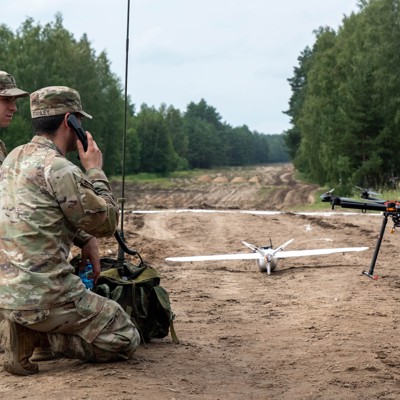
At Fort Stewart, Georgia., soldiers in the 3rd Infantry Division are working on a pair of courses to certify soldiers to operate small unmanned aerial systems, part of servicewide effort to create doctrine around using drones throughout every formation.
“3rd ID, specifically, is developing ways to qualify their operators on the different systems, and we are sending feedback back through the proper channels to big Army, to work on developing an Army-wide qualification course,” Capt. William Langley, who leads the UAS and electronic warfare element in the 2nd Armored Brigade’s 6th Squadron, 8th Cavalry Regiment, told reporters Tuesday.
Both the 1st and 2nd Armored Brigade Combat Teams are participating in TiC, with a special focus on integrating drones into tank units, said Capt. Brenden Shutt, the division’s innovation officer.
“The legacy UAS systems were focused on dedicated 15-series UAS operators, whereas now, we’re leaning more toward training standard infantry and armor soldiers to be the UAS operators,” Shutt said.
So far the division has been focusing on UAS classified in groups 1 and 2—that is, under 55 pounds. They’ve fielded more than 150 of them, Langley said, including the Anduril Ghost-X, Performance Drone Works C100, the Neros Archer, the Teal 2, and the AeroVironment Switchblade 600.
“We mainly use these in a hunter-killer format, so we use the recon assets to find the targets, and then Archers…to strike the target,” Langley said.
To qualify, soldiers start with about 40 hours of simulation training before ever touching the UAS itself.
“After that, we work with smaller [first-person view drones], and they have to hit some obstacle courses and hit some gates before they go to a larger FPV, where they then actually learn to fly them, and then put certain skills into practice and learn to integrate them into conventional armor/infantry tactics,” Langley said.
And rather than picking out a handful of soldiers to be the designated UAS operators, 3rd ID wants everyone to be familiar with flying a drone, in the way they are all qualified on their rifles.
“Previously, it was very much a select group of people who were tasked with leveraging this technology to deliver effect,” Shutt said. “Now, every single soldier, from a maintainer to an infantryman to a signal soldier who fixes the radios—all of them kind of have a baseline understanding of how drones work, and could, with the sim time, with a little bit of minimal field training, be able to deliver effects during an operational or training environment.”
Read the full article here
