

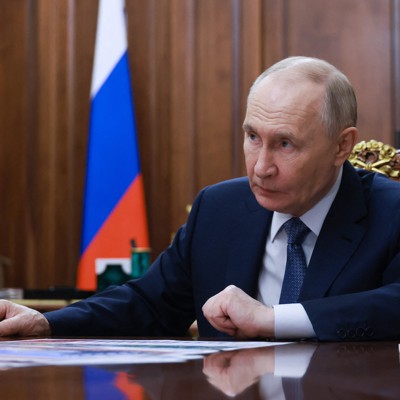
Recent U.S.-Russian talks about ending Moscow’s war on Ukraine should not be taken as a sign that Russia poses less of a threat to the United States and Europe, according to a new report from Estonia’s foreign-intelligence agency.
“Despite this illusory thaw, Russia continues to regard the U.S. as its principal global adversary,” says “International Security and Estonia 2026,” released Tuesday.
Such talks are designed to “exploit the new U.S. administration to restore bilateral relations,” the report says. That could facilitate Russian espionage, influence operations, and the movement of sanctioned goods. Most importantly, it could erode U.S. international influence, creating new opportunities for Russia to expand its own regional dominance.
The report says Russian leader Vladimir Putin intends such talks to benefit him in two ways: “First, by binding U.S. and Russian interests more closely together; second, by widening what Moscow perceives as existing rifts between the U.S. and Europe.”
U.S. and other high-ranking officials across NATO member states frequently describe Estonia as a leader in intelligence collection and public dissemination, particularly regarding Russia. Estonia, for instance, accurately predicted Russia’s full-scale invasion of Ukraine in 2022, then moved to provide Ukraine with anti-tank weapons and draw global attention to Moscow’s plans.
The restoration of U.S.-Russian relations may not be viewed as damaging by the current White House. The National Security Strategy released in December does not explicitly call Russia a threat, as previous strategies have. Instead, the NSS calls for “strategic stability” with the Kremlin, while echoing Russian criticisms of the European Union for its “current trajectory.”
The Estonian report notes that Moscow’s official messaging frames European states as more hostile than the United States, which remains treaty allies with many of them.
Some White House observers and high-ranking defense officials have suggested that normalizing relations with Russia could pull Moscow away from Beijing to isolate China—a strategy often called the “reverse Kissinger.”
But China-Russia cooperation is deepening, as noted by the Estonian report and the Munich Security Report 2026, released Monday.
“China and Russia present a united front internationally in their pursuit of an alternative governance model intended to marginalize Western states,” says the Munich report.
The report adds that Moscow’s propaganda frames the war in Ukraine as a “civilizational struggle between Russia and the West,” led by Washington.
China is filling the voids left by the U.S. retreat from international institutions and the implementation of aggressive tariffs.
As the Munich report observes, “For countries such as Brazil, U.S. trade pressure has hardened their stance vis-à-vis Washington and could push them closer to Beijing. Indeed, China has happily stepped into the void left by the U.S. retreat from global trade.”
Read the full article here
