
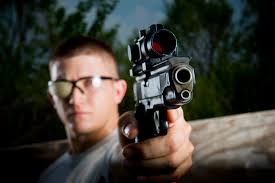
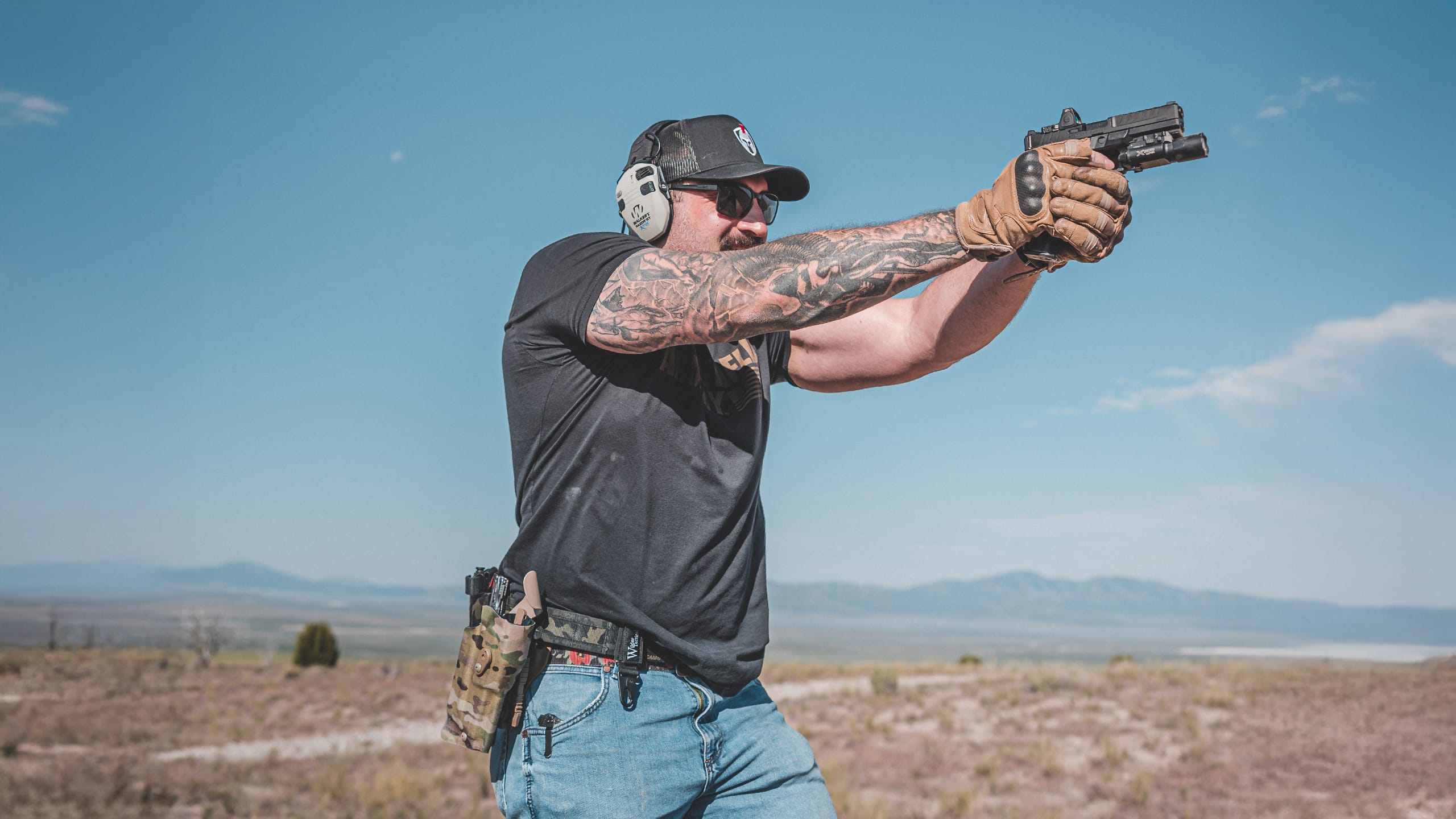
Ever wonder if you can learn how to shoot faster without sacrificing accuracy? This is a question many shooters have wrestled with in both competition and defensive shooting. In today’s article, veteran law enforcement officer and trainer Mike Boyle provides concrete steps you can take to improve your shooting speed. As with any firearms training, follow all safety rules and seek professional assistance locally for maximum benefit.
Speed can be defined as the rate at which someone or something moves or operates. For the competitive shooter engaged in action shooting, well-placed hits on target in the fastest possible time frame remain the ticket to the winner’s circle. In an even higher-stakes personal defense situation, the need to get decisive hits on an adversary before he does you harm is obvious. The inability to do so indeed has dire consequences.
Col. Jeff Cooper is widely recognized as the father of defensive pistolcraft, and many of his ideas have stood the test of time. Cooper was fond of using three Latin words, Diligentia, Vis, and Celeritas, which roughly translate to accuracy, power, and speed when describing the elements of combat shooting.
While some contemporary trainers dismiss Cooper as being a bit too old school, striking a balance between accuracy, power and speed in armed conflict remains as important today as when he developed this concept many years ago. I find it difficult to take exception to this philosophy.

Quite simply, when it comes to stopping a threat, there is no substitute for accuracy. Putting hits on a threat where they will do the most good is absolutely critical. One must also strike with sufficient power to impact vital organs or the central nervous system to prevent an aggressor from continuing his attack.
Finally, you must perform this task at a pretty fair clip before an opponent can bring his destructive power to bear. The bad news, of course, is that both the police and armed citizens are reactive by nature, and very often the bad guy initiates the action. We just have to be that much better.
But how fast do we have to be? While it is important that we can act quickly, recognizing danger and taking appropriate measures is even more critical. For the responsible citizen, getting out of harm’s way as quickly as possible may be the best course of action. This may or may not be possible depending on what is unfolding in front of you. But if confronted by a potentially lethal and unavoidable threat of death or serious bodily injury, the only logical recourse is to strike as fast and as hard as you can.
First Actions
With just about any martial art, the combatant who strikes the first decisive blow is typically the victor. In a potentially deadly force situation, if we can read the danger signs and act sooner, so much the better. This could include moving to an advantageous position of cover and drawing the concealed firearm.

Do we practice the draw stroke with the firearm, holster, and clothing we wear when going about in polite society? Putting hits on target is certainly productive, but if the draw stroke is not part of your practice regimen, you are only getting part of the picture. I recognize that many public ranges prohibit drawing from a holster, and if that’s the case, you need to practice off the range with an empty or inert training pistol.
The armed citizen also needs to recognize that many attacks occur in close quarters and with little warning. The threat may be so close that your initial response may be with an empty hand in order buy a precious second or two to draw your gun. The faster we can get into action, the greater the likelihood of meeting with success.
Shooting Speed: Sooner, Faster, More
In the grand scheme of things, the effect of rounds fired from any handgun is unpredictable. If we find ourselves in a fight for our lives, our chances of prevailing are much greater if we place multiple hits on an adversary in the places that will do the most good.
I’m not suggesting a magazine dump, but two or three rounds to the high chest area can possibly stop the threat. Clearly, multiple hits will cause greater disruption of organs that support life and shut down a determined adversary than a single shot. Once the threat is neutralized, strike no more, but see that he is stopped.

With a bit of quality instruction and some practice, hitting a man-sized target at typical combat distance with a handgun is not necessarily that difficult. Being able to do the same task at speed requires a greater commitment. Unfortunately, some training offered to the police and private citizens may not adequately address this issue. Posting a high score on a police qualification course or on your CCW test does not necessarily translate to real-world proficiency.
Shooting Faster
For me, one of my bigger challenges as an instructor has been helping people with a modest level of proficiency reach the next level. They may very well be safe gun handlers and capable of posting a satisfactory score on a course of fire, but are locked into their comfort zone and are not especially confident when it comes to pushing the gas pedal just a little bit harder.

Live The Armory Life. The latest content straight to your inbox plus an automatic entry to each of our monthly gun giveaways!
By reinforcing combat shooting fundamentals such as grip, index on the target, and trigger management and slowly introducing them to a few different drills, I often see great improvement. The ultimate goal is to set each individual’s mental clock so they can strike that ideal balance between speed and accuracy.
What follows are a few exercises that I have used over the years to teach people how to shoot faster. Perhaps there is something you can use in this mix to improve your skills.
The Count Drill
The Count Drill is also known as the Trigger Bar or Rhythm Bar Drill. No matter what you call it, I find it especially useful for getting shooters to shoot faster and hit their targets. For building shooter confidence in their ability to shoot at a faster shot cadence and also hit, I really haven’t found anything better.

First, let’s consider the target. In its purest form, three vertical bars are contained side by side on an 8-1/2 x 11-inch sheet of paper. The bars are roughly 6 inches long by 2-1/2 inches wide. For new shooters, I might start them at 3 yards from the target and, as skill improves, move back to 5 and 7 yards.
To begin the exercise, load your handgun with at least six rounds and come to a low ready position with the muzzle depressed. The first phase involves firing 6 shots at a comfortable pace. On the shoot stimulus, fire six rounds in a slow, even cadence by counting off one Mississippi, two Mississippi, three Mississippi, etc. Splits between shots are approximately 1.5 to 2 seconds, allowing ample time to focus on the fundamentals of combat shooting. Watch for the front sight to come down from recoil and settle on the target before breaking the next shot.
After firing those first six shots, secure your handgun in the holster and do a little self-assessment. Are all those shots inside the rectangle? Do we have a nice, tight knot of hits? Perhaps one got away, and if so, what did I do wrong?

In the next sequence, work the middle bar. Again, you will fire six shots in total. However, the shot cadence will be twice as fast as the first phase. This time, you will count off “one and”, “two and”, “three and”, and so on until you have fired all six shots. This shot cadence will yield splits of about one second apart — still sufficient time to mentally rehearse those fundamentals. Again, assess that target and don’t be surprised if this six-shot group is tighter than the group you shot at the slower cadence.
Finally, it’s time to push at game speed. In this final phase, the shot cadence will again be cut in half, and you will simply count off one, two, three, etc. until we have expended all six shots. Splits between shots will now run about a half-second apart, which is a pretty lively pace. It is very important that you don’t let your finger run away from the eye and the brain. Despite the fact that you are shooting faster, the rules haven’t changed, and it’s still about the hits.
If you can reliably dump six shots in a fairly tight cluster with half-second splits, you have arrived. Remember, it’s okay to miss in training because if we don’t push it every now and again, you will never find your true limitations. Once this is no longer a challenge at close range, bring it back to 7 yards and give it a go. The Count Drill remains a personal favorite for building speed, and I regularly use it for my own training.
The Lucky Gunner 5×5 Drill
The Lucky Gunner 5×5 Drill is another gem I’ve used in training both new shooters and more experienced operators. The Lucky Gunner drill was based on a drill developed by shooting instructor, competitor and author Gila Hayes. The target is a 5-inch circle placed five yards away.

On the first run, I will have the shooter begin in a low-ready position with the muzzle depressed. On the signal, you drive the gun to eye level and fire off five shots in a nice, even cadence. The goal is to place all five shots inside the circle in five seconds or less. After meeting with success, the handgun will be placed in the holster, and the draw stroke will become part of the process. No more time is allowed, and one still has to drop all five shots in the circle.
This might be a slightly easier test than the Trigger Bar Drill, but I’m often amazed at the lack of success some shooters have with the gun they actually carry. Very often, the contributing factor might be a small, lightweight handgun that is difficult to control in rapid fire.
Time Crisis Drill
For shooters who require a greater challenge, there are a few other solid drills with a similar theme. Dave Spaulding designed one he calls Time Crisis that certainly takes this to the next level. Instead of a 5-inch circle, your target is now a 3×3 inch post-it note. With the target set five yards away, draw and fire five rounds.
Are we under the five-second par time with all hits? If so, repeat. Did you post a faster time with all hits? Continue until you miss or your elapsed time is slower than your previous performance.
Tom Givens of Rangemaster has a similar test but instead uses five playing cards affixed to a backer. Before you think this is easier, consider that you have to do it five times in a row without missing. A bit of concentration is required as it’s easy to get a little cocky after three or four successful reps and drop a shot on the last card. Stay focused!
Adding Multiple Targets
So far, our efforts have focused on placing multiple shots on a single target. Now we are going to mix it up a bit and fire one or more shots at multiple targets. Rather than shoot a geometric shape, some type of humanoid targets — preferably with a high-value scoring area — will be utilized. Three targets (T1, T2 and T3) will be set in a row with a one-yard separation. Targets can be set anywhere from five to 10 yards away, depending on the shooter’s skill.

To run the drill, load the pistol to full capacity and assume a low-ready position. On the shoot stimulus, fire one shot at the T1, two shots at T2, three shots at T3, reverse direction, and fire four shots at T2 and five shots at T1. This drill was originally designed for a double-column pistol, but it can be done with single-stack and micro-compact pistols by reloading before reversing direction.
I prefer IPSC, IDPA, or similar targets with a realistic-size high-value scoring area. A high-value area can be created on any silhouette target by affixing a small paper plate to it. As indicated earlier, in the unforgiving real world, your best chance of meeting with success is by placing one or more rounds in the heart/lung area.

Have a training partner time you as you run the drill. Do the hits look good? Run it again and push it a little harder. When shooting multiple targets, make sure the eyes move before the gun and don’t break the shot before the sights are on the target. If this is new territory, don’t try to go 100 mph right out of the gate, but instead work at a more moderate pace until you are confident you are making decisive hits each time you are pressing the trigger. Ultimately, you are only competing with yourself, and if you can demonstrate improvement each time, success is yours.
Final Thoughts on Improving Your Speed
Gunfights are unpredictable; there is no telling where or when they might unfold, how many shots will be fired, how close to the threat, how many assailants there are, or what the lighting conditions are. For the armed, responsible citizen, the best course of action remains avoidance. But if you find yourself with your back against the proverbial wall, the only option is to take the fight right to the bad guy and not hold back.
Having the right gear, using sound tactics, and especially mental toughness all weigh heavily into deciding the outcome of an armed encounter. Bear in mind, we also need to sharpen the saw from time to time to ensure our skills are up to the challenge. The ability to place one or more hits in rapid succession remains a critical skill that can certainly tip the odds in your favor. When your life is on the line, mediocrity is not an option.
Editor’s Note: Please be sure to check out The Armory Life Forum, where you can comment about our daily articles, as well as just talk guns and gear. Click the “Go To Forum Thread” link below to jump in!
Read the full article here
