

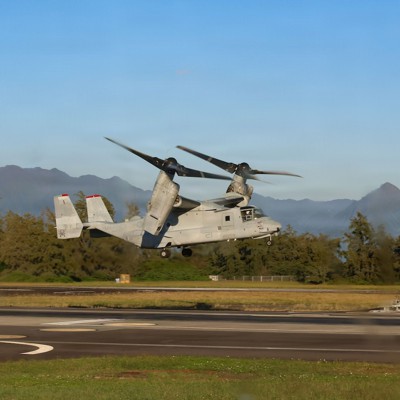
A gearbox failure forced a Marine Corps V-22 to make an emergency landing on Feb. 3, days before Navy leaders briefed lawmakers on fixes being implemented for the troubled tiltrotor aircraft.
A MV-22B with the 1st Marine Aircraft Wing landed in the Tactical Flight Training Area on Oahu, Hawaii, “after experiencing an in-flight malfunction,” according to an emailed statement from the aviation wing.
None of the crew was injured but the aircraft will “require maintenance actions and repairs” before returning to its home station, the statement said. An investigation into the mishap is ongoing. A gearbox failure was the root cause of a 2023 Air Force Osprey crash that killed eight airmen and a 2022 crash that killed five Marines.
Naval Air Systems Command confirmed in an emailed statement that the Osprey belonged to the wing’s VMM-268 squadron and added that “the aircrew executed the precautionary procedure in accordance with established standards, remaining fully committed to safety.”
The incident happened a week before a Feb. 10 briefing about the Osprey program by Naval leaders to Congress. They discussed efforts to address recommendations in two watchdog reports released late last year, and said some of the permanent fixes won’t be fully implemented until the 2030s. News of the latest mishap was made public by Rep. Joe Courtney, D-Conn, during the hearing.
“Your office was very good about notifying, I think, a number of us,” Courtney told Brig. Gen. David Walsh, NAVAIR’s program executive officer for air anti-submarine warfare, assault and special mission programs. “There was a crack in the gearbox that was detected just, actually, last week or so.”
Since 2022, four V-22 crashes have killed a total of 20 service members. Investigations blamed failures within the Osprey’s proprotor gearbox and sudden surges in power after a clutch slip, known as a hard clutch engagement. After the crashes, the Pentagon imposed range and other limits on V-22 flights.
A person familiar with the Feb. 3 incident told Defense One that the MV-22B does not have the permanent mechanical solution for the gearbox yet and that it is flying in a restricted status. He said the interim gearbox on the aircraft was in its early flight hours.
“It looks like this is going to be a situation where a gearbox failed within the realm of what we would expect because of the interim solution,” the person said. “Some of these gear boxes have that infant mortality where if something is going to happen, we expect it to happen within X amount of hours.”
In the Marine Corps’ 2026 aviation plan, released the same day as the House hearing, the service praises the Osprey as the “cornerstone” of its air-ground task forces.
“The MV-22 Osprey provides unmatched operational flexibility due to its combination of speed, range, payload, and aerial refueling capability,” the document reads.
The service began replacing its gearboxes this month and is “estimated to result in an unrestricted operational fleet by December 2027,” according to the service’s aviation plan.
The gearbox upgrades are to be finished for the Air Force and Navy in 2029 and the Marine Corps in 2033, according to a Feb. 11 statement by NAVAIR.
Vice Adm. John Dougherty, NAVAIR’s commander, told lawmakers on Tuesday that completely redesigned Input Quill Assemblies to remedy hard clutch engagements should be fielded in late 2027. The Marines plan to install its new assemblies in 2028, the service’s aviation plan said.
In December, the Government Accountability Office and NAVAIR separately issued reports that said the V-22 Joint Program Office failed to adequately assess and address mounting safety risks, even as service members died.
No Navy rotorcraft had more “systems safety risk assessments”—that is, unresolved catastrophic parts problems, the reports said. Only one other aircraft type—the F-35—had more than the V-22’s 28.
On Tuesday, Courtney told Navy leaders that the service “should explore the possibility of legislative action to codify elements of these recommendations,” akin to the late Sen. John McCain’s push for naval safety reforms after a string of ship collisions in 2017.
That “would send a powerful message to our service members and the public that ‘real change is happening.’” he said.
Read the full article here
