

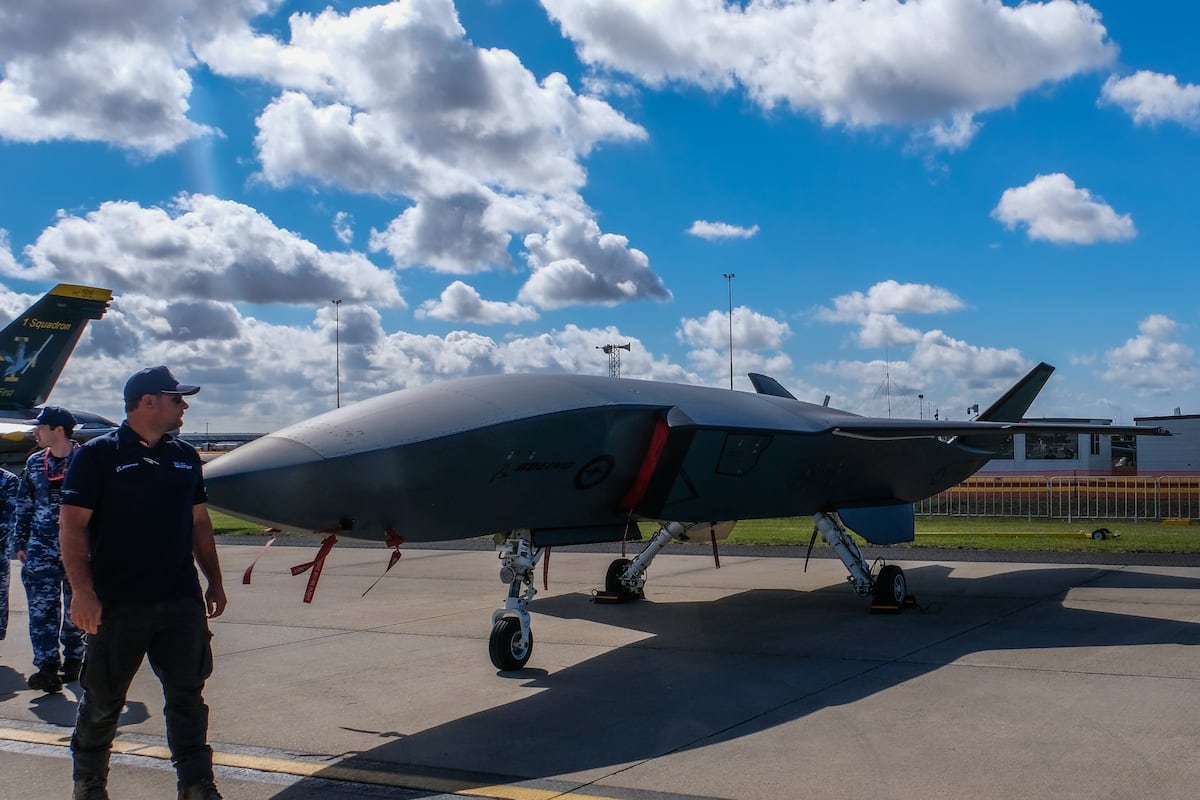
SINGAPORE — Australia is one of the pioneers exploring collaborative combat aircraft, or CCAs, as it throws its full weight behind Boeing Defence Australia’s MQ-28A Ghost Bat platform.
The Royal Australian Air Force (RAAF) already has eight Block 1 aircraft in testing. In addition, the first of three Block 2 aircraft ordered in February 2024 is currently performing ground testing and will fly soon, according to the manufacturer.
On Dec. 9, 2025, Boeing Defence Australia announced the RAAF had ordered seven additional Ghost Bats. This third tranche worth AUS$754 million (US$534 million) entails six CCAs in Block 2 configuration plus the first-ever Block 3 aircraft.
This will put the Australian air force on a path to have 10 operational Ghost Bats by 2028.
Australia, worried by the military rise of China, is prioritizing long-range deterrence. Unmanned systems like the Ghost Bat are a prominent part of that puzzle, allowing Australia to project airpower far from its shores.
Fleet mix
Boeing Defence Australia conducted two demonstrations in recent months. The first involved a pair of MQ-28As flying in formation, with an E-7A Wedgetail early-warning aircraft acting as a quarterback.
“That mission was to go out there against a representative target at a representative range and achieve the find, fix, track, target piece of the air-to-air kill chain,” Glen Ferguson, MQ-28 Global Program Director at Boeing Defence, said at the Singapore Airshow this month.
What followed was the MQ-28A’s first-ever missile firing on Dec. 8, 2025. This involved a Ghost Bat launching an externally mounted AIM-120 AMRAAM against a Phoenix drone. An F/A-18F Super Hornet fed targeting data, while an E-7A provided command and control.
“We did the engage-assess part of the kill chain, and we did it on purpose to show that all spectrums of the mission can be covered through a mix of crewed and uncrewed teaming,” Ferguson said.
The Block 3’s internal weapons bay is provisioned to carry one AMRAAM-sized or two GBU-39/B bomb-sized weapons. Boeing has trialed an electronic warfare payload and infrared seeker, as well as three or four other sensor packages that Ferguson declined to discuss.
“The thing about CCAs that we’re learning is they’re not replacement aircraft,” he said.
According Pat Conroy, Australia’s minister for defense industry, the government is eying a fleet mix of at least least three uncrewed aerial platforms for every crewed combat aircraft.
Production and exports
Construction of a Ghost Bat production facility in Toowoomba, Queensland, will conclude this year, allowing it to begin operations in 2027.
Australia’s goal is for a Ghost Bat to cost 10% of a crewed combat aircraft, a target that Boeing believes it can reach.
“We’re really, really comfortable with our affordability,” said Ferguson. “We’ve built this aircraft from day one to be affordable.”
Exports are part of Boeing’s objective.
“We’re having conversations with a lot of customers right now about how they might feel or determine or deliver a CCA capability,” said Ferguson, who mentioned Japan as a potential collaborator.
Despite Boeing’s early start in the CCA testing business, Ghost Bat is not without competitors. Anduril Industries exhibited its Fury – designated the YFQ-44 by the U.S. Air Force – in Australia last year. General Atomics is also working on its Gambit family of collaborative combat aircraft.
Gordon Arthur is an Asia correspondent for Defense News. After a 20-year stint working in Hong Kong, he now resides in New Zealand. He has attended military exercises and defense exhibitions in about 20 countries around the Asia-Pacific region.
Read the full article here
