

KYIV, Ukraine — The army that stopped Russia’s march on Kyiv four years ago no longer exists.
Outmanned and outgunned by a nuclear power in the largest land war in Europe since 1945, Ukraine’s front line is increasingly held not by soldiers, but by machines and the skeleton crews that control them.
Commanders describe brigades hollowed out to half strength or worse. Frontline units often operate at 50% to 60% of authorized manning, some as low as 30%.
In some sectors, a maximum of 12 fighters hold 5 to 10 kilometers of front, far below what Cold War-era NATO planning assumed for high-intensity defense.
The numbers tell the story of an army running out of people. The average frontline soldier is 43 to 45 years old, according to Bloomberg.
Roughly 200,000 troops are absent without leave, and around 2 million men are evading mobilization, Defense Minister Mykhailo Fedorov told CNN in January, with Western and Ukrainian analysts estimating the overall shortfall at 300,000 personnel.
Ukraine is no longer just supplementing its infantry with tech — it is replacing infantry in many cases with drones, ground robots, sensor networks, minefields and artillery cued by unmanned systems.
The battlefield revolution was not born simply of necessity, but as a war strategy of a smaller nation against a much larger enemy.
In the Donetsk region alone, Russian losses reach 156 soldiers per square kilometer, Fedorov said in an address marking the fourth anniversary of the full-scale invasion.
Ukraine’s benchmark: more than 200 casualties per square kilometer — “a level of losses at which further advance becomes impossible,” Federov told reporters on Monday.
Over the past year, Military Times interviewed dozens of drone operators, robotics engineers and defense officials across Ukraine to understand how the country is bridging its manpower shortage — and what an increasingly unmanned army looks like.
As a correspondent who has covered this war since the first hours of the full-scale invasion, I have never seen the battlefield transform this rapidly.
Inside Lazar’s Group, a National Guard special forces formation that has claimed more than 40,000 targets destroyed since the full-scale invasion, the substitution is already operational architecture.
The roughly 1,700-person drone unit, according to its commanders, stations a ground crew every 10 kilometers along the front, an ISR team every 20, with FPV pilots and interceptor crews filling the gaps.
Commanders say its strike drones now account for 60% to 70% of all hits in its sector.
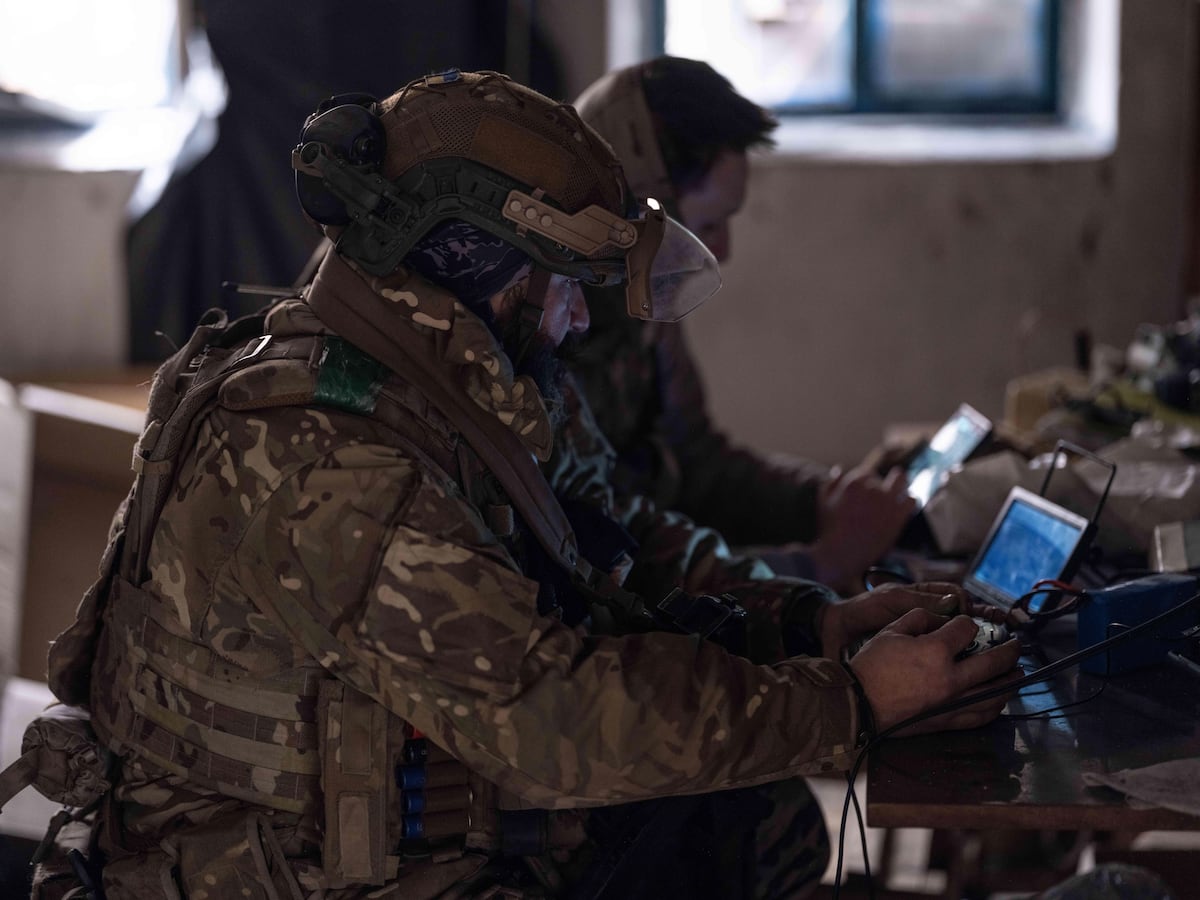
In practice, that means a single operator hunched over a tablet in a basement can toggle between three FPV feeds while sending one drone into a trench line as two more orbit overhead waiting for targets — one pilot doing the work of a squad.
“More drones, more Russians killed,” “Phoenix,” the operational head of Lazar’s Group, told Military Times at the Kyiv International Cyber Resilience Forum in February.
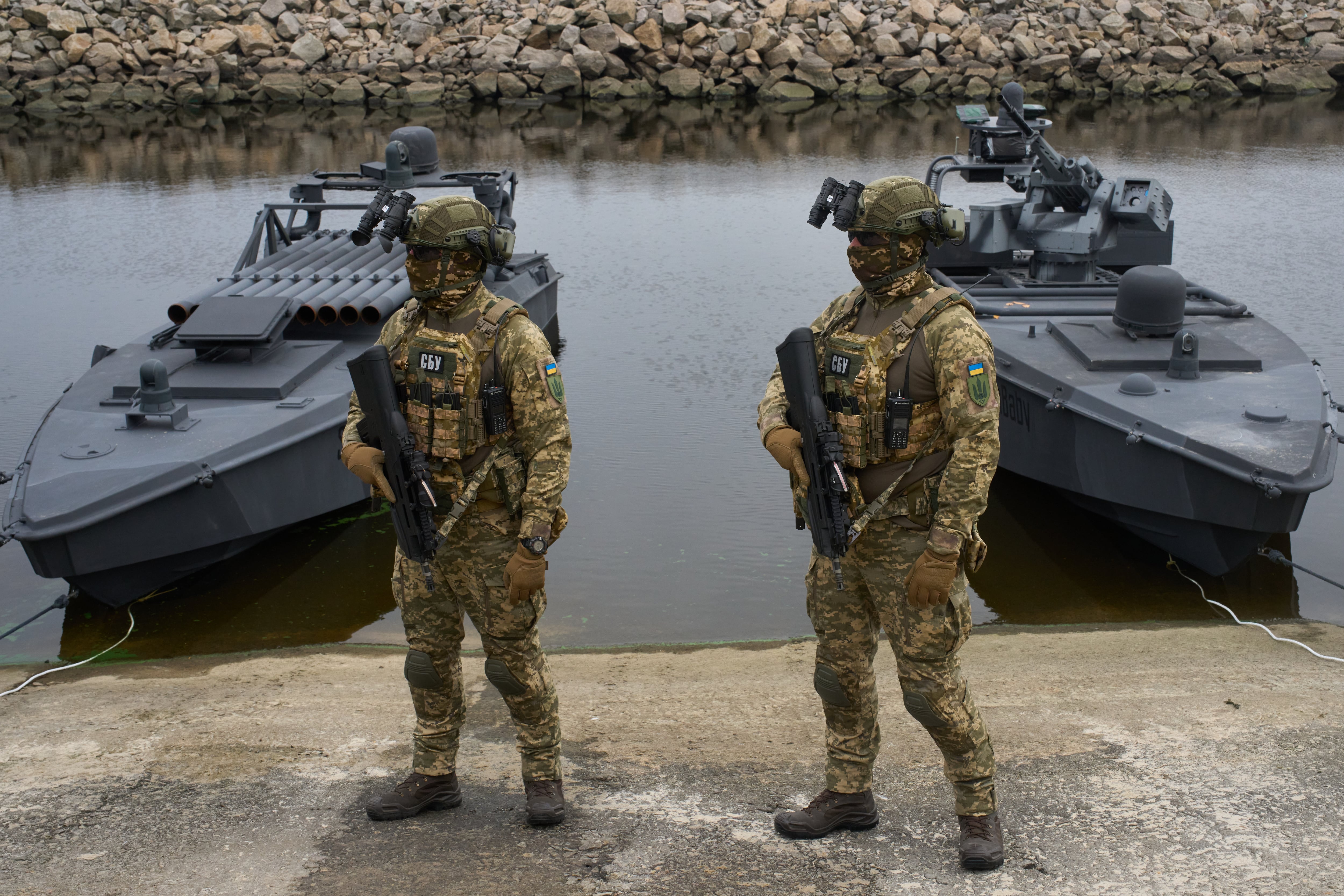
Military Times agreed to refer to all active duty soldiers by their nom de guerre for operational security.
Russia does not face the same constraint — and is not pushed to innovate as quickly or dramatically as a result.
Ukrainian President Volodymyr Zelensky said last year that Moscow was recruiting 40,000 to 45,000 troops per month, compared to Ukraine’s 25,000 to 27,000.
Ukrainian military intelligence data suggests the actual pace is around 30,000 to 35,000 new Russian contract soldiers per month, according to the Kyiv Independent — still enough to outpace Ukraine’s intake by a widening margin.
Deputy Defense Minister Lt. Col. Yuriy Myronenko, a former infantry officer and combat drone unit commander who now helps oversee Ukraine’s unmanned systems strategy, told Military Times, “This is the only chance to win for us. There is no other chance.”
So, the military is adapting.
The 28th Brigade’s newly formed Unmanned Systems Battalion “Flash” is Ukraine’s first international UAV unit — a foreign-heavy drone force where English fluency, not combat experience, is the entry requirement.
“Infantry is dead,” “Scooby,” a Polish Flash operator who had just returned from his first mission with Flash, told Military Times earlier this month.
The 28th Brigade has already shifted 70% of frontline logistics to robotic systems, its commanders told Military Times.
Designed as a replicable model for how Ukraine wants to restructure force composition, the unit runs FPV strikes, drone-on-drone air defense and ground robot operations. The substitution is happening in layers.
His description matches what drone operators across multiple units described to Military Times: units are exponentially increasing their kill rates by investing a majority of their strategic resources on autonomous and unmanned tech.
According to internal Ukrainian estimates and government data published by Reuters, drones accounted for 69% of strikes on Russian troops and 75% on vehicles and equipment in 2024.
By the end of 2025, drones were responsible for more than 80% of all enemy targets destroyed, with 819,737 video-confirmed hits logged that year.
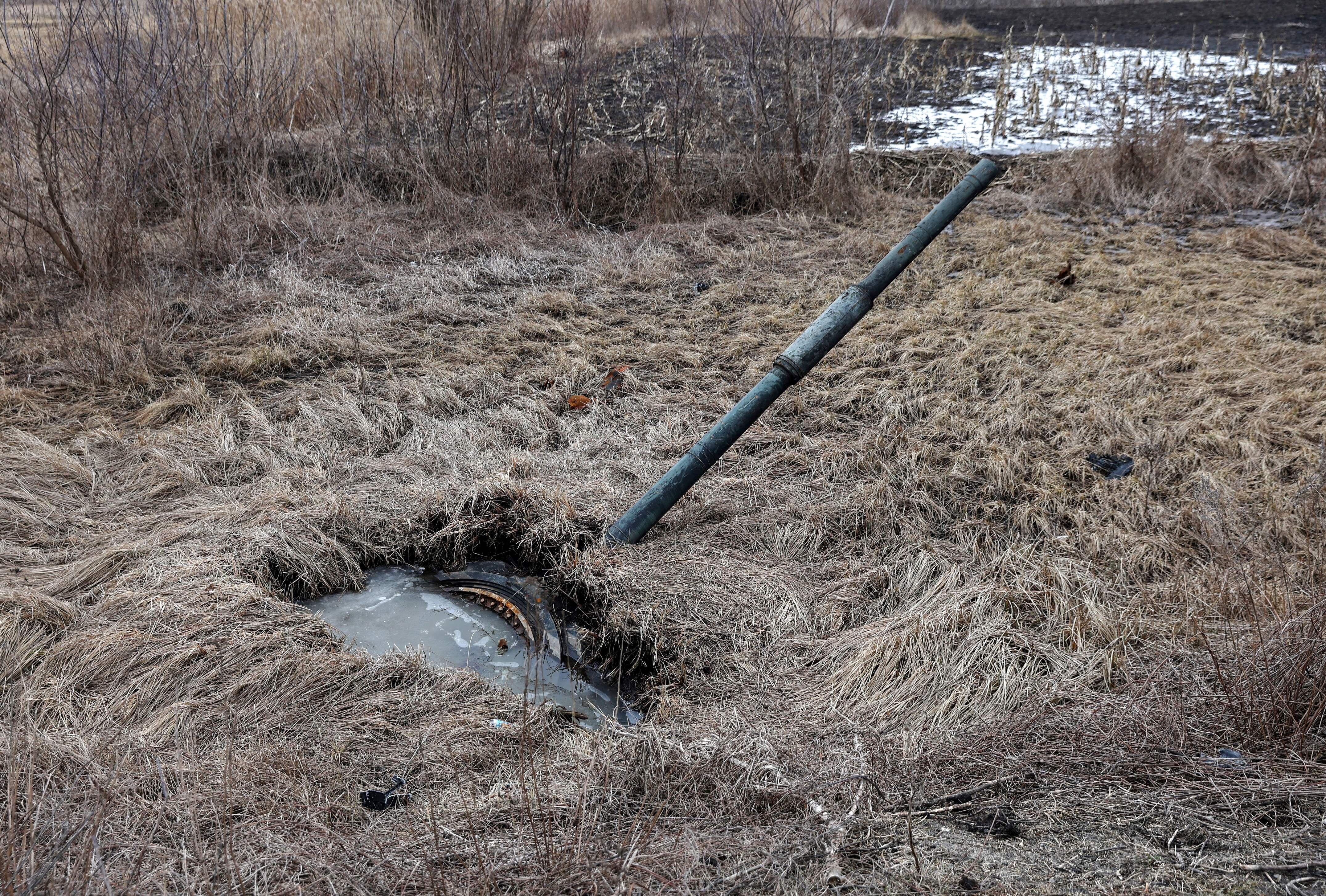
Twelve drone operators with enough airframes can now do the work of dozens of infantry — a ratio that inverts the traditional calculus of ground combat.
In the 12th Azov Brigade’s sector, commander “Kil” has described areas where there is “absolutely no Ukrainian infantry” — defense maintained largely through UAV surveillance, artillery strikes and minefields, according to NV.
Drones spot targets, artillery fires on them, mines block movement — and infantry enters only for specific tasks.
“Our battalion is an unmanned systems battalion,” Ash, head of Flash’s medical and MPZ — the unit’s morale and psychological support program — told Military Times. “It means we don’t have infantry.”
After four years of mixed battlefield tactics blending muddy trench warfare with kamikaze drones and ballistic missiles, Russia’s full-scale invasion of Ukraine has already become the drone war of the future — fought almost autonomously from a distance, strength, brute strength and numbers matter less than robotic force multipliers and electronic warfare.
“We do drones. We kill with drones. We save with drones. We liberate with drones.”
Integrating unmanned systems into the core of its military fabric is no longer improvisation in Ukraine. It is doctrine.
After taking office in January, Fedorov outlined a government plan built around what he called “the mathematics of war” — from completing corps-level reform to transforming command systems through data-driven management.
Ukraine’s Unmanned Systems Forces, a standalone military branch established in 2024 and now commanded by Maj. Robert “Magyar” Brovdi, encompasses more than a dozen strike and reconnaissance units, including the 414th “Magyar’s Birds” Brigade, the top performer on the military’s verified combat-rating leaderboard.
These USF units have destroyed thousands of enemy targets each week in February, according to Ukrainian Defense Ministry data.
Brovdi’s philosophy for the force: “People think — machines do the work.”
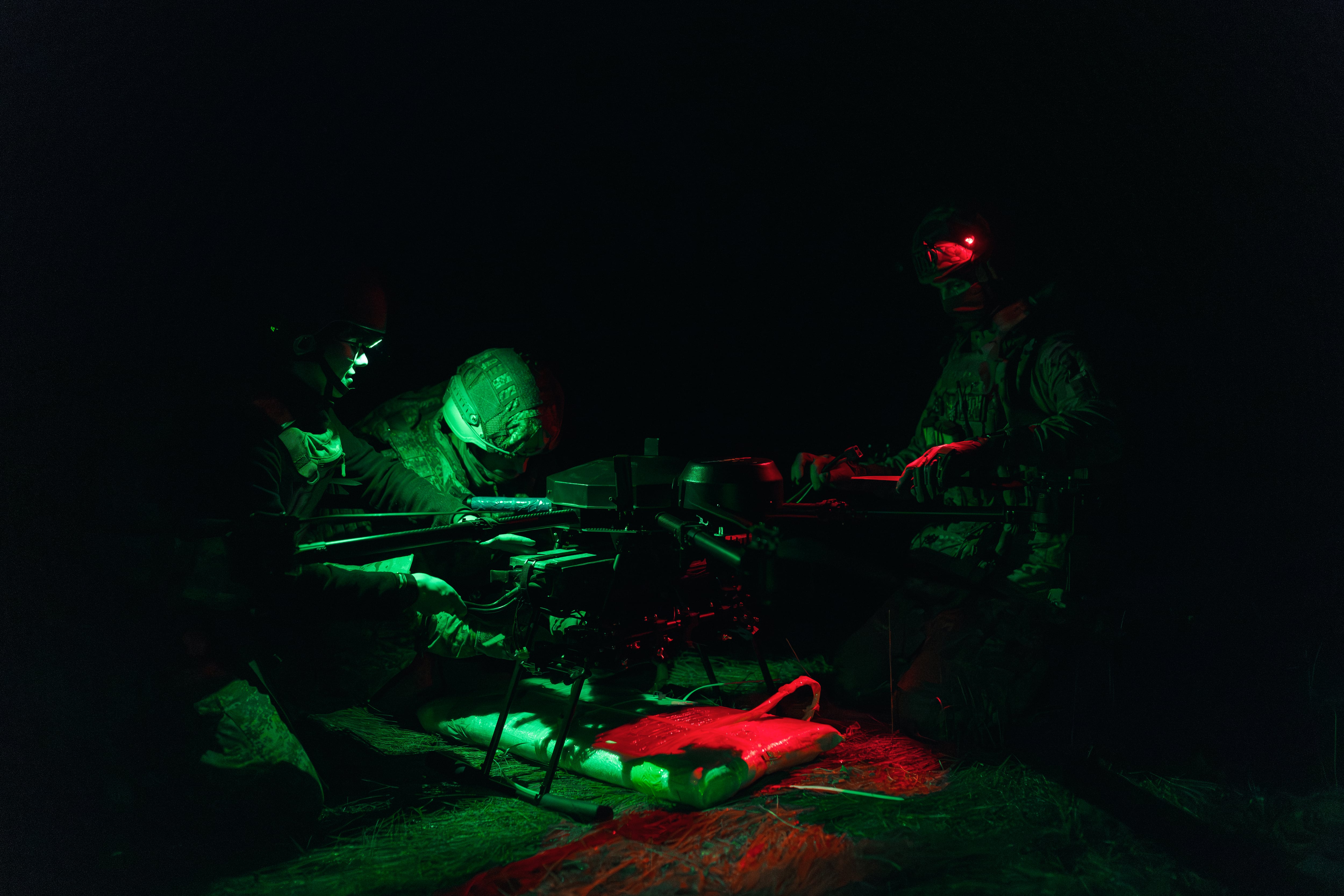
The Ukrainian military has separately set the goal of establishing a 15-kilometer unmanned “kill zone” along the front lines, a project dubbed the Drone Line.
And the supply chain is catching up to the doctrine.
Alona Zhuzha, director of digitalization at Ukraine’s Defense Procurement Agency, told Military Times that drone delivery times have dropped from two to three months to an average of 10 days — and in some cases, one day from order to frontline delivery.
But the ambitious model still faces challenges.
A historic winter has hammered battery-powered drones. Temperatures across the 1,200-kilometer front line plunged to their lowest of the entire four-year war — hitting minus 20 Celsius — with cameras icing over, batteries dying mid-flight and short-circuits grounding entire fleets, AFP reported.
Troops have resorted to unorthodox solutions for airframe insulation.
“We just put lard on them, and it takes off. I’m laughing, but it’s how it is,” Denys Shtilierman, chief constructor at Fire Point, a company making Ukraine’s first long-range drones, told AFP.
Russia is adapting in parallel, scaling its own FPV production and using heavy electronic warfare to jam and burn down Ukrainian drone swarms.
Robots are still a long way from warring autonomously.
“There’s no such thing as replacing infantry,” Jesse Nuese, a former U.S. Army paratrooper and Afghanistan veteran who co-founded Forward Horizon Group to facilitate reconstruction and technology transfer between the U.S. and Ukraine, told Military Times in Kyiv. “Unmanned systems cannot hold ground alone.”
He may be right — for now.
But on a stretch of front east of Pokrovsk, a tracked robot with a 12.7mm machine gun holds a position for weeks without a crew — and somewhere behind it, a single operator toggles between three feeds, doing the work of a squad.
And battlefield dynamics continue to evolve at lightning speed.
“One pilot, three drones now,” Phoenix said. “It would already be 10 with more funding.”
Read the full article here
