
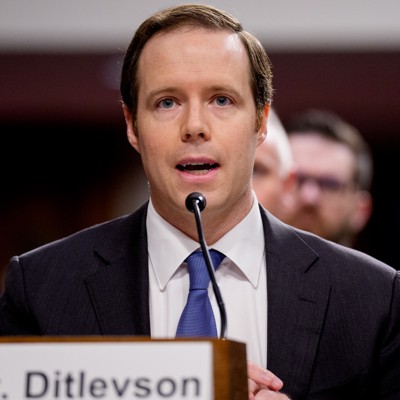
The White House pick to lead policy related to domestic military use dodged direct questions Thursday on whether he would advise the defense secretary to deploy National Guard troops to election polling places, repeating that the “first objective is always to make sure that people are safe and secure.”
“I appreciate the concern, and I would point to past precedent in a lot of cases. For example, during the COVID pandemic, we did have to utilize National Guard to assist with all the logistics around these things,” Mark Ditlevson, nominated to be the assistant secretary of defense for homeland defense and Americas security affairs, told the Senate Armed Services Committee during his confirmation hearing. If confirmed, “I commit to following or making sure that we analyze this, provide the best recommendation up to the secretary. We’d talk to the office of general counsel to make sure everything that we’re doing is legal and lawful. Before that advice gets to the secretary, I can make that commitment to you.”
The National Guard often provides logistical support for elections, including cybersecurity functions. But that’s different from patrolling polling locations, senators argued, pushing Ditlevson for a yes or no answer on whether there are credible threats to the elections that would warrant calling in the National Guard.
When asked about National Guard troop presence at election polling locations, Ditlevson deferred to the Pentagon’s general counsel on the legality of such deployments, acknowledging U.S. law that bars National Guard from election locations unless there are “armed enemies of the United States” present.
Ditlevson, who has been acting in the role since last year, agreed the statute is an “extremely high bar to meet” that requires “robust analysis,” but stopped short of refusing to recommend, as a matter of policy, sending troops to the polls.
Senators—particularly Democrats—took umbrage with Ditlevson’s opaque answers.
“You are nominated for this position. I’m just asking, do you think it would be appropriate to station troops next to polling stations? Simple yes or no,” said Sen. Elizabeth Warren, D-Massachusetts.
Ditlevson called the question “speculative,” declining to discuss “what threat levels may exist during an election cycle.”
Warren retorted: “I have to say, if you’re not willing, just to say, ‘No, it is not appropriate,’ then I have real concerns about you in this job.”
Sen. Tim Sheehy, R-Montana, brought up violence he saw around the 2010 elections in Iraq when he was a Navy SEAL, saying, “the point was to suppress voter turnout, because they didn’t want a democratically elected government.”
He asked if it would be appropriate to use the National Guard and other resources in the event of a “direct terrorist threat against a polling station.”
Ditlevson said yes.
The debate comes alongside reports the White House is considering an executive order that seeks to codify President Donald Trump’s previous calls to “nationalize” elections. Trump’s supporters then called for immigration agents to stake out the polls during the upcoming midterm elections. A Homeland Security official has since promised that ICE agents, who have violated multiple court orders in Minnesota, won’t be at the polls during the midterms this year.
In August, Trump deployed the National Guard in Washington, D.C. to fight crime, followed by deployments to several other cities, facing myriad legal challenges. Those deployments, which have been winding down, could cost taxpayers more than $1 billion.
A recent Associated Press-NORC Center for Public Affairs Research poll found that only 27% of Americans have “a great deal or quite a bit” trust in Trump’s judgement in using military force. Along party lines, 60 percent of Republicans had that same level of confidence compared to 5 percent of Democrats and 14 percent of independent voters.
Sen. Tammy Duckworth, D-Illinois, closing out the hearing in a fiery exchange, asked several questions: how far from polling stations would National Guard troops be posted for logistics support, would they be in uniform, would they wear Kevlar or would they carry a sidearm.
“Are you saying that there are potentially other reasons to send them to polling stations, beyond logistics, and that they may actually be fully up-armored, fully combat equipped, depending on what you decide is the situation on the ground?” she said.
Ditlevson called the question “speculative,” but said “questions for the specific distance and what equipment people would wear on any deployment: We always look at what the threat scenario may be and tailor that for whatever they may have to deal with. And so, as you pointed out, for logistics, it’d be a very different footprint than some other type of mission.”
Those responses still left senators with questions.
“I am concerned. I am concerned that you can’t make basic reassurances to this committee as to how you would advise on the calling of our National Guard to be there at polling places at an election on United States soil,” Duckworth said.
“You cannot intimidate Americans when they go out to vote. It is against the law. It is against code. I just read that code to you. I am at a loss,” she said. “The American people would not stand for this. I will not stand for it, and my colleagues in Congress should not stand for this administration’s attempts to use our nation’s military to intimidate Americans from exercising their fundamental right to cast a vote in elections.”
Read the full article here
