

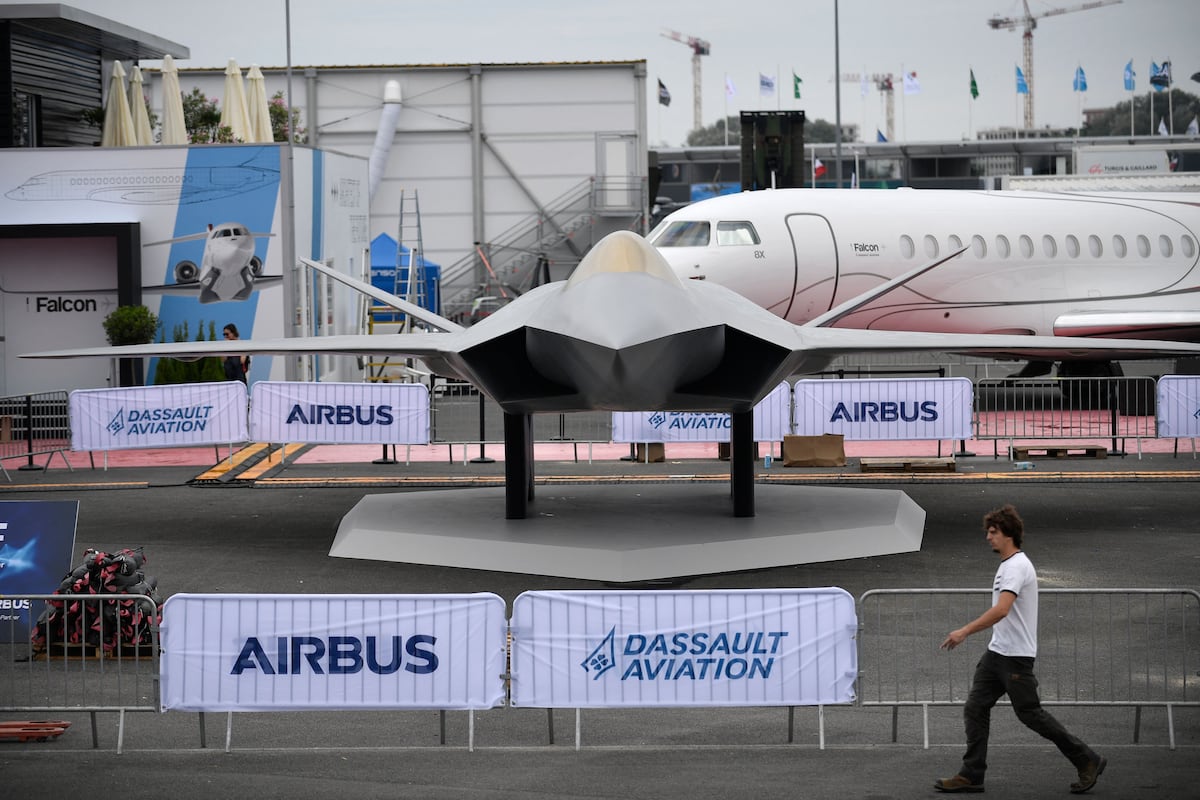
PARIS — The French-German project to develop a future combat air system appeared closer to failure on Wednesday, after aircraft maker Dassault Aviation blamed partner Airbus for no longer wanting to work together on the next-generation fighter at the heart of the plans.
“If Airbus maintains its position of not wanting to work with Dassault, the matter is dead,” Dassault Aviation Chief Executive Officer Eric Trappier said at a press conference outside Paris on Wednesday, where he showed a slide on FCAS with only a question mark, saying, “I don’t know.’’
French President Emmanuel Macron and then-Chancellor Angela Merkel announced the future air combat project in 2017, and work has been split up in several so-called pillars, including a new engine, drones and a combat data cloud. Dassault and Airbus, the partners for the next-generation fighter in FCAS, have been bickering for years over project authority and work share.
France was designated as the lead nation for the combat aircraft at the start of the project, with Dassault Aviation assigned the leader of the pillar, based on a joint decision by the partner countries, according to Trappier. “Not everyone is happy with this, but I believe that in order to develop combat aircraft of this level for the future, we need a leader.”
The CEO said an effective program requires “a real leader” who decides on whether subcontractors are performing, on the shape of the aircraft, and who will take responsibility for getting the aircraft to fly. He said Airbus would like to reduce Dassault Aviation’s role as part of a “co-co-co construction, on which I don’t agree.”
Dassault is abiding to the letter of its contract, and Airbus is not sticking to the “intial equation,” according to Trappier, who said it’s now up to the governments to arbitrate. He declined to speculate when or what France and Germany might decide on the future of the project.
German Chancellor Friedrich Merz said in an interview last month his country doesn’t currently need the same aircraft as France, which requires a fighter able to operate from an aircraft carrier and deploy nuclear weapons to ensure sovereign capabilities. Trappier said that while he hasn’t spoken to Merz, he was assured by French authorities there is agreement on operational requirements.
Trappier said Airbus is not looking to resolve its dispute with Dassault, and accused Airbus of communicating via labor union IG Metall and the German Aerospace Industries Association BDLI rather than “saying it loud and clear.” IG Metall in December said it would no longer work with Dassault Aviation, while the BDLI said on Feb. 6 it favored a “two-aircraft solution” for FCAS.
Airbus would support a two-fighter solution to break the deadlock, and is “committed to playing a leading role in such a reorganized FCAS,” Airbus CEO Guillaume Faury said during a press conference in February.
Trappier said neither Dassault Aviation nor France back the idea of having two aircraft as part of FCAS, in comments on the sidelines of the press conference, though “if France asked me to develop a combat aircraft, I would do it,” Trappier said.
Airbus declined to comment.
Dassault Aviation would be able to develop a next-generation aircraft by itself, and would be able to do so for “well below” a budget of €50 billion, Trappier said.
Trappier said Airbus does not have the skill set of Dassault Aviation in building combat jets, just like his company doesn’t build commercial jets. The executive said that while Dassault is always being accused of arrogance, “where is the arrogance today?”
The Dassault CEO said the German partner for the next-generation fighter is Airbus Germany, which he suggested may want a program setup for FCAS similar to the Eurofighter rather being in a subcontractor position.
Trappier said he demanded “clear leadership” from the start, and the organization was agreed that way. With one company in the team “better than the other,” the other partner has a legitimate demand to gain expertise, “but just because you’re learning doesn’t mean you have to be a co-leader right away,” Trappier said.
Trappier said while work on phase 1 of the FCAS fighter is being finalized, negotiations on phase 2 haven’t started yet due to “a certain number of difficulties.” That had delayed development of a demonstrator, according to the Dassault Aviation CEO, who said unresolved questions include who would lead the test-flight program.
Meanwhile, the company expects to negotiate a contract with India for 114 Rafale jets this year, and will continue to work on a combat aircraft for the post-Rafale era, “which is to say well after the 2040s.”
Dassault Aviation expects the F5 standard of the Rafale, which will included an unmanned stealthy loyal wingman drone, to enter service around 2035.
Rudy Ruitenberg is a Europe correspondent for Defense News. He started his career at Bloomberg News and has experience reporting on technology, commodity markets and politics.
Read the full article here
