

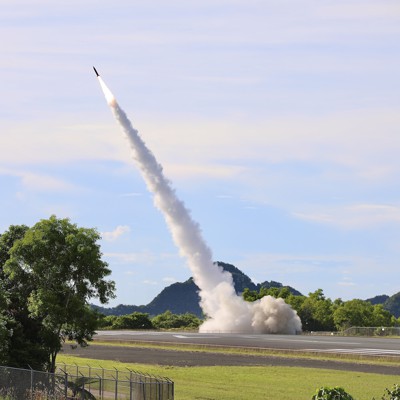
Pentagon officials report that the ground-launched Precision Strike Missile—PrSM for short—made a successful combat debut in the opening hours of the war on Iran. The new, now-proven ground-launched missile offers long-range strike capacity needed in the Middle East, to counter further Russian aggression in Eastern Europe, and to deter Chinese action in the Pacific. Washington should move quickly to replace expended PrSMs and expand the U.S. capacity to produce them.
Like the older Army Tactical Missile Systems, or ATACMS, the Precision Strike Missile is a short-range ballistic missile fired from the M142 High Mobility Artillery Rocket Systems (HIMARS) or the M270 Multiple Launch Rocket System (MLRS). PrSM has a longer range than ATACMS—longer, indeed, than the 499 km limit of the now-lapsed Intermediate-Range Nuclear Forces Treaty. And its smaller size means each HIMARS and MLRS can load twice as many PrSMs.
Ground-based systems have advantages in persistence and survivability when compared to ships in littoral waters and planes operating from well-known air bases. Tracking and targeting highly mobile vehicles on land, such as HIMARS and MLRS, is a difficult and resource-intensive task for any adversary.
PrSM played an important role in the early hours of the operation, augmenting strikes from the air and sea and appearing in Epic Fury footage released by the Pentagon on Feb. 28. Gen. Dan Caine, Joint Chiefs chairman, alluded to its use during a March 2 press briefing: “On the ground, forces fired precision standoff weapons” that were “measured, deliberate, precise, and lethal.” The next day, CENTCOM Commander Adm. Brad Cooper confirmed PrSM strikes against Iran.
PrSM is useful throughout a conflict, but is especially valuable at the onset, when it can be used to destroy adversary air defenses and command-and-control networks. That mission is typically conducted with air- or sea-launched long-range weapons to reduce the risk to U.S. assets and service members. Once those networks are degraded or destroyed, U.S. aircraft can more safely operate in adversary airspace, allowing them to strike targets with large numbers of low-cost stand-in weapons.
As the authors wrote in these pages in 2023, deploying PrSM to the Middle East makes a lot of sense. At the time, some suggested that Arab partners would not permit such strikes from their territory. The current conflict demonstrates that this is not always the case.
PrSMs fired by U.S. forces in the Arabian Peninsula can strike important targets across southern and central Iran, including air bases, military headquarters, and air defenses. That can augment strikes by air and naval assets, potentially reducing the burden on them somewhat and freeing them up for other missions.
That could prove useful as the U.S. military eyes the need to continue strikes in Iran while preparing for a potential U.S. Navy tanker escort mission in the Strait of Hormuz. PrSM’s short time between launch and impact, as well as the persistent nature of its launchers, could allow it to strike pop-up targets when air assets are not available.
The range, persistence, mobility, and survivability of PrSM also make it well-suited for deployment in the Indo-Pacific to deter China. It will be even more effective in that theatre with the arrival of PrSM Increment 2, which adds a multimode seeker that can target naval vessels at sea. The first flight test of Increment 2 took place on March 12 and reportedly met its objectives. Increment 3 is intended to add payload options, and Increment 4 seeks to extend the range even farther.
Given these growing capabilities, PrSM could also help deter further Russian aggression in Europe. Ukraine has already used ATACMS to destroy modern Russian S-400 air defense systems, and Russia has struggled to target the launchers. PrSM would present additional challenges for Russian military planners contemplating new aggression.
Despite these advantages, PrSM has so far been procured in relatively small quantities: 98 in fiscal 2024, 230 in FY 2025, and 124 in FY 2026.
Given PrSM’s now combat-proven capabilities and the clear benefits of deploying the missile to the Middle East, the Pacific, and Europe, those numbers are wildly insufficient. Hopefully, the administration will act quickly to change course and push for a dramatic increase in procurement quantities and production capacity. If it does, Congress would be wise to quickly authorize and appropriate the necessary funds.
The U.S. military faces munitions shortages because successive administrations of both parties failed to procure sufficient quantities over several decades. With current conflicts depleting American stocks and the PLA conducting a massive buildup in the Indo-Pacific, shortchanging PrSM would be penny-wise and pound-foolish.
Ryan Brobst is the deputy director of the Center on Military and Political Power (CMPP) at the Foundation for Defense of Democracies (FDD), where Bradley Bowman is the CMPP senior director.
Read the full article here
