

Reliable communication used to be the first thing you lost the moment you stepped away from the grid. Once your cell signal faded, you were effectively on your own. Starlink, and now the Starlink Mini, have changed that reality in a way that is nothing short of game-changing. In a compact, packable form factor, the Starlink Mini provides high speed, low latency internet in places that were once total dead zones. It is light enough to ride in a daypack, rugged enough to survive hard use, efficient for its output, and capable of delivering real bandwidth for calls, messages, mapping updates, and file transfer in remote country.
For hunters, overlanders, backcountry travelers, SAR professionals, and anyone with a serious outlook on preparedness, that capability offers more than simple convenience. It adds safety, flexibility, and confidence. It allows you to check in with family from deep in the backcountry, coordinate with teammates, receive updated weather information, and maintain situational awareness. Most importantly, it gives you a reliable emergency communication option when everything else fails. However, to get the most out of the Starlink Mini in remote terrain, you must solve three practical problems: how you power it, how you carry and deploy it, and how visible or detectable it is once active.
The Solution?
Over the past several months, I have spent extensive time building, refining, and field testing a Starlink Mini loadout that addresses those needs directly. The core of my system involves four highly capable components. The Star-Batt Mini serves as a long duration power solution. The Forge Concepts Starlink Mini Bag provides a compact method of carry and deployment. Covert Innovations produces camouflage and scrim options that significantly reduce the visual footprint of the dish. RELV produces a specialized hide panel that manages visual, thermal, and night vision signatures. Working together, these products transform the Starlink Mini from a clever piece of consumer technology into a truly capable off grid communications tool.

Power is the first limiting factor when operating electronic communication equipment in the field. The Starlink Mini is efficient compared to legacy satellite systems, but it still requires steady power. When you are multiple hours from the nearest outlet or intentionally planning to remain in the wilderness for extended periods, that need becomes a central part of your planning. The Star-Batt Mini is the answer I have relied on most.
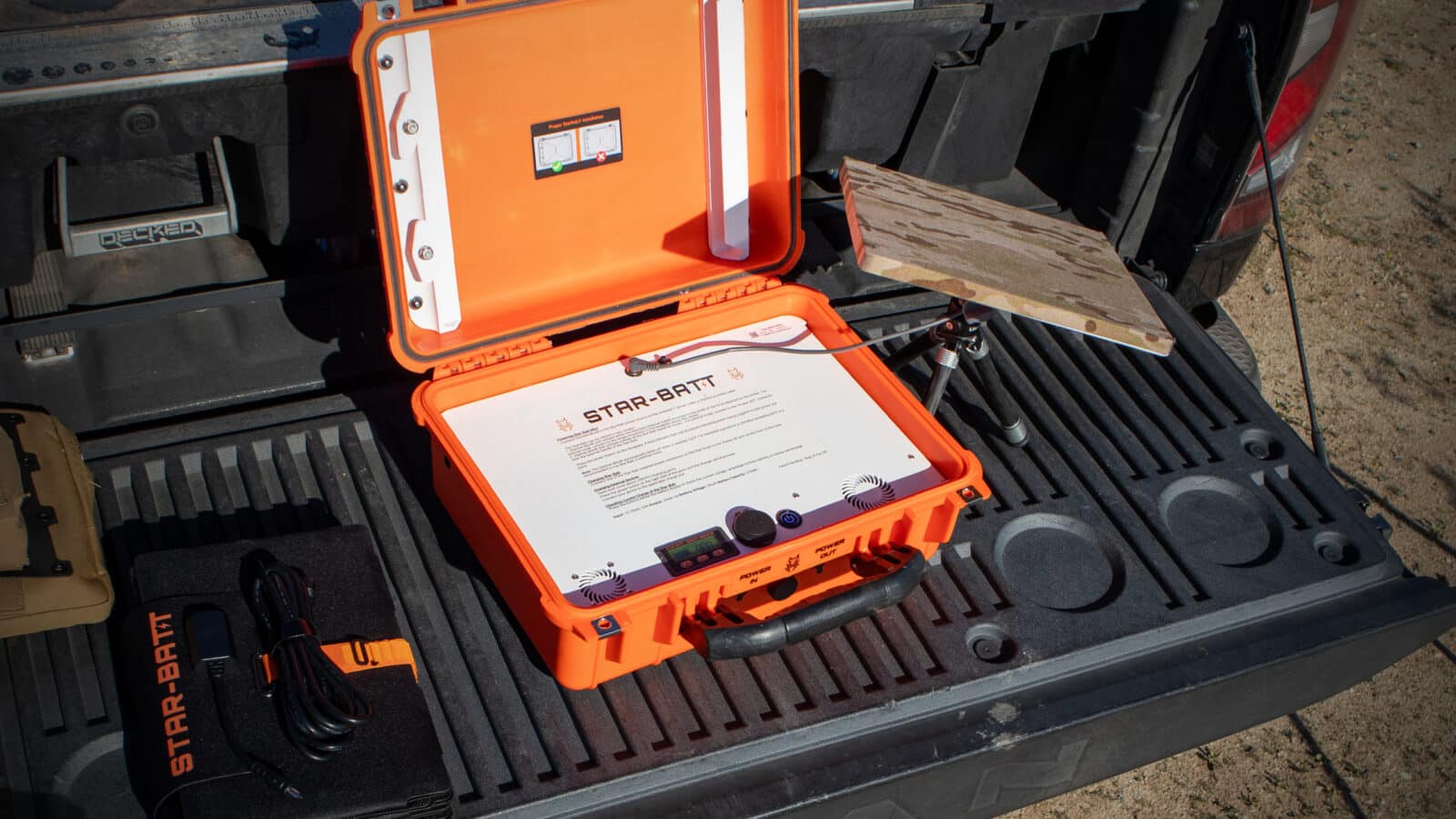
The Star-Batt Mini is a dedicated, purpose-built power system created specifically for the Starlink Mini. The heart of the system is a rugged, weatherproof hard case that houses the battery, power management components, and connection points designed for the Starlink Mini. The case is impact-resistant and designed to float if it is dropped in water, which offers meaningful peace of mind around rivers, boats, and areas where flooding is a possibility. The system can provide up to 24 hours of Starlink Mini runtime on a single charge, depending on usage and conditions. The case weighs approximately 27 lbs. and measures around seventeen by thirteen by seven inches, making it ideal for vehicle-supported trips, basecamps, or extended stays far from infrastructure.

The Star-Batt Mini’s design is centered around the Starlink Mini itself. The lid contains precision-cut slots that accept the terminal, along with rotating clamps that secure it in place. Once the dish is seated, you connect the Star-Batt power lead to the terminal, tap the backlit power button, and allow the Starlink Mini to connect normally through the app. Because the Starlink Mini transmits cleanly through the lid, it stays protected while fully operational. The case incorporates a backlit display embedded directly into the unit that provides a clear readout of remaining battery percentage along with voltage and amperage draw. The Star-Batt also features additional USB and USB-C ports that allow you to power or recharge other devices such as phones, tablets, GPS units, or cameras from the same system.
In the Field
I have used the Star-Batt Mini on multiple hunts and assignments throughout the Arizona and New Mexico border region. On a recent wilderness hunt, it became the core of our backcountry communication setup. In an area with absolutely no cellular reception, the Starlink Mini consistently provided download speeds in the ninety to one hundred twenty megabit per second range and upload speeds between forty and eighty megabits per second. That level of performance allowed for clear daily check ins, map downloads, cloud-based file management, and even FaceTime calls with family. Being able to see and speak with loved ones from a remote hunting camp is a luxury, but it is also a real safety benefit if someone becomes injured or lost.

The Star-Batt also became an essential power hub for the rest of our gear. Garmin GPS units, phones running mapping apps, and other electronics were recharged regularly without issue. Instead of juggling multiple small power banks, we had one reliable system that kept everything online. The Star-Batt effectively turned our Starlink Mini into a fully self-contained, around-the-clock communications center inside a single rugged case.
Ultimate Fuel Source
In addition to the Star-Batt Mini itself, I also incorporated the Star-Batt Solar solar charging panel array, which expands the system’s usefulness dramatically during long trips or multi-day operations. The Star-Batt Solar uses a compact 160-watt monocrystalline array designed specifically to recharge the Star-Batt efficiently in the field. It is built with durable, weather-resistant materials and folds down into a footprint that is easy to pack or secure to a vehicle, making it a practical companion for extended off-grid setups.

Live The Armory Life. The latest content straight to your inbox plus an automatic entry to each of our monthly gun giveaways!
I had the opportunity to test the solar panel on a clear day in the Arizona desert, and the results were impressive. The array was able to raise the Star-Batt’s charge by roughly two and a half to three percent in just under ten minutes of exposure. For a portable array of this size, that level of input is genuinely useful and makes continuous or repeated field charging a realistic option. With steady sunlight, you can keep your Star-Batt topped off throughout the day, which in turn keeps the Starlink Mini online without having to ration power or return to a fixed charging location. It adds a sustainable layer of capability that pairs naturally with the long-duration battery system and makes the entire package even more practical for hunts, extended expeditions, or emergency situations where conventional power is unavailable.

I later used the Star-Batt system at an archery expo in Flagstaff, where cell coverage was overloaded and unreliable. By running the Starlink Mini directly from the Star-Batt, I was able to maintain stable connectivity throughout the event and shared that connection with other vendors who needed dependable service to process card transactions and communicate with their families. The system handled the load reliably and consistently throughout the event.

Through extended use, a few practical habits emerged. I try to position the Star-Batt in shaded areas when possible, both to keep the case comfortable to handle and to support long-term battery health. The rugged housing can handle extreme weather without issue, but avoiding prolonged direct heat is a smart practice for any battery-powered system. I also found that I relied heavily on the USB-C and PD outputs. Once you have a central power station in camp, you naturally begin to support more devices from it.
On the Move
While the Star-Batt Mini excels as a basecamp solution, it is not the tool you want for rapid mobility or lightweight operations. For those scenarios, I turned to the Forge Concepts Starlink Mini Bag. The bag is a purpose-built, American-made soft case designed to protect the Starlink Mini while allowing it to operate directly from inside the bag. Whether the stand is stowed or deployed, the terminal remains usable without removing it from the protective shell.

The Forge Concepts bag includes a removable CURV impact plate and a quarter-inch high-density foam panel. Together, these layers protect the dish from rock strikes and rough handling while keeping the bag lightweight. The bag weighs approximately ten and a half ounces on its own and around three pounds five ounces with the Starlink Mini installed. This keeps the system well within a manageable range for backpack carry or mounting to a vehicle.
One of the most impressive aspects of the Forge Concepts bag is its modularity. The rear Multimount Panel allows the bag to be secured to MOLLE or PALS platforms, shoulder straps, ratchet straps, cables, and even accessories like magnets or suction cups for mounting to vehicles. The interior is lined with loop material, which gives you the freedom to add hook-backed organizers, rigid inserts, or battery retention solutions. The bag also includes a shielded cable pass-through that protects the interior from dust and weather while allowing you to run external power or data lines.

From a build quality standpoint, the bag is cleanly executed with strong stitching, quality fabrics, and a slim profile. It is water and dust-resistant and has been tested extensively by end users in harsh climates without measurable performance loss. It also provides meaningful signature reduction when the Starlink Mini operates inside it. A bright white dish becomes a muted, non-reflective surface that blends into your gear, your vehicle, or your pack far more effectively than the bare terminal.
I configured my Forge Concepts bag to function as a fully self-contained grab and go system. Inside the main compartment, the Starlink Mini remains secured and ready to deploy. I keep a USB C Starlink Mini power cable stored in the interior pocket so it is always paired with the terminal. I then attached MOLLE pouches to the rear Multimount Panel to carry a compact carbon fiber tripod, an Anker battery bank, and a Poseidon Pro portable battery from Dark Energy. This single compact bag gives me approximately six to eight hours of Starlink Mini runtime in the field, depending on load, and it deploys and packs away quickly.
Undercover
Power and portability are essential, but there is an additional concern that most civilian users do not initially consider. The Starlink Mini is highly capable, but it is also highly visible. A bright white rectangle placed in natural terrain is easy to see from the ground and from the air. The unit also produces a clear heat signature when viewed through thermal optics. In modern environments where drones, thermal cameras, and night vision equipment are increasingly common, this level of visibility can be undesirable. Covert Innovations addresses this problem directly.
Covert Innovations produces high quality vinyl and Cordura wraps for the Starlink Mini as well as a field ready scrim called the LinkScrim Mini. The wraps add both camouflage and physical protection and are available in several authentic MultiCam patterns. For my personal setup, I chose the MultiCam Arid Cordura wrap, which covers both the front and back of the Starlink Mini. MultiCam Arid is designed for desert and rocky terrain, offering a muted, earth toned pattern that blends naturally into sand and stone dominated environments.

In addition to the wrap, I installed the LinkScrim Mini. This scrim is designed to break up the recognizable geometric shape of the dish and reduce its visual and near infrared signature. It secures to the terminal using an integrated shock cord system that is fast to apply and holds firmly during use. The scrim adds lightweight, three-dimensional breakup that helps the terminal blend into natural terrain rather than standing out against it.
Beyond the products themselves, the story behind Covert Innovations is worth sharing. The founder brings years of manufacturing experience, having run an FDA-approved, ISO certified operation before starting this project from his kitchen with the help of his children. It is a family-driven business grounded in hands-on craftsmanship and problem-solving. The attention to detail shows in the final products and in the willingness to offer custom solutions when users need them.
I deployed the Starlink Mini in open desert with the MultiCam Arid wrap and LinkScrim installed and evaluated the setup from the ground and from the air using a drone. The difference was dramatic. Without camouflage, the Starlink Mini stands out clearly. With the wrap and scrim applied, the bright white color was eliminated, and the geometric outline was broken up enough that the terminal blended significantly better into its surroundings. From above, where the white dish normally appears as a sharp contrast against natural terrain, the combination of wrap and scrim made the terminal much more difficult to detect.
Deeper Cover
To further enhance concealment and create a full hide, I incorporated RELV Eclipse GEN 2 in the MOAB / MOAB OPFOR configuration. RELV Eclipse is a specialized camouflage fabric designed to reduce visual, thermal, and near infrared signatures for hide sites. The panel measures approximately 96″ by 55″ and weighs about 1.7 lbs. One side features the MOAB OPFOR pattern, which is designed for red clay and rocky desert environments. The reverse side features a touch more green and vegetation color palettes that will allow me to quickly select my color scheme depending on the surrounding scrub brush or foliage. Each panel includes a VEG PAX with ten vegetation strips that can be woven into the laser-cut openings for additional breakup.

The Eclipse panel is designed to remain quiet during setup and movement. It is engineered with controlled tear strength so that if it becomes deeply snagged in vegetation during movement, it will tear free rather than entangling the user. The panel uses leaf-shaped openings throughout its surface, which adds three-dimensional texture similar to natural foliage and allows controlled heat transfer. This approach helps the panel mimic natural thermal patterns instead of appearing as an unnatural solid block on thermal optics.
I spoke extensively with RELV founder Curt Liddle while preparing this article, and several of his design principles were immediately recognizable when working with the panel in the field. He described the guiding philosophy as “blend rather than block”. The goal is not to completely trap or contain heat but rather to disperse and shape it so the panel behaves more like its surroundings. He explained that the material functions somewhat like a heat sink, helping dissipate heat rather than transmitting a hot spot. He also emphasized proper fieldcraft, advising users to keep the material off direct heat sources, to avoid pulling it tight, and to let it drape naturally so it takes on the irregular shapes and shadows present in natural terrain.
I quickly built a simple blind in the desert using the Eclipse panel next to a patch of scrub brush. I draped the panel loosely, wove several Veg Pax strips into the cutouts, and dressed the base with rocks and deadfall to create a natural transition to the terrain. From ground level at distances between twenty five and fifty yards, the blind blended very well into the surrounding vegetation once the base was set. From the air, the Eclipse panel disrupted the shape and tone of the hide convincingly, creating an organic, irregular pattern rather than a uniform block of color.

Inside the blind, the Eclipse fabric performed as advertised. I had a clear view through the material and was able to focus a camera through it without obstruction. The same principle would apply to binoculars, spotting scopes, or rifle optics. You remain concealed while retaining visual and thermal control over your position.
To evaluate the thermal impact, I viewed the Starlink Mini through a Shinenyx AIM 101 thermal and digital night vision optic. Running bare, the Starlink Mini presents a bright hot spot even in relatively warm ambient conditions. Once concealed behind the Eclipse panel, with the fabric kept off the surface of the unit, the thermal signature was significantly reduced from my observation point. The improvement was immediate and substantial.
At this stage in my testing, one more component proved valuable when working with the Eclipse system. The Starlink Mini produces a considerable amount of heat during operation, and placing the Eclipse fabric directly against the terminal can allow that heat to transfer through and appear as a concentrated hot spot. To prevent that, I incorporated the Starlink Mini Cage. The Cage creates a lightweight frame that keeps the Eclipse panel suspended off the dish, which allows the fabric to disperse heat naturally and perform the way RELV intended. It weighs only a few ounces, breaks down into a compact bundle that stows easily on MOLLE or in a pack, and assembles quickly even in low light. It did not interfere with connectivity during my testing, and when combined with the Eclipse panel, it helped minimize visual, thermal, and near infrared exposure much more effectively than fabric alone.
Conclusion
After months of field use, what stands out most to me is how well these products work in combination. The Star-Batt Mini provides a reliable 24-hour power source in a floating, weatherproof case. The Forge Concepts bag gives you a lightweight, grab-and-go deployment method that supports smaller batteries and rapid mobility. Covert Innovations wraps and scrim reduce the visual and near infrared impact of the dish itself. RELV Eclipse enables you to construct a hide that functions across visual, thermal, and night vision environments while allowing you to see and work through the material. The Cage ensures that the Eclipse fabric can do this effectively by preventing unwanted heat transfer.
This creates a flexible and scalable communication package. For a single-day hunt or a short trip, the Forge Concepts bag and a compact power bank are all you need for several hours of reliable internet access. For longer trips or vehicle-supported operations, the Star-Batt serves as a dependable power station. In situations where concealment is important, the Covert Innovations, RELV, and Cage components significantly reduce how visible or vulnerable your communication setup becomes.
For me, the value of this system goes well beyond convenience. It provides peace of mind. It ensures that I can speak to my family from nearly anywhere, that I can send accurate location data in an emergency, and that I am not fully dependent on unreliable or overloaded cellular networks. The combination of rugged power systems, practical load carriage, and well-designed signature management tools has earned a permanent place in my off-grid gear.
Editor’s Note: Please be sure to check out The Armory Life Forum, where you can comment about our daily articles, as well as just talk guns and gear. Click the “Go To Forum Thread” link below to jump in!
Read the full article here
