

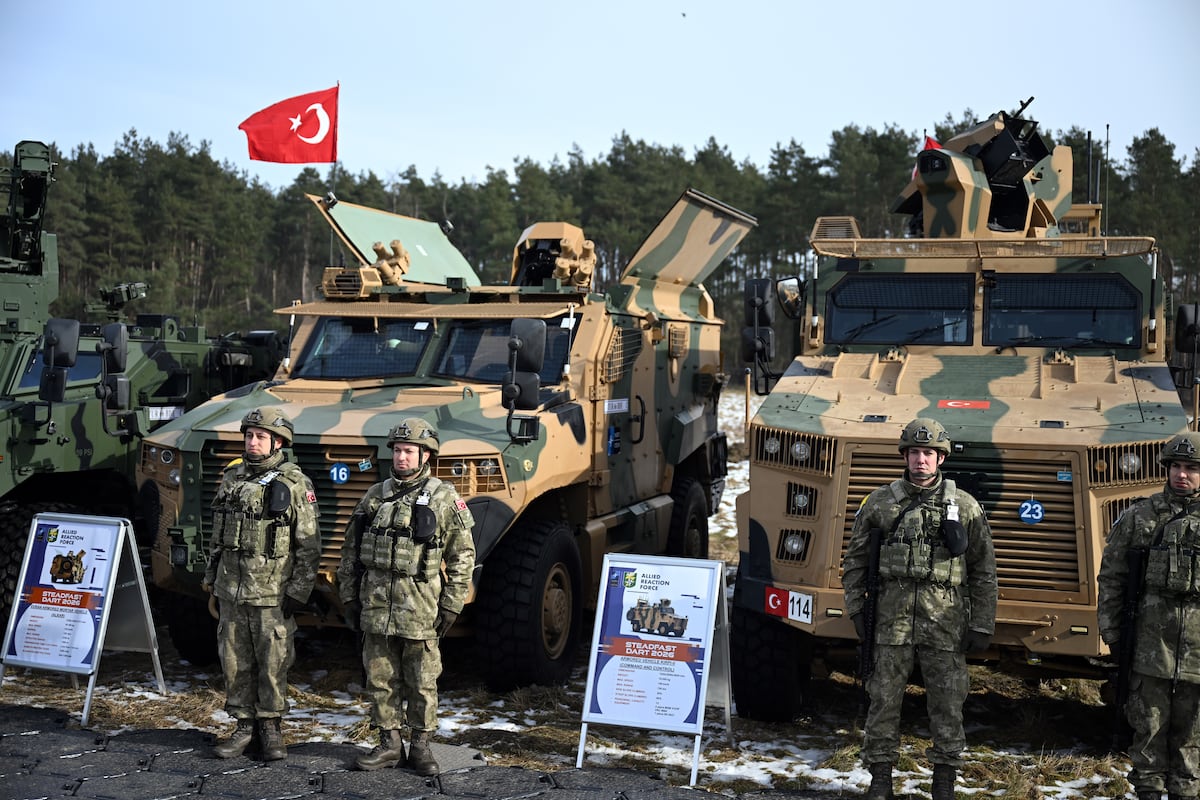
ISTANBUL — As the United States under President Donald Trump rethinks its security guarantees to Europe, Turkey is making the case for closer integration into the continent’s defense architecture.
Speaking at a conference marking the 74th anniversary of Turkey’s entry to NATO, Defense Minister Yaşar Güler criticized the European Union’s reluctance to fully open its defense initiatives to Ankara.
Turkey is a member of NATO but not the EU, which means two sets of rules govern — and in many cases limit — cooperation with members of the bloc.
“Otherwise, we assess that such an approach by the European Union would cause more harm to Europe’s security and resilience than the reduction of U.S. forces in Europe,” Güler said, voicing Ankara’s clearest warnings yet against EU defense initiatives that marginalize non-member allies such as Turkey.
“Turkey is no longer a flank country on NATO’s southeastern periphery,” Güler said April 9 at a conference organized by the Presidency of Communications and the SETA Foundation. “It is a central ally capable of generating security across the entire European theater.”
Güler’s remarks, delivered ahead of the 2026 NATO Summit in Ankara this summer, offer a window into Turkey’s proclaimed place within the alliance as well as Ankara’s assessment of a rapidly transforming international security landscape.
He announced that Turkey will assume command of NATO’s Allied Reaction Force from 2028 to 2030.
“Turkey has become one of the few NATO allies capable of contributing across multiple operational domains with meaningful scale,” said Serhat Güvenç, a professor of international relations at Kadir Has University in Istanbul.
He noted that countries on NATO’s eastern flank including Poland, Romania, the Baltic states and Nordic allies, increasingly recognize Turkey’s value, as Europe seeks to bolster deterrence against Russia while managing instability to its south.
Ankara argues it can offer Europe a large standing military, extensive combat experience, strategic geography bridging Europe and the Middle East, and a defense industrial base capable of rapidly producing drones, munitions, armored vehicles and naval platforms.
As Turkey itself faces an increasingly complex threat environment, the government’s focus on Europe is not driven solely by a desire for recognition or influence. In Ankara’s view, a weakened NATO or fragmented European defense posture could leave Turkey more strategically exposed at a time of rising regional instability.
Retired Brig. Gen. Hüseyin Fazla, president of the Ankara-based think tank STRASAM and a former Air Force pilot, said Turkey’s operational contributions and industrial capacity have strengthened its case for deeper integration into European defense planning.
“In recent years, the ground Turkey has covered in its defense industry is compelling European capitals to cooperate with Ankara,” he said. Military-tech contributions flowing through the alliance’s formal defense planning processes have been prominent enough to be recognized by top NATO commanders, he added.
However, Turkey’s defense integration via EU channels faces significant political obstacles.
For example, the bloc’s PESCO framework and the multibillion-dollar European Defence Fund operate on unanimity, giving Greece and the Greek Cypriot Administration a veto over Turkish participation.
Turkey applied to join the Military Mobility project, one of PESCO’s more operationally focused initiatives. The application stalled due to objections from Athens and Nicosia.
“Greece and Cyprus view Turkey’s integration into EU defense architecture not as a contribution to their own security, but as the collapse of their strategy for balancing Turkey within the EU,” said Fazla. “For them, one of the implicit purposes of EU defense cooperation is already to provide deterrence against Turkey in the Eastern Mediterranean.”
The second barrier is political culture, as much of Western Europe — particularly France and Germany — remains resistant to formally acknowledging Turkey as a central strategic partner, Fazla said.
“For Western Europe and the Brussels bureaucracy, Turkey is seen not as an organic member of the European family, but as a vital geopolitical actor that needs to be managed, balanced, and cooperated with, when necessary,” he told Defense News.
“There is an irrationality here,” said Güvenç. “Part of Europe refuses to set aside its cultural and civilizational objections even when a matter like collective security is at stake. Even if such a risk exists — and it does — they appear willing to take it rather than engage Turkey on its own terms.”
Countries on Europe’s eastern flank — like the Baltics, Poland, Romania and Bulgaria — that most acutely feel a Russian threat tend to view Turkey’s military and industrial capacity as vital, he noted.
Then, there is the Russia question.
While Turkey keeps its political and economic ties with Moscow open and maintains bilateral relations, Ankara also needs NATO’s defensive umbrella and contributes to the development of plans aimed at containing Russian military adventurism, according to Güvenç.
“This is not cynicism,” he said, but the behavior of a country managing a genuinely exposed position.
To Turkey’s southeast, Iran’s expanding ballistic missile capabilities represent a direct threat that Ankara has been careful not to acknowledge publicly even during the U.S. and Israeli-led Operation Epic Fury.
The Kürecik radar installation in central Turkey provides ballistic missile early warning coverage significantly deeper than Romania-based alternatives, said Fazla.
“Without Kürecik, European ballistic missile defense against Iranian missiles would start from Romania,” Fazla noted. “Starting from Turkey provides substantially earlier warning and interception opportunity. No European country can simply substitute for that.”
Growing tensions with Israel and increasingly hostile rhetoric from some senior Israeli officials have also factored into Turkish security planning.
“Turkey understands that as a member of NATO with an Article 5 commitment, its deterrence is far stronger than anything Turkey could achieve alone,” Güvenç said, referring to the alliance’s mutual-defense clause.
He added that the approximately 50 American nuclear weapons said to be stored at Incirlik Air Base function as a concrete security guarantee — making Turkey an extremely difficult target for any actor.
Güler, the defense minister, said he hopes for something of a foundational pledge to that end from the Ankara gathering of alliance leaders.
“In order for the future NATO to be able to provide a multi-dimensional security ecosystem, our expectation from the Ankara Summit is, first and foremost, that allies reaffirm their commitment to Article 5,” he said.
For Ankara, the strategic logic is straightforward: if Europe is preparing for a future with less American support, then both Europe and Turkey will need each other more.
Cem Devrim Yaylali is a Turkey correspondent for Defense News. He is a keen photographer of military ships and has a passion for writing about naval and defense issues. He was born in Paris, France, and resides in Istanbul, Turkey. He is married with one son.
Read the full article here
