

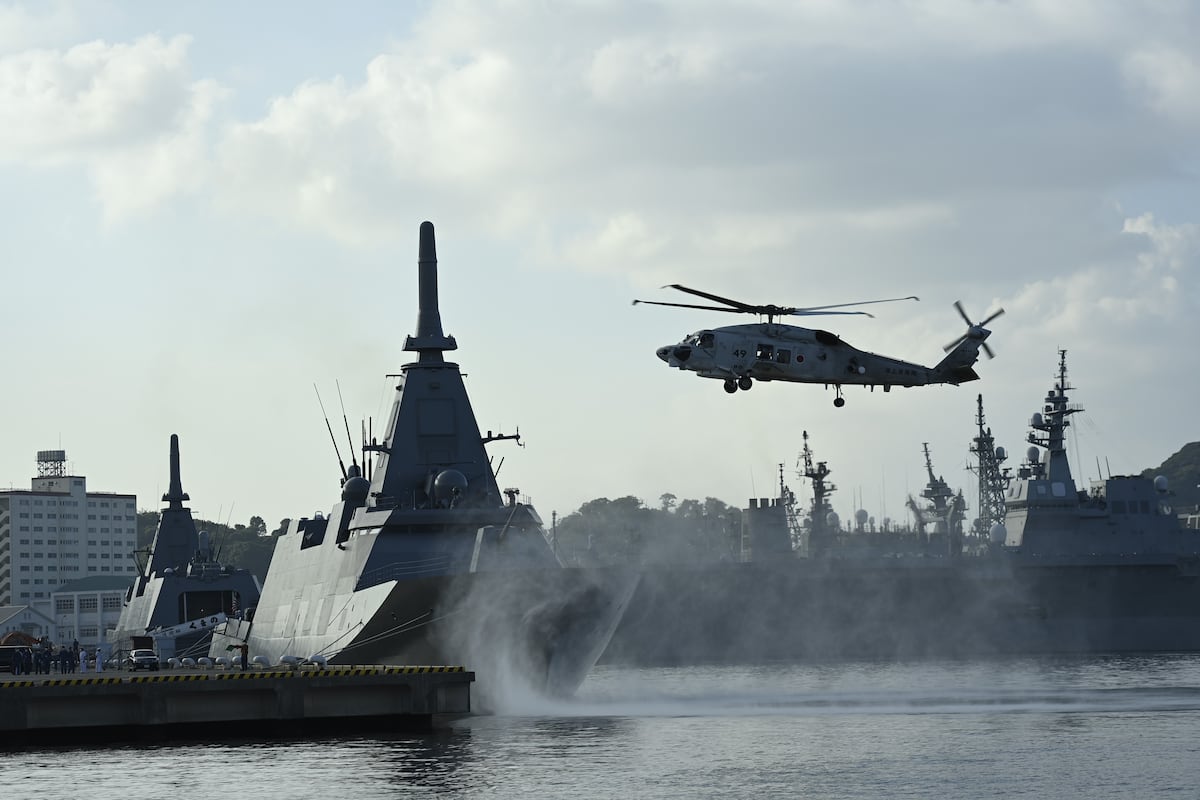
MANILA, Philippines — Australia has moved to reverse a decline in the number of warships, as its surface combatant fleet stands to fall to its smallest size since World War II.
Under Project Sea 3000, Australia and Japan inked a deal to buy three upgraded Mogami-class frigates for the Royal Australian Navy (RAN). The contract was signed by the two countries’ defense ministers aboard JS Kumano in Melbourne earlier this month.
This represents Japan’s largest-ever defense export, a major boost to its shipbuilding industry, and it advances greater strategic alignment between the two countries.
Mitsubishi Heavy Industries (MHI) will construct three 4,800-ton frigates in Japan, with the first to be delivered by December 2029.
Another eight frigates will subsequently be built in Western Australia. This shipbuilding effort is slated to cost up to A$20 billion (US$14.4 billion) over the next decade, double the amount indicated two years ago.
Minister for Defence Industry Pat Conroy stated: “This is the fastest acquisition for the Royal Australian Navy in peacetime. We’re working closely with Japanese and Australian industry partners as we acquire one of the most, if not the most, advanced general-purpose frigate in the world.”
Speaking to Defense News, Rear Admiral Stephen Hughes, the RAN’s Head of Naval Capability, said: “It’s going to be a game-changer from a capability perspective. The reality is that Mogami is going to allow us to jump a generation in technology in a ship,” not only in its combat system, but how the RAN operates and crews these highly automated ships.
Subcontracts are already being awarded, including Japanese company NEC – for nine types of equipment such as sonars and UNICORN integrated masts – and Rolls-Royce for MT30 gas turbines.
These frigates are desperately needed, since the RAN presently has just ten surface combatants – three Hobart-class destroyers and seven Anzac-class frigates. The latter will be replaced by the upgraded Mogami.
Hughes rejected the notion that the navy’s capability is currently declining. “I think what you’re managing is a transition from a current force which has a certain amount of capability, to a different force with greater capability, different opportunities. And I don’t believe you count the number of ships. It’s about the capability.”
Hughes described the upgraded Mogami as larger and far more capable than the Anzac class, plus they will offer greater availability of 300 days at sea annually.
Their armaments include ESSM Block 2 surface-to-air missiles in a 32-cell Mk 41 vertical-launch system, deck-mounted Naval Strike Missiles, MK 54 lightweight torpedoes and a SeaRAM.
Otherwise, these frigates will boast Japanese systems and sensors such as the combat management system, sonar and UNICORN mast.
Hughes explained the aim is to have as few Australianized changes as possible, because that “would delay the delivery of the ship.”
He added, “We’ve actually picked the best ship with the most compatible capability for the Australian navy’s use.”
Ultimately, Australia and Japan will end up operating a combined fleet of 35 Mogami frigates.
Gordon Arthur is an Asia correspondent for Defense News. After a 20-year stint working in Hong Kong, he now resides in New Zealand. He has attended military exercises and defense exhibitions in about 20 countries around the Asia-Pacific region.
Read the full article here
