

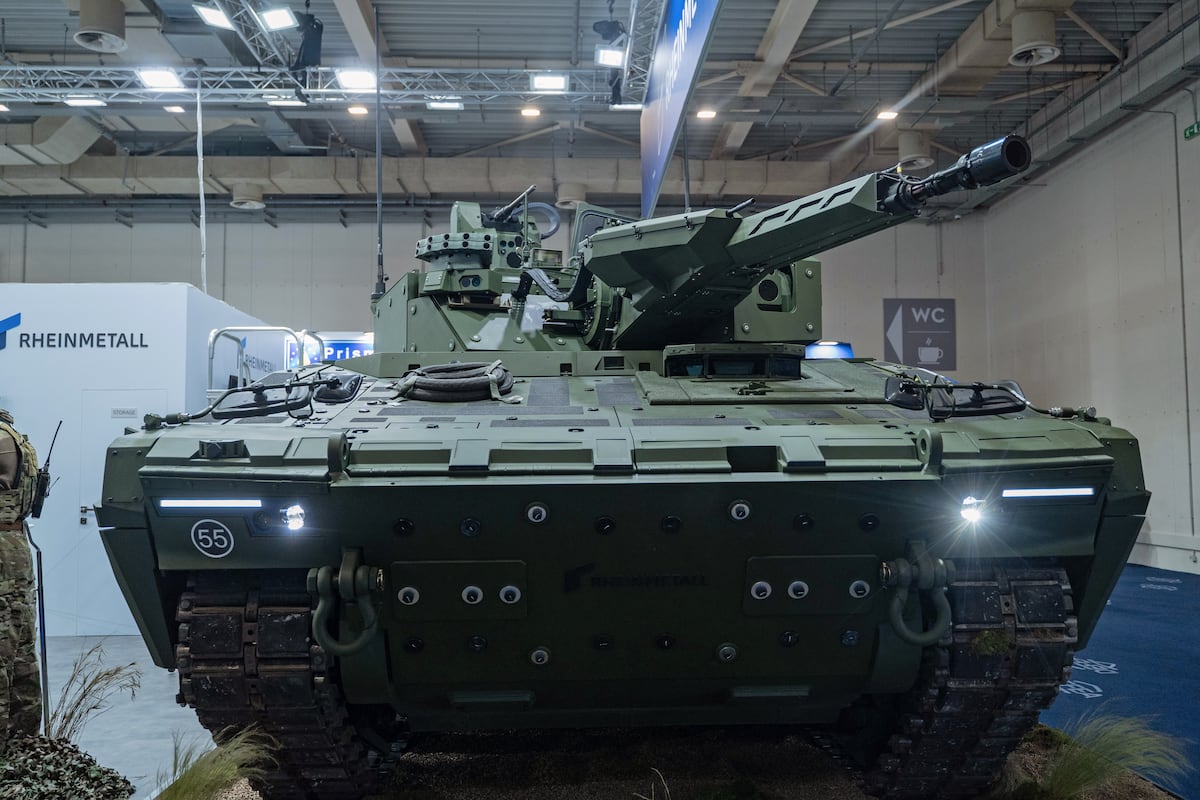
WARSAW, Poland — The Romanian Ministry of National Defence has selected Rheinmetall’s Lynx KF41 infantry fighting vehicle to replace the military’s outdated Soviet-times MLI-84 tracked vehicle. The planned acquisition is estimated to be worth around €3.4 billion (US$4 billion).
The IFV procurement was included on the list of projects that Bucharest aims to finance with the use of the European Union’s Security Action For Europe (SAFE) loans. On April 29, the national defense ministry submitted the list to the Romanian parliament for its approval, a spokesperson for the ministry told Defense News.
The EU has made available to Romania around €16.7 billion in low-cost loans which potentially makes the country the second-largest beneficiary of the program, preceded only by Poland which was allocated roughly €44 billion. In addition to the tracked vehicle purchase, other military procurements that Romania seeks to finance with SAFE-backed loans include acquisitions of new helicopters, wheeled armored vehicles, air-defense systems, vessels, unmanned systems, as well as personal weapons and ammunition, among others.
The IFV purchase is scheduled to be carried out in stages and completed in 2030, according to the ministry representative.
“Under this initiative, 232 infantry fighting vehicles will be financed via the SAFE mechanism and produced by Rheinmetall at its Romanian facility in Mediaș. The remaining units, bringing the total to 298, will be covered through alternative funding sources. This program aims to equip the land forces with a total of 298 units,” the spokesperson said.
To strengthen its foothold in the Romanian market, Rheinmetall purchased a majority stake in local military vehicle maker Automecanica Mediaș in 2024.
The spokesperson said that the acquisition program will necessitate a considerable level of participation of Romania’s defense sector which is to cooperate with Rheinmetall.
“It should be noted that the new procurement contracts will ensure the significant involvement of the national defense industry and will be finalized through negotiations with both domestic and European defense operators,” according to the ministry representative. “The selection process for these economic operators is currently underway at both the Ministry of National Defence and governmental level.”
Romania made its choice between a number of vehicles pitched by producers who are competing for a rising number of IFV orders in this part of Europe. In addition to the Lynx, these are said to include the CV90 made by BAE Systems Hägglunds in Sweden, the AS21 Redback offered by South Korea’s Hanwha, and the Ascod by General Dynamics European Land Systems. A committee comprising national defense ministry officials and representatives of state-owned defense company Romtehnica was tasked with picking the winner.
In July 2025, as the Romanian government kicked off the acquisition program, the country’s authorities said that, after an initial batch of vehicles is manufactured by the selected producer, the nation’s state-dominated defense industry would take over production activities and make the remaining IFVs.
Bucharest’s objective is “to protect the supply chain through a technology transfer of the assembly, integration, testing and maintenance capabilities for the aforementioned technology and products to Romania,” the ministry said in a statement.
Owing to the latest development, Romania is set to become another Lynx user on NATO’s eastern flank, joining Hungary which, in 2020, became the vehicle’s first-ever taker with an order for 218 units. As part of the procurement, in August 2023, Rheinmetall opened a new factory in Zalaegerszeg, Hungary, to accommodate the vehicle’s production.
In January 2026, Rheinmetall announced that Germany will bankroll the delivery of five Lynx vehicles to Ukraine, marking the country’s accession to what the producer brands as a larger-scale procurement program for the next-generation IFV. In the long term, the tracked vehicle is to be made in Ukraine, according to the company.
“The decision in favor of the Lynx KF41 was made after extensive testing of the next-generation infantry fighting vehicle (IFV). The IFVs will feature the two-man Lance turret and be configured specifically for … Ukraine’s armed forces. The next step is to procure additional batches, including production in Ukraine,” the German group said in a statement.
Also last January, the Italian military obtained a batch of four Lynx IFVs, the first in a large-scale, planned order covering 1,050 units under which Italian group Leonardo is joining forces with Rheinmetall.
Jaroslaw Adamowski is the Poland correspondent for Defense News.
Read the full article here
