

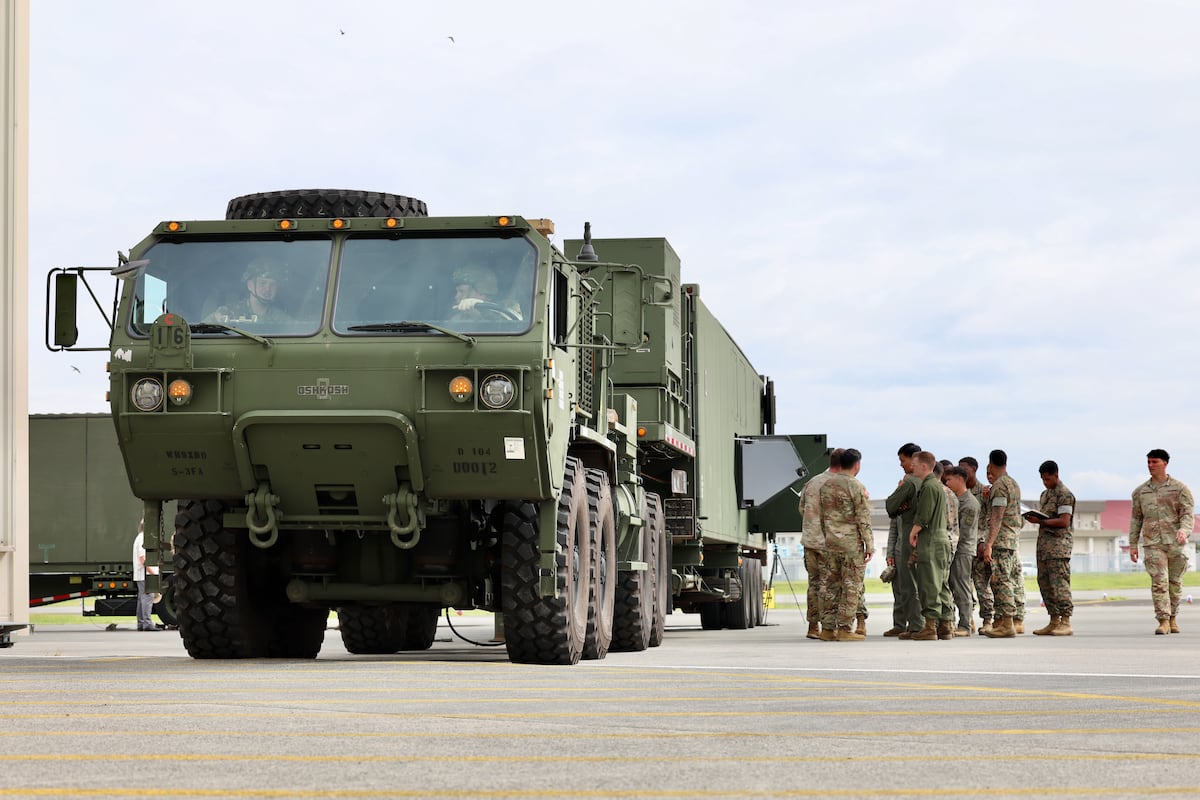
VIENNA — Germany’s ambitions to close a long-range strike capability gap are facing a fresh setback after the Trump administration moved to withdraw thousands of U.S. troops from German soil and effectively shelved a Biden-era plan to temporarily deploy Tomahawk cruise missiles and SM-6 missiles there.
Defense Minister Boris Pistorius, speaking Monday in Munster, Germany, after a major Bundeswehr combined-arms exercise, said the reported decision meant Germany would be left with a capability gap.
“That was an agreement between Joe Biden and Chancellor Olaf Scholz at the time − as a temporary bridge, until we as Europeans had developed our own systems,” Pistorius told reporters, referring to the former U.S. and German leaders “That this may now not happen in the way we had assumed tears this capability gap open again. We have to look at how we can compensate for that.”
“There are ideas, but no solution yet,” said the defense minister.
The Biden administration announced in July 2024 that it would temporarily station a Multi-Domain Task Force in Germany equipped with the Typhon ground-launched system, which can fire Tomahawk cruise missiles and SM-6 interceptors, in what officials described as a bridging measure ahead of European alternatives coming online.
That plan is now in doubt following fresh reports that the Trump administration intends to withdraw approximately 5,000 U.S. troops from Germany, with President Donald Trump suggesting the actual figure could be significantly higher.
At the government’s regular press conference on Monday in Berlin, Defense Ministry state secretary Kornelius Müller laid out Berlin’s three-pronged response to fielding a long-range missile capability.
The first thrust involves modernizing existing Taurus cruise missile stocks and accelerating development of the Taurus Neo successor, a program approved by the Bundestag’s budget committee in late 2025. The second pillar − the purchase of market-available systems, with a formal Letter of Request for Typhon launchers submitted to U.S. Defense Secretary Pete Hegseth last July − remains officially “in process,” though Müller declined to say whether Washington had responded to the ask.
The third pillar is the European Long-Range Strike Approach, or ELSA, a joint program with the United Kingdom under which Berlin and London are co-developing strike capabilities beyond 2,000 kilometers range, with France recently signaling its intention to join.
The timeline, however, remains uncertain. When pressed on whether ELSA-derived capabilities would be ready before 2030, Müller declined to commit to any date. “I cannot say anything about a timeline,” he told reporters, citing dependence on industrial availability and technology development.
In Munster, Pistorius pointed to the ongoing European effort. “We began in 2023, together with the British, and now the French want to join, to develop the precision-strike systems ourselves as Europeans − as fast as possible,” he said. “At the same time, we need an instrument − with U.S. help or via other paths − to close the capability gap in that bridging period as quickly as possible.”
The admission underscores how dependent Germany’s defense planning remains on American cooperation at a moment when that bond is increasingly uncertain. It also suggests that both of Berlin’s planning scenarios for obtaining Typhon launchers – by way of a U.S. Army formation stationed in Germany, or through a Bundeswehr purchase for use by national forces – are now deemed dead ends.
Müller sought to downplay the operational implications, insisting that NATO’s defense plans account for capability contributions across allied nations and that no gap would emerge at the alliance level. “It is not Germany’s deep-precision-strike capabilities alone on which the deterrence and defense capability of Europe hangs,” he said.
Pistorius has previously warned, including as far back as 2023, that European NATO members would need to adapt to a reduced U.S. footprint on the continent as Washington pivots toward the Indo-Pacific.
Linus Höller is Defense News’ Europe correspondent and OSINT investigator. He reports on the arms deals, sanctions, and geopolitics shaping Europe and the world. He holds master’s degrees in WMD nonproliferation, terrorism studies, and international relations, and works in four languages: English, German, Russian, and Spanish.
Read the full article here
