

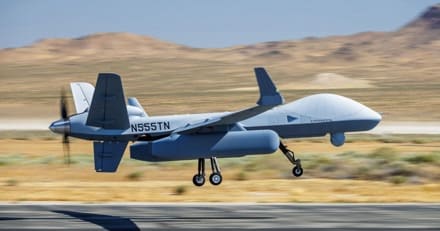
SAN DIEGO – 21 May 2026 – General Atomics Aeronautical Systems, Inc. (GA-ASI) flew its MQ-9B Remotely Piloted Aircraft for the first time with Airborne Early Warning (AEW) pods. The much-anticipated AEW capability is being provided through a partnership with Saab. Once the AEW sensor, named LoyalEye, is made available to MQ-9B operators and new customers, it will deliver persistent and cost-effective air surveillance capabilities in regions where it is currently unavailable.
GA-ASI conducted a validation flight of MQ-9B using AEW radar pods on May 19 from GA-ASI’s Desert Horizon flight operations facility in Southern California using a company-owned aircraft. The flight signaled the first step in a development process that is expected to take several months and culminate with a full-capability demonstration later this year.
GA-ASI and Saab announced their partnership last year with the intention of bringing AEW capability to the MQ-9B platform.
MQ-9B models include the SkyGuardian®and SeaGuardian®, the United Kingdom’s MQ-9B variant known as Protector, and the new MQ-9B STOL (Short Takeoff and Landing) configuration currently in development for naval aircraft carriers.
“AEW for MQ-9B will offer critical aloft sensing to defend against tactical air munitions, guided missiles, drones, fighter and bomber aircraft, and other threats. Operational availability for a medium-altitude, long-endurance UAS is the highest of any military aircraft, and as an unmanned platform, its aircrews are not put into harm’s way,” said GA-ASI President David R. Alexander.
“This partnership integrates MQ-9B with LoyalEye, equipping operators with vital information for critical decision-making. LoyalEye extends the capabilities of manned systems, and it offers persistent surveillance and greater operational flexibility. This enhances situational awareness and boosts mission success,” said Carl-Johan Bergholm, Senior Vice President and Head of Business Area Surveillance at Saab.
GA-ASI and Saab’s AEW offering will span a wide range of applications, including early detection and warning, long-range detection and tracking, and simultaneous target tracking and flexible system integration, all over line-of-sight and SATCOM connectivity.
Both comments and pings are currently closed.
Read the full article here
