

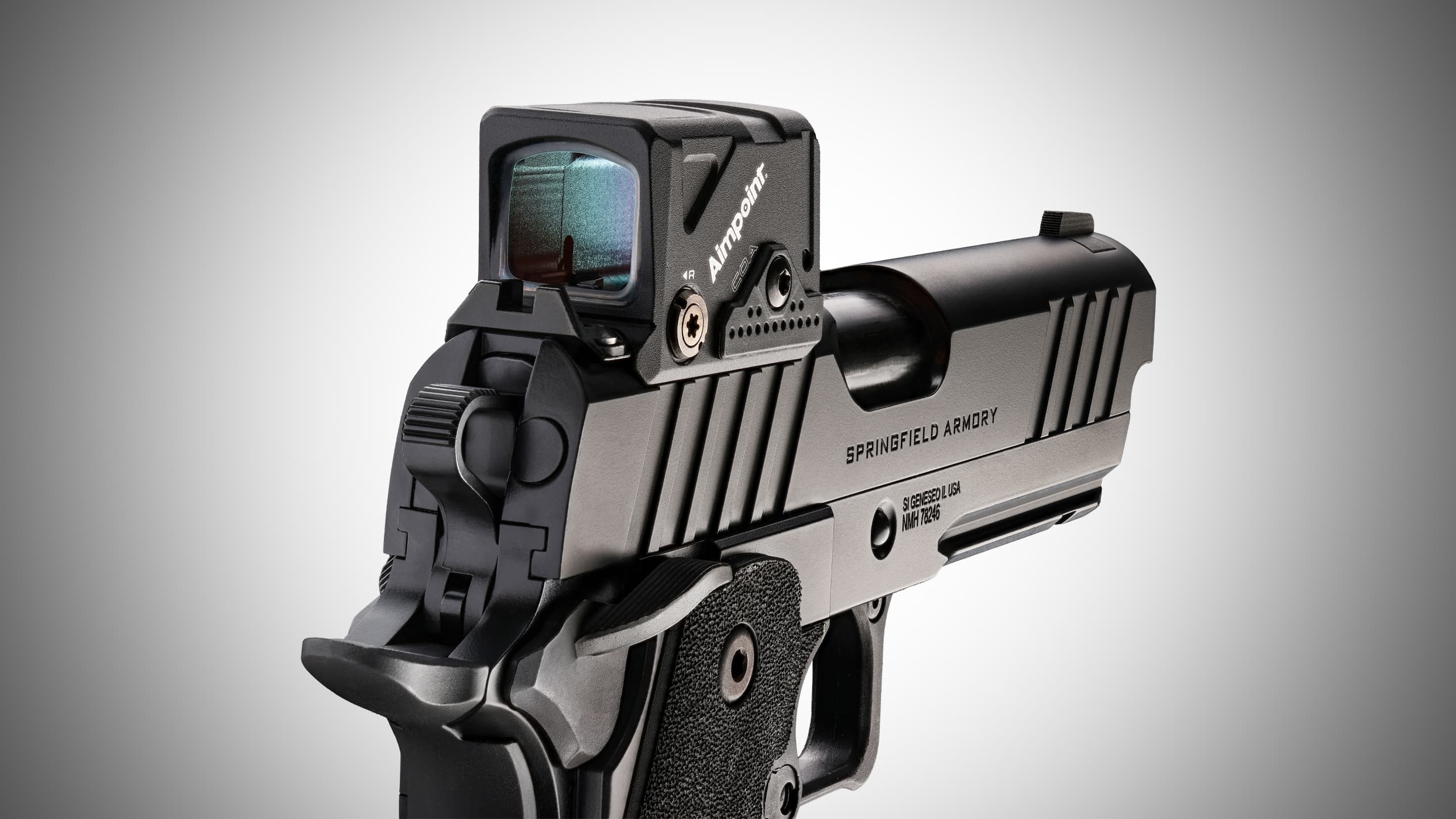
Aimpoint’s COA, an enclosed-emitter red-dot pistol sight, has been the hottest and most exclusive pistol accessory of the past two years. Springfield Armory is in a great position when it comes to dedicated A-CUT integrations (more on that in a moment), first introducing COA-equipped Echelons and now expanding to 1911 Operators and TRP pistols as well as 1911 DS Prodigy pistols. Spoiler alert: These may be the best pairings yet.
COA Competencies
Aimpoint built its reputation producing some of the most durable combat optics in the world, and much of that design philosophy has been carried into the company’s pistol-mounted red-dot sights. Take one look at the company’s pioneering ACRO family of enclosed-emitter, cross-slot-mounted pistol optics and you’ll realize the “tactical toaster” is an example of form following function. Reliable and robust? Absolutely. Compact and concealable? Less so.

The COA is a clear evolution. It retains the best features of the ACRO, particularly durability thanks to its impact-resistant 7075-T6 aluminum construction and a 15x15mm lens. Too, the enclosed-emitter design reduces the chance of environmental interference compromising the sight picture. The optic’s reticle-emitting LED is encased by its aluminum housing and sealed lenses, fore and aft, to protect the electronics from water, dirt and debris.
Unlike the ACRO, however, the COA strikes a significantly trimmer profile. It’s still suitable for duty use, but intended to captivate the concealed carry audience, as well.

Surprisingly, the leaner design did not necessitate a smaller ocular or objective windows — the lenses for the COA and the ACRO are nearly identical. However, because its housing is significantly smaller, the COA’s lenses “feel” larger than the ACRO’s.
Enclosed optics naturally draw the eye into the “tunnel,” and the 15x15mm aperture provides ample real estate for the 3.5 MOA reticle. Together, the elements don’t feel undersized — they feel proportional and streamlined, which can be a very difficult balance for hard-use equipment to achieve.
Fitting Choices
With the COA, Aimpoint has continued to rebel against the common plate-and-screw optic mounting systems so prevalent with handguns. Its solution is a direct-mounting system, as low in the slide as possible, to provide the surest set-up.
The ACRO addressed mounting with a clamp and cross-slot lug very similar to the Picatinny rail mounts used by its rifle sights. The COA goes a step further with the A-CUT, a specialized slide cut that creates a “hook” to bite the optic’s front edge; a full-length dovetail — a shallow, elongated lug running front to back — to stabilize the sight against lateral forces; and a rear, screw-down wedge rear sight unit to lock the optic in place. The system minimizes unnecessary interfaces and improves the security of the mount for long-term reliability.

In terms of controls, the COA is exceptionally intuitive and well-designed. Two diagonally stacked, rubberized buttons, “+” and “-”, on the left-side of the housing cycle the reticle through its 12 brightness settings — eight daylight and four night-vision compatible. The legend around the buttons clearly reads “Increase”, “Decrease”, and “Hold [to turn] Off”.
Also on the left side is the elevation adjustment screw, clearly marked to indicate counterclockwise rotation will adjust the reticle upward. The windage screw — counterclockwise to adjust right — is on the right side of the housing along with the battery tray. Yes, that battery tray gives you access to the battery without having to remove the optic. Nice.

Live The Armory Life. The latest content straight to your inbox plus an automatic entry to each of our monthly gun giveaways!
One of my favorite features of the COA is that the adjustment dials, the battery housing and even the mounting wedge all use T10 Torx pattern screws, meaning only one tool is required for maintenance of the optic. Also, it’s an exceptionally common wrench or driver bit. Again, nice.
In use, the windage and elevation adjustments are clearly audible and tactile, and translate to approximately 1 MOA per click. The battery tray contains a single CR2032 battery good for around 50,000 hours of use, depending on the brightness setting.
Overall, the Aimpoint COA is a robust, yet very refined, pistol optic.
Single-Action Options
As mentioned, the COA is coming to several of Springfield’s single-action platforms, including TRP and Operator 1911 models, as well as the 1911 DS Prodigy. The TRP is a black 5” railed model in .45, and the Operator is the same. The 9mm Prodigy is a 4.25” model.

For this review, I received the Prodigy 4.25” COA pistol. The 1911 DS Prodigy line has already earned attention for combining the crisp trigger characteristics and natural ergonomics of John Browning’s classic design with modern capacity, optics-ready capability and accessory compatibility.
In all three offerings, Springfield pairs the pistol with Aimpoint’s COA to create a defensive handgun package that feels purpose-built for modern carry and duty applications. In the case of the 1911 DS Prodigy 4.25” COA 9mm I was trying out, capacity also remains one of the strongest selling points for the platform. The COA model Prodigy ships with two Mec-Gar 18-round magazines.

At first glance, the pistol retains the familiar visual profile shooters expect from the Prodigy line. The forged steel slide and frame maintain the pistol’s solid feel, while the polymer grip module helps reduce the overall weight. The 4.25” bull barrel configuration continues to be a favorite of mine for both its shorter, lighter dimensions, and — in my opinion — the best balance in hand during rapid strings of fire of all the Prodigy models.
The most significant change for the new model, of course, is the inclusion of Aimpoint’s A-CUT to the Prodigy’s slide, and the factory-mounted optic itself.
Browning-inspired 1911-style firearms have been notoriously difficult when it comes to mounting modern optical sights. Their narrow slides, which commend the platforms emphatically for concealed carry, simply don’t offer enough width for full-size red-dot sights. Even many compact optics end up overhanging the edges a bit. Too, due to necessary plates and screws, the sights may sit high up on the slide, precariously clinging on, and requiring comically tall iron sights to achieve co-witness.
Springfield Armory largely solved these issues in partnership with Agency Arms when it introduced the Agency Optic System (or “AOS”) mounting system for its 1911 and 1911 DS Prodigy pistols. I’m willing to wager, though, that no optic has been so well-sited on a 1911 slide as the Aimpoint COA.

The A-CUT mounting interface allows the COA to sit significantly lower in the slide than many plate-mounted systems. For evidence, note the wedge’s integrated square-notch rear sight and the slide’s small, black front sight. These irons are lower than most modern, production 1911 sights, and yet they co-witness flawlessly through the COA.
The lower mounting configuration is noticeable the moment the pistol comes up on target. Presentation feels natural, the optic window appears faster during the draw stroke, and transitions between targets require less visual adjustment. Shooters moving from iron sights will appreciate how closely the optic tracks with the pistol’s natural pointability.
The arrangement also matters for recoil management. The closer an optic sits to the bore line, the less visual disruption shooters experience during recoil impulse. Instead of the optic appearing to bounce excessively above the slide, the sight picture tracks flatter and returns predictably.
Potent Pairing
On the range, the Prodigy 4.25” COA continues to reinforce why the double-stack 1911 category has become so popular. The trigger remains one of the pistol’s greatest strengths, with my test sample exhibiting a clean 5-lb. break as measured by a Lyman digital trigger gauge.
A good trigger is essential to exploiting the precision of a red-dot sighting system. This was proved out as I conducted accuracy testing at 15 yards shooting from a Ransom Multi-Cal Steady Rest. Using a mix of range and defensive ammunition, all loads tested averaged less than 1.3” for three, five-shot groups.
Of the bunch, Remington UMC 115-gr. FMJ posted the best group at a tight 0.78”, and the second-best average — great news for shooters on a budget. The best performer overall was Speer’s 124-gr. Gold Dot load, punching all three groups right around 1”, and further confirming that the Prodigy is well suited for use with defensive ammunition.

In hand, the already excellent balance of the 4.25” Prodigy is only enhanced by the weight of a full 18-round magazine and the Aimpoint COA. The gun is remarkably soft shooting and tracks flat in recoil given a positive grip, a characteristic attested to by the unfaltering red dot reciprocating back and forth within my field of view. Solid purchase and sure manipulations are facilitated by serrations and texturing thoroughly applied to the Prodigy’s grip and controls.
The 4.25” Prodigy is rightly seen as a pistol enhanced for carry. At around 38 oz. with the COA mounted and an empty magazine, it’s not a light gun. But, the narrow slide helps mitigate beltline bulge when carried inside the waistband, and the COA’s equally trim proportions reduce printing under a cover garment. The shortened barrel “clears leather” quickly on the draw, while the full-size grip promotes control during handling.
It’s on the draw and in transition that the Prodigy-COA combination really comes into its own. Over the course of hundreds of draws during dry-fire and live defensive drills, I’d estimate that the dot appeared naturally in my sight picture 98 percent of the time, and was perfectly centered better than 80 percent of the time.
If ever the dot was not visible or uncentered, only the slightest grip adjustment was required to make the world right. Sure, part of that is a practiced hand and a lot of time on the trigger with the Prodigy. But it’s also a credit to the new model’s low and unobtrusive mounting method, as well as the COA’s optical design.

High firing cycles and prolonged testing tend to uncover any weaknesses in an optic mounting system, but for the Prodigy-COA combination, several range trips and hundreds of rounds only proved their strengths. The optic remained secured and zeroed throughout multiple live-fire sessions, dry-fire practice, and even several iterations of disassembly and reassembly so the author could study the A-CUT system more closely. The COA never wavered.
Final Shots
Many shooters today want a single pistol capable of handling multiple roles: concealed carry, home defense, training and recreational range use. The Springfield Armory 1911 DS Prodigy 4.25” with Aimpoint COA achieves that balance without compromising durability or reliability.
Overall, the new models of COA-equipped 1911 and double-stack 1911 pistols demonstrate what happens when firearm manufacturers treat the optic as part of the original design rather than an aftermarket accessory. The result is a leaner, cleaner, and more robust combination that can elevate the shooting experience for both seasoned red-dot users and those transitioning from iron sights.
Ultimately, for me the Springfield Armory 1911 DS Prodigy 4.25” COA represents one of the most thoughtfully integrated handgun-and-optic combinations currently available, with each element significantly enhancing the performance of the other. Perhaps the future of defensive handguns is no longer simply optics-ready, but rather optics-integrated.
In that respect, Springfield and Aimpoint are prodigiously ahead of the curve.
Editor’s Note: Be sure to check out The Armory Life Forum, where you can comment about our daily articles, as well as just talk guns and gear. Click the “Go To Forum Thread” link below to jump in!
Read the full article here
