

PRAGUE, Czech Republic–A small but growing number of European officials and analysts are saying what four years ago was unthinkable: Ukraine isn’t just surviving its grueling war with Russia, it is in some ways thriving and may even be on a path to victory.
This isn’t yet captured in headlines—for example, about last weekend’s barrage of Russian drones and missiles around Ukraine—but in the details, like how some 90 percent were intercepted.
Several long-term trends have shifted in Ukraine’s favor, and the core reason is its fierce focus on AI and robotics.
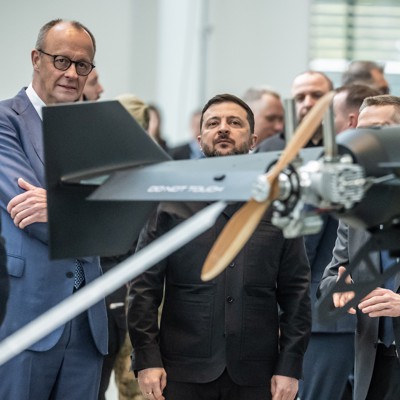
In the crucible of war, Ukraine has developed drones and ground robots that can hold territory—even take it back. Some are fully controlled by humans, like supply robots and medical-evacuation vehicles. But an increasing number are controlled in at least some aspects by dozens of AI products, from guidance packages on aerial drones to decision aids at the highest levels. Take the TFL-1 module, which can enable a one-way drone to function autonomously after a human has selected its target, reducing its susceptibility to jamming and other defenses. Its manufacturer, a Ukrainian company called The Fourth Law, says TFL-1 makes a drone four times more likely to hit its target.
Just as important as the tech are the new tactics. Given unusual latitude to experiment, Ukrainian fighters began to develop robot-forward infantry concepts, like combined-arms attacks by airborne and ground systems, “more than a year ago. Right now, we’re massively starting to implement this,” said Davyd Aloian, deputy secretary of the National Security and Defence Council of Ukraine, the coordinating body on domestic and international security, in an interview.
Ukraine and its partners are also steaming ahead on new concepts for highly autonomous defenses against Russian drones, combining ISR sensors and AI to detect and identify enemy drones in less time and with more certainty.
“All of the systems are being linked with each other and with people” to create a distributed network with interceptor drones at various locations to be activated when needed, Aloian said. “One day we will have only like 10 guys who are just going to be responsible for approving interception. And it will automatically go direct to the target.”
The human operators will be dispersed as well. “Everything can be controlled from Kyiv, Lviv, from cities in other countries,” he said.
Ukraine’s advantages go beyond weapons and tactics. It is more willing than Russia—or even Kyiv’s Western backers—to rebuild its doctrine, acquisition, and resupply systems around autonomous warfare.
Countries that fail to follow suit risk disaster, one of Ukraine’s top dronemakers warned attendees at the GLOBSEC conference here.
“It’s not what happened to Ukraine”—meaning Russia’s barrage of Shahed drones—that “should scare us in Europe,” said Swarmer CEO Serhii Kupriienko.
Instead, Kupriienko said, people should be scared by how quickly a middling military—in this case, Ukraine’s—developed the ability to inflict precise, devastating, and long-range damage.
“We are behind by literally 10 years or 20 years” in some defense-technology areas, such as satellite imagery, Kupriienko said, and yet his country has climbed a capability curve that just two years ago seemed insurmountable. So could others, he said.
“The answer is always AI solutions and integrating the AI into even the daily routine work within the bureaucracy,” he said.
Ukraine has also developed a defense industry that can keep up with the Russian threat. Its success is reflected not only on the battlefield, but in the growing number of foreign investors who see potential in defense products developed in and with Ukraine.
“We have evolved since 2022, the industry has and our defense has as well. Right now we are able to provide not only [large quantities of drone] assets but everything what is needed to build out the ecosystem,” including parts and production, training, modification, etc. Aloian said.
Strike drones FTW
Ukraine’s strike drones, more than any other factor, have helped counter a key Russian advantage: a large population of economically desperate young men and a comparative willingness to discount the cost of their deaths. Vladimir Putin has drawn hundreds of thousands into service with upfront bonuses and insurance benefits, which has provided numerical superiority on Ukrainian battlefields along with “considerable stimulus for the ailing Russian economy,” writes expatriate economist Vladislav Inozemtsev, who calls the system “deathonomics.”
But human waves are ineffective if drones kill soldiers faster than they can be replaced at the front—and that has become the case, analysts at the Institute for the Study of War wrote this week.
“Ukraine’s successful mid-range and frontline drone strike campaigns are limiting Russia’s ability to transport personnel to the frontline and to supply and sustain frontline positions,” they wrote.
Putin must now “convince an increasingly tired Russian populace not only to support a fifth year of war but also to accept involuntary mobilization for a war that has already cost Russia well over a million casualties.”
Ukraine’s deep-strike capabilities have changed the game in other ways as well. Oil infrastructure deep in Russian territory is no longer safe, giving Kyiv leverage over Moscow’s export revenues no matter what the White House does with sanctions relief. Even more humiliating, the drone threat forced Putin to hold his annual Victory Day parade this month without Soviet-esque ranks of tanks and missiles.
“Believe us. We were in the occupation of the Soviet Union for 50 years, and we know how important” the Victory Day parade is,” Estonian foreign minister Margus Tsahkna told the GLOBSEC audience. “For the first time, Putin was not able to wage this parade. This is the facade actually collapsing. And Putin is losing face among the Russian people, not only among us.”
“Putin thought that Ukraine was a question of five days. And, let’s be frank, we, too, we said, ‘Five days, and then it’s finished,’” said Xavier Bettel, Luxembourg’s deputy prime minister. “In fact, the resilience of the Ukrainians was a big surprise for all of us.”
Changing fortunes
To understand how dramatically Ukraine’s prospects have changed, consider that in March, then-ODNI director Tulsi Gabbard, testified that the U.S. intelligence community believed that Russia had the “upper hand” in the conflict.
Now Ukrainian officials and other observers have begun to worry about a premature sense of victory among Ukraine’s foreign backers. Kyiv still depends on aid and imported weapons. Last week, Ukrainian President Volodymyr Zelenskyy said the government continues to be “very persistent” in its efforts to secure advanced Patriot missiles from the United States. “I believe [the U.S.] must act quicker,” he told reporters during a visit to Sweden.
Some European governments, however, are ever more eager to forge deeper ties with their continent’s new defense leader—not just for Ukraine’s sake but for their own.
“It means enlargement processes for the European Union, for NATO in the future,” Estonia’s Tsahkna said. It means security guarantees not only to Ukraine and for Ukraine, but the other way around, because actually Ukraine is the largest military power in Europe at the moment, and increasing as well its industrial base.”
As for the Ukrainian government, declaring victory will require more than the cessation of hostilities. The invading country must be left “much weaker,” so that it can’t re-arm as it did after its 2014 invasion of Crimea, Aloian said.
“If there’s going to be a ceasefire, there will be very harsh conditions and difficult negotiations for the taking off of the sanctions, and when it will be,” he said. Otherwise, Russia will “renew all of those processes [of military buildup] before the full-scale invasion.”
“Right now, they’re aiming like about 30 percent of their economy for the defense industry,” which is too much, he said.
Even the downfall of Putin, who has led Russia since the end of the 20th century, would be insufficient.
“The change of the regime shouldn’t just be only external. It should be also internal,” he said.
If it happens, much of the credit will go to the makers and operators of Ukraine’s drones.
Read the full article here
