

Allies of Russian leader Vladimir Putin are openly advocating nuclear war and wishcasting for a diminished United States even while boasting about better trade relations.
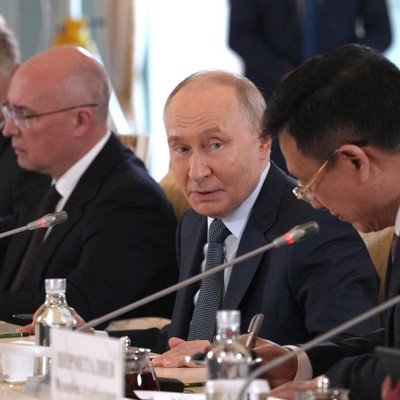
The venue was the St. Petersburg International Economic Forum, a Putin-backed conference that took place on Wednesday against a backdrop of billowing smoke from a Ukrainian drone attack at a nearby oil terminal. The forum, which featured presentations by Russian oligarchs and elites, also attracted high-ranking Russian officials, representatives of far-right European groups, and American internet influencers.
One notable presentation was given by two of Putin’s close allies: Konstantin Malofeev, a billionaire and founder of the Tsargrad TV channel; and Alexander Dugin, who is considered a key philosophical influence on the Russian leader. They suggested that Russia might reasonably use nuclear weapons in its war on Ukraine.
“Yes,” Malofeev said later on his Telegram channel. “The use of tactical nuclear weapons in Ukraine is considered a good-case scenario in our analytical report.”
The pair argued in general that the United States is an existential threat to Russia that must be weakened. It’s a view previously articulated by Yevgeny Primakov, a former prime minister, and is believed to echo Putin’s own thinking.
The pair also outlined what they called a “good” scenario for Russia by 2036; it included a “crisis of American-centrism.” By 2050, they foresee the “demise of the imperialistic plans of Western countries.”
The Institute for the Study of War called Malofeev’s scenarios “unrealistic,” and suggested that the Kremlin may use them to portray its own and “other government officials’ rhetoric as moderate and reasonable in comparison to the extreme scenarios presented by a small cadre of ultranationalists.”
The pair are not the first prominent Russians to bandy tacit or explicit threats of nuclear war. In 2017, Russian parliamentarian Vyacheslav Alekseyevich Nikonov said that if NATO or U.S. forces were to go to Crimea, the Kremlin would be forced to use smaller nuclear weapons. But when long-range Ukrainian strikes devastated the Black Sea Fleet in Sevastopol, the Kremlin responded with drone and missile strikes—but not nukes.
In May, Russia held drills for its nuclear forces in Belarus, which led NATO Secretary-General Mark Rutte to say, “Well, [Russia] knows if that happens, the reaction is devastating.”
Prospects for Russian advances on the field have dimmed since 2022. On Wednesday, Secretary of State Marco Rubio told the Senate Foreign Relations Committee, “Russia will definitely not be able to achieve the objectives it set for itself on the first day of the war; and it will likely not even be able to enforce—by military means—the demands it is currently making in negotiations.”
At the forum, Russian officials and elites admitted that no easy victory was in sight. The war will last “for decades,” said Andrey Bezrukov, a former spy whose double life in the United States inspired the television show “The Americans.” “Even now we understand that a drone using Starlink can fly into any region and hit a specific target. This is a serious problem for us. We were not prepared for it,” Bezrukov said.
There was even at least one U.S. official at the St. Petersburg forum, but the intense planning and coordination that would customarily precede a U.S. delegation’s visit to Russia appears to have been lacking. The official was Rodney Mims Cook Jr., who, as the chair of the U.S. Commission of Fine Arts, is in charge of the White House ballroom makeover.
On Wednesday, Secretary of State Marco Rubio said that he had no knowledge of any high-ranking officials attending the event.
At least one Russian leader at the forum touted “strong Russian economic cooperation” between the United States and Russia. Kirill Dmitriev, who runs a Russian sovereign-wealth fund, claimed that he had just spoken with White House envoys Jared Kushner and Steve Witkoff. He seemed to suggest the governments would announce a Bering Strait tunnel project on Friday, but later tweeted that he was speaking only of an engineering contract award.
The White House has not responded to questions about the claim.
Read the full article here
