

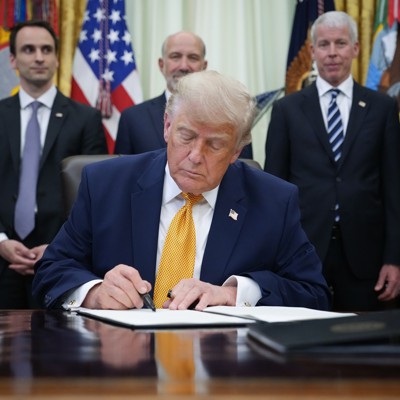
Two two executive orders on Monday aim to hasten the arrival of useful quantum computers while protecting U.S. systems from them.
“Innovation and security have to be balanced,” National Cyber Director Sean Cairncross said during the White House signing ceremony on Monday.
As expected, the orders address different aspects of the burgeoning quantum information sciences and technology landscape.
One, “Ushering In The Next Frontier Of Quantum Innovation,” launches “a national effort” to create a quantum computer that can perform basic operations and improve quantum sensors. It directs the creation of a “Quantum Computer for Application Development and Discovery Science Effort” at in a Department of Energy facility, while other provisions support quantum computing supply chains, foster workforce development, and explore private sector and international partnerships. The order also expands the Quantum Information Science and Technology Counterintelligence Protection Team to study threats to domestic quantum-computing efforts.
The other order, Securing the Nation Against Advanced Cryptographic Attacks,” pushes the government to move to cryptographic standards that can withstand quantum computers. It puts several agencies in charge of the effort, including the Office of Management and Budget, the Department of Commerce, the Department of Homeland Security, the Cybersecurity Infrastructure Security Agency, and the National Security Agency. The National Institute of Standards and Technology has helmed the effort to identify and test new encryption algorithms.
The order sets a deadline of 2030 to update key elements of critical infrastructure, and of 2031 for “high-impact environments.”
Garfield Jones, the executive vice president of Strategy and Research at QuSecure, said the executive order on post-quantum cryptography is an “unambiguous signal” of the need.
“The 2030 deadline for key establishment is a tangible compliance deadline, and the gap between where most organizations are today and where they need to be is significant,” Jones said in a statement. “Agencies and contractors that haven’t started a cryptographic inventory are already behind. The organizations that move now will have options. The ones that wait will find themselves managing a crisis.”
IBM CEO Arvind Krishna, who was present at the signing ceremony, said his company “applauds” the Trump administration for both orders.
“Sound policy, sustained investment and public-private partnership are vital to sustaining U.S. quantum leadership and technological resilience,” Krishna said in a statement. “Today’s Executive Orders bring that same spirit of policy and investment working in lockstep to the national stage.”
Energy Secretary Chris Wright said quantum computing will join artificial intelligence and advanced semiconductors as the three-part foundation of future computing technology.
“This is tricky. We’re not there yet. We’re close, but with this executive order and this coordinated effort, we will have scientifically relevant — meaning error-corrected — quantum computing during this administration. The impacts of it will be tremendous,” Wright said during the ceremony.
Read the full article here
