

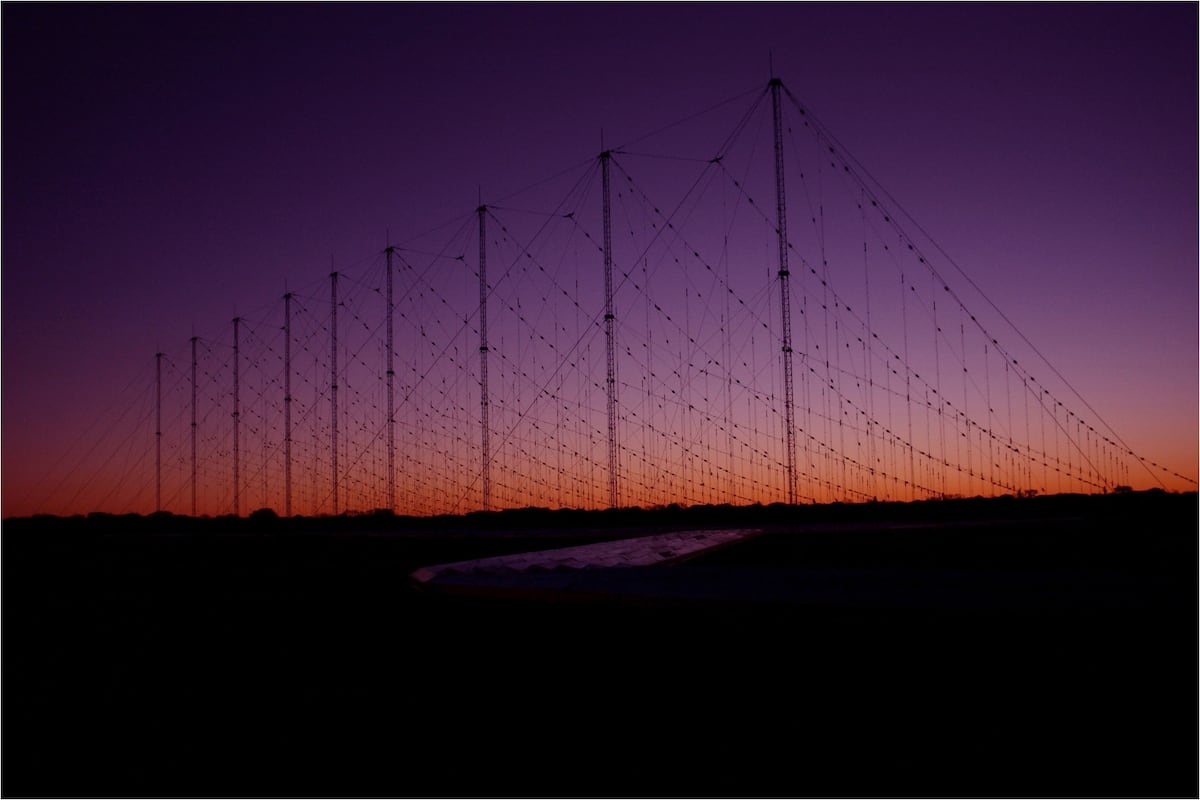
CHRISTCHURCH, New Zealand — The North American Aerospace Defense Command (NORAD), operated by Canada and the United States, has gaping holes in its airspace radar coverage. Ottawa went some way to filling those gaps when it signed four related agreements in June for a new radar system sourced from Australia.
The system is called the Arctic Over-The-Horizon Radar (A-OTHR), and the deal is worth some US$1.75 billion to Australia.
Gordon Frazer – Founder and CEO of the Australia-based HF radar technical services company FrazerLab – told Defense News Canada’s decision would fill an urgent need.
“I used to say to people, you could fly a jumbo jet from Beijing to Canberra if it had its transponders off and no one would know,” he said, arguing the same is likely true for Canada.
“Russia could fly a Tu-95 from one of their bases, Engels Air Base or something like that, to Canada and possibly no one would know.”
He added, “That’s why NORAD is so concerned, and why they’ve been pushing so hard to get this sort of technology done.”
Frazer was formerly an engineer involved in Australia’s OTHR program known as the Jindalee Operational Radar Network (JORN).
Expanded surveillance coverage
While NORAD maintains the North Warning System, a line of microwave radars in Canada’s frozen north, Frazer said it would be “almost a trivial problem to defeat it” by flying at low altitude between these known and stationary radar sites.
Instead, because OTHR bounces high-frequency signals off the ionosphere, it can look down on airborne targets — and sometimes even surface vessels — with ease, including aircraft and missiles.
An over-the-horizon radar results in radar coverage stretching far beyond what traditional line-of-sight radars can achieve due to the curvature of the Earth.
With its particular A-OTHR contract, BAE Systems Australia will transfer technology and expertise for Canada to build its own OTHR radar sites to monitor its periphery. Officially, Canberra says JORN can detect targets 3,000 kilometers (1,700 miles) away, but its capability almost certainly reaches far beyond that.
Ottawa stated in a press release: “The signing formalizes Canada’s partnership with Australia and enables the delivery of Australia’s proven OTHR technology in support of Canada’s A-OTHR program. It marks a major milestone in the program, transitioning A-OTHR from the planning phase into delivery phase.”
Natural challenges
Canada has already been researching the application of OTHRs in its north, where environmental and solar conditions are far different than they are in Australia.
Furthermore, significant differences exist between operating OTHRs in equatorial, mid-latitude, high-latitude and polar areas. Frazer pointed out that Canada, despite the “Arctic” in the A-OTHR nomenclature, is actually buying a high-latitude system.
Polar regions present even more complicated challenges for OTHRs due to the Earth’s magnetic field, which creates serious background clutter. In fact, some 40% of Canadian territory lies above the Arctic Circle.
Although it may sound counterintuitive, Frazer said Canada’s A-OTHR radar facilities would be built as far south as possible. This is in order to bounce radar signals off the ionosphere ahead of the zone where the worst distortion occurs.
However, Canada will also have the future opportunity to expand its OTHR network with trans-polar coverage, which would allow it to see deep into Russia.
Positioned thus, the technology could enable NORAD to see Russian strategic bombers taking off or ballistic missiles being launched, for example.
If Canada does seek transpolar radar coverage, it would likely want to place those radar installations as far north as possible, Frazer explained.
Australia has three JORN radar sites, but it is unclear how many sites Canada will establish. In North America, Frazer expects the Pacific west coast will be covered by an American system, the Atlantic east coast will be covered by Canada, and then an additional system can cover the north. If NORAD wants 360-degree coverage, Frazer suggested five or six radar installations would be needed.
Australian expertise
Craig Lockhart, CEO of BAE Systems Australia, said: “Canada’s acquisition of a cutting-edge Australian OTHR system supports the strategic interests of both nations through enhanced detection and tracking of threats to North America, strengthening Five Eyes situational awareness.”
Frazer said Australia developed world-leading OTHR talent “because of multi-generational consistency” in its investment in the technology.
The New Zealand-born engineer pointed out that around 15% of the cost of OTHR technology sits in equipment to inform human operators how to set the radar’s parameters to account for constantly changing atmospheric conditions.
Frazer highlighted that OTHRs are bespoke, national systems built only once per generation. However, he hopes the Canadian deal will benefit both countries.
“I think you’re starting to get the critical mass of being able to keep the technology pipeline from design to sustainment to upgrade to far-reaching tech.”
Because over-the-horizon radar coverage can vary drastically due to solar conditions, other methods help plug surveillance gaps.
Airborne early-warning aircraft, for example, are complementary to OTHR. In May, Canada selected Saab’s GlobalEye as its future airborne early-warning platform.
Canada expects its A-OTHR to reach an initial operational capability by December 2029.
Gordon Arthur is an Asia correspondent for Defense News. After a 20-year stint working in Hong Kong, he now resides in New Zealand. He has attended military exercises and defense exhibitions in about 20 countries around the Asia-Pacific region.
Read the full article here
