

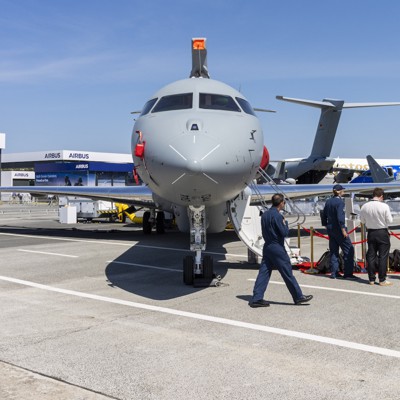
LONDON—The trio of Saab GlobalEye radar planes ordered by the Swedish Air Force are separate from—but a vital complement to—NATO’s own order of 10, the service’s top officer said Monday.
Maj. Gen. Jonas Wikman, the head of the Swedish Air Force, told reporters in London that his country’s order of the Swedish-built airborne early warning and control aircraft is “on top” of the alliance deal announced at the NATO summit in Turkey earlier this month.
“My view is that NATO will have the fleet, like AWACS today,” Wikman said. “We will have our fleet, a national fleet, in cooperation with other nations, hopefully.”
He added that he had started a “dialogue” with the alliance to develop operational concepts for the aircraft.
Earlier this month, NATO announced plans to buy 10 GlobalEyes to replace its Boeing E-3 AWACS, snubbing the U.S. company’s pitch of its E-7 Wedgetail. In 2024, Sweden placed an order for its third GlobalEye. The country has donated two of its older fleet of Saab 340 radar planes to Ukraine as it awaits delivery of the new aircraft in 2027 or sooner.
“We are supporting Ukraine with our previous fleet of airborne early warning and control aircraft, and we are now waiting to introduce our next generation of aircraft,” Wikman said. “The intention of introducing the GlobalEye, or the S106, is not to introduce another early warning and control aircraft for control of the air. It is to introduce airborne early warning and control aircraft for all domains.”
Boeing executives, in a roundtable with reporters in London on Sunday, defended their E-7 Wedgetail after NATO’s announcement.
“We’ve got a number of platforms, airborne early warning and control platforms, in the Middle East. What capability was asked to come and help? It was the E-7 Wedgetail,” said Steve Parker, Boeing Defense, Space and Security president and CEO. “It’s that way for a reason, because it is unmatched and it has a technology roadmap that’s going to take it out 30,40 years and stay relevant. It’s the world’s leading capability right now.”
Parker added that Boeing is “super proud” to support the NATO mission with the E-3.
In May, Defense Secretary Pete Hegseth reversed course and decided to support funding for the E-7, after it was initially zeroed out in the initial budget request. Last month, House appropriators, mostly, supported the White House’s $1.5-billion budget amendment to fund Wedgetail development.
Debates over fielding the E-7 intensified after a U.S. Air Force E-3 Sentry was heavily damaged during the war in Iran. Last year, Hegseth rallied the Wedgetail and defended space-based capabilities for the mission instead. Now, Air Force officials are backing space programs, like the Airborne Moving-Target Indicator, and the next-generation radar plane.
Wikman said the Swedish’s air and space force hasn’t discussed a similar arrangement. The military’s first space-based ISR asset, a Planet Labs satellite, was launched into orbit in May. He said the hope is to share that data with the new fleet of GlobalEyes.
“So, in that sense, we are already there,” Wikman said. “I’m telling Saab ‘hey, you need to be able to import the space data.”
Read the full article here
