

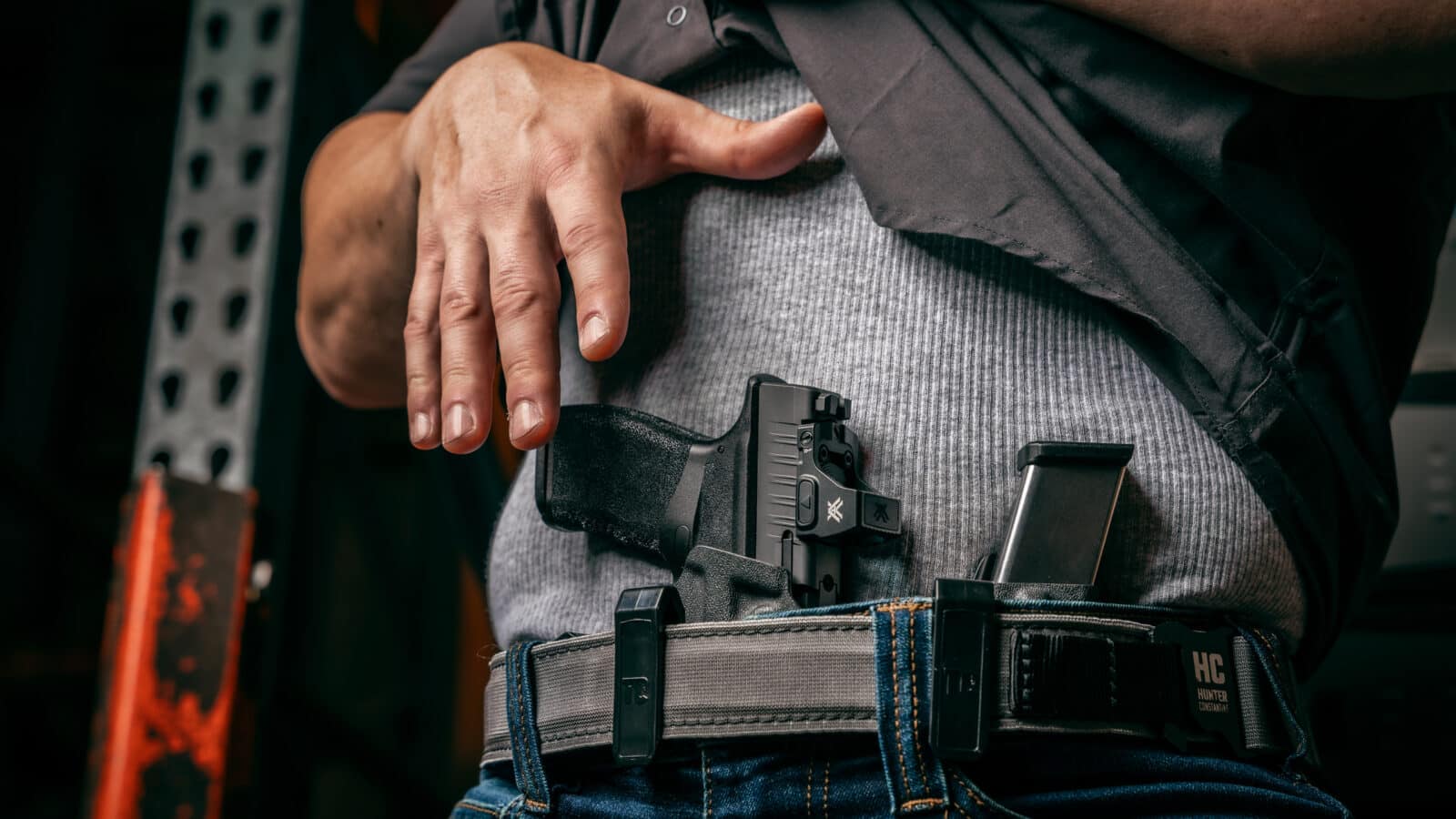
For most people, their EDC is carried in an inside-the-waistband holster. The problem with that is that you have to wear your shirts untucked. For some, this really isn’t an option for various reasons, and they need their shirt tucked in.
Why Carry Tucked
Various reasons for wearing a tucked-in shirt include attending a formal event, such as a wedding or an awards ceremony, working in an office setting where an untucked shirt is not allowed or looks unprofessional, or simply because it appears neater and more orderly.
What Type of Holster
Carrying your EDC with a tucked-in shirt requires a holster engineered for tuckable wear, without sacrificing access to your pistol when needed.

For the purposes of this article, I tested out the DeSantis Slim-Tuk Holster that fits the bill for tucked carry. It features a J-clip that provides space to tuck your shirt behind, allowing you to carry your pistol without sacrificing comfort or mobility.
When properly fitted, a tuckable holster will keep your shirt tucked in. If you are having issues with this, that means your holster is not set up properly. Incorrect clip tension, incorrect height, or a shirt that’s too thin may be the cause.
Another factor regarding holsters is the retention of the firearm. You need a quality holster with retention adjustment. Your retention adjustment needs to be snug enough to keep your pistol in place, but loose enough to allow a smooth draw.
How to Carry Tucked
Generally, you can carry it in the same position as you would when it is untucked.
Appendix carry, positioned at the 1-2 o’clock position (10-11 for left-handed individuals), is popular because it is ideal for fast presentations; however, it can be uncomfortable if used for extended periods.

Many people prefer the strong side carry around the 3-4 o’clock position (9-10) for lefties, just behind the hip. This is generally a suitable position for those who spend most of their day seated, such as office workers or individuals who drive vehicles.
Regardless of the carry method, printing is something to be watched for. You want the element of surprise when things go sideways.
What Are Some Issues?
Generally, carrying with a tucked-in shirt is more complex. With a shirt that’s more snug on your body, hiding your EDC becomes more difficult, as it may cause printing. The tucked-in shirt will also hinder your draw compared to an untucked shirt.

What type of shirt?
Some tips when deciding on a shirt to wear include:
- A larger-sized shirt can give you some extra room to carry without looking messy. Ensure it’s a little longer so it stays tucked in when in motion.
- A shirt with patterns will help break up the outline of your EDC.
- A thicker shirt can also help hide your EDC.
What Type of Belt?
The proper belt is critical to your tucked setup. A heavy-duty leather belt is best for a stable mounting position. You want to prevent any shifting or tilting.

Live The Armory Life. The latest content straight to your inbox plus an automatic entry to each of our monthly gun giveaways!
A quality belt is also crucial in keeping the holster from pushing away from the body. This can give away the fact that you are carrying and also slow down your draw time. Buy a quality belt that has the same width as the belt clips. You don’t want a lot of slop here, as it will impair the draw.
What About an Extra Magazine?
You are going to want to carry an extra magazine or two to go along with your EDC. Many people use a flush-fitting magazine for carry, and their extra magazine is often an increased-capacity version. You want to have sufficient ammunition. These can be carried in a pants pocket, a tucked magazine pouch, or a tucked holster with a magazine pouch combination.
The Tucked Draw
Drawing with a tucked shirt requires some changes. Here are some tips for a safe draw:
- Using your non-dominant hand, reach down to the bottom of your shirt near the clip and pull your shirt up and away from your body. You need to get your shirt clear enough so it does not interfere with the draw.
- Grip the pistol with your dominant hand, keeping your finger off the trigger! This is one of the four rules of firearm safety. I know you want to have a fast draw, but a negligent discharge and injury is not the way to go.
- Draw your EDC straight up from the holster in a smooth motion. Several of my firearms instructors continuously quote “Slow is Fast.” I’m here to tell you that it’s true. I didn’t think so at first, but a smooth draw will improve your draw time and get you the drop on the bad guys.
The Re-Holster
When re-holstering, be very careful, as your shirt may get stuck in the holster and interfere, or it may work its way into the trigger guard and catch on the trigger, potentially leading to a negligent discharge.

You need to get your shirt completely out of the way before re-holstering. If possible, untuck your shirt completely out of the way so you can see the holster clearly.
If that’s impossible, then pull your shirt up with your non-dominant hand, making sure your shirt is out of the way, and slowly insert your pistol using your dominant hand. This is not a race, so take your time.
Train With Your Holster!
I cannot stress this enough. Train with your holster! You must practice to develop muscle memory and master your technique. My old department transitioned from the Safariland SS III holster to the Kydex ALS duty holster, which features three retention devices.
For a few months, the sounds of retention devices being manipulated filled the headquarters and substations as officers practiced their draw with the new holster to become proficient.
Train with your equipment to find the optimal holster position for your specific situation. It’s just sound advice.
Editor’s Note: Be sure to check out The Armory Life Forum, where you can comment about our daily articles, as well as just talk guns and gear. Click the “Go To Forum Thread” link below to jump in!
Read the full article here
