

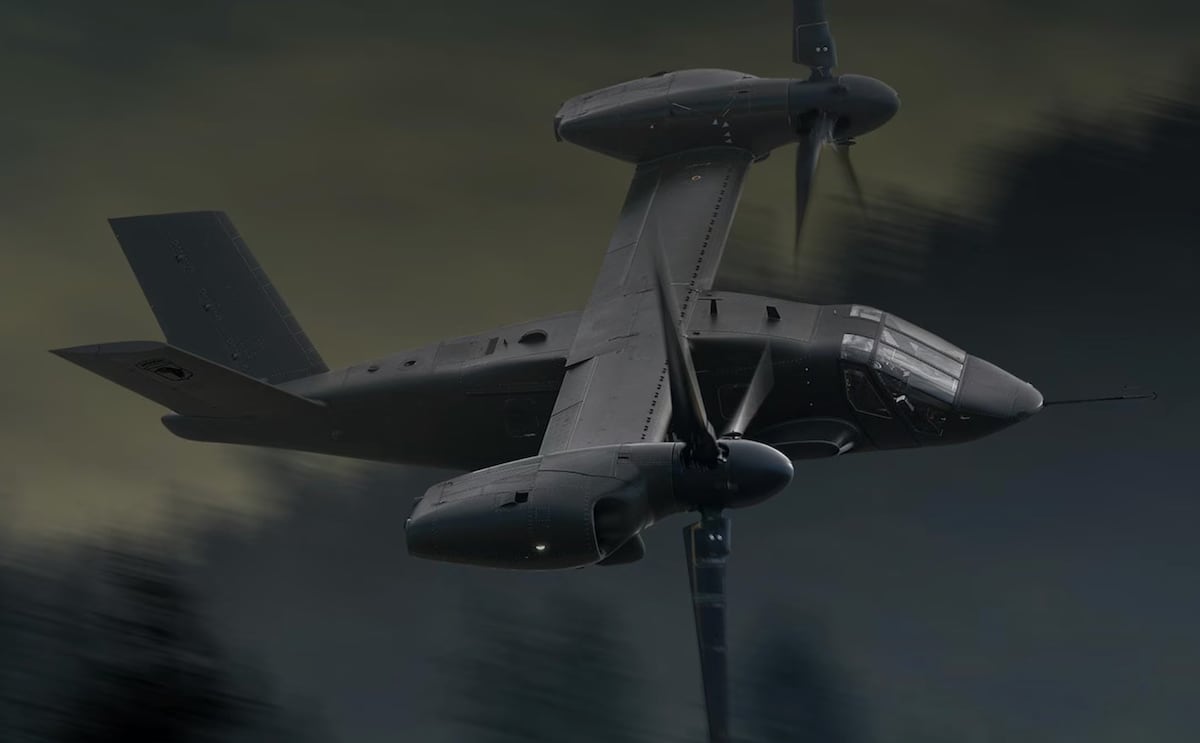
The U.S. Army will field the long-anticipated Bell MV-75 tiltrotor aircraft this year ahead of its former schedule, Army Chief of Staff Gen. Randy George announced at the Army’s Senior Leader Sitrep town hall meeting that premiered online today.
The Bell MV-75, previously designated the Bell V-280 Valor, promises greater maneuverability in the air than traditional helicopters. The aircraft was previously slated for delivery between 2031 and 2032, but George announced during the town hall that production has been accelerated.
“We said, ‘No, we need it very quickly,” George said. “At the end of this year, we will actually have those flying.”
During the town hall, George outlined priorities alongside Secretary of the Army Dan Driscoll and Sergeant Major of the Army Michael Weimer, and took questions from service members.
The accelerated helicopter delivery comes as the Army continues to overhaul its acquisition processes and seeks to rapidly integrate new technology, George explained.
“You guys all know what’s happening out there in the world and how fast technology is changing,” said George, citing a recent visit to Ukraine. He noted that the Army is transforming units to be capable of offensive drone warfare, in step with the drone combat unit recently formed by the 10th Mountain Division.
“Things are moving very rapidly. We can do the same thing and I think we’re proving that 10th Mountain is one of those units. We have units all over the Army that are proving that,” George said.
Force modernization will see every infantry combat brigade team transform into a mobile brigade in the next year to 18 months, George said, and these are set to be equipped with GM Defense’s new Infantry Squad Vehicle and next-gen squad weapons.
“All of that is coming,” he added.
George also announced that the service has been transforming its combat aviation brigades to integrate larger unmanned aerial systems classed in Groups 3, 4 and 5, with Group 5 being the size of a Reaper MQ-9 drone.
George said that the Army will proactively seek input from the troops about which technology is effective and what is working as opposed to top-down decision-making when it comes to new technology.
“We want to give things to units and let you tell us what works, what doesn’t and you guys should be the ones deciding what we buy,” George said. “It’s going to be a little different.”
This will especially apply to autonomous systems, George noted, adding that engineers will work together with service members to adapt new technology as it is used.
“We’re going to be breaching with robots,” he said. “We’re going to be doing things with autonomous systems and we need your feedback on what will work and what doesn’t.”
Zita Ballinger Fletcher previously served as editor of Military History Quarterly and Vietnam magazines and as the historian of the U.S. Drug Enforcement Administration. She holds an M.A. with distinction in military history.
Read the full article here
