

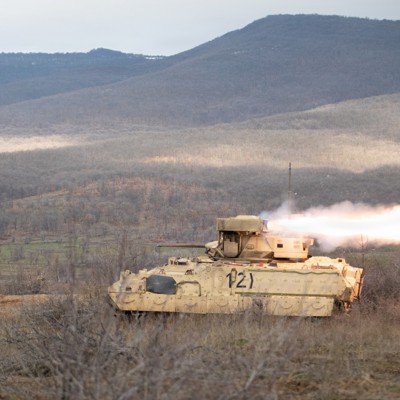
HUNTSVILLE, Ala.—Despite recent rumblings that the Army might be looking to change up its latest attempt at replacing the Bradley fighting vehicle, the service is still looking to unveil its choice for the XM-30 early next year.
Two competing vendors will deliver prototypes to Transformation-in-Contact brigades in July, allowing soldiers to give feedback on how the vehicle drives and the kinds of systems that will make it most effective in combat, the Army’s assistant secretary for acquisitions, logistics and technology told reporters Tuesday at the AUSA Global Force Symposium.
“I think the summer will be interesting to see how the prototypes roll out and how well they work,” Brett Ingraham said when asked whether its prospective 2027 Detroit auto show debut will feature one winner, or whether both the Rheinmetall and General Dynamics versions will share the stage.
The mechanized infantry combat vehicle would be the Army’s sixth attempt at replacing the Bradley, a mountain the service has been trying to climb since the 1980s. It could take about a year to get them into production after this summer’s testing, Ingraham added.
“So absolutely, we’ll be on the floor next January,” he said. “Absolutely, because it could be on the floor in June.”
It would also represent a big win for the Army Transformation Initiative, a laundry list of new technology, legacy divestments, and organizational changes Defense Secretary Pete Hegseth issued to the service nearly a year ago.
“We’re very optimistic about the gains that we were able to make from divesting of legacy systems, and the ability that we had to reinvest those in two areas, readiness and modernization, so all of the funds recapitalized,” said Army Undersecretary Mike Obadal.
That has included canceling the M-10 Booker light tank, reorganizing combat aviation brigades to phase out the AH-64D Apache helicopter, and setting up an online marketplace for small unmanned aerial systems, to speed up the fielding of drones to every division and beyond.
“This new digital storefront that allows you [to get] this trusted, cutting-edge technology to our soldiers and allies faster,” Ingraham said. “This is 30 systems, roughly, in there, growing every day. We’ve got basic ordering agreements lined up with the companies in there.”
Most of the initiative has gone smoothly, but there have been snags. For example, the Army’s proposal to end its Joint Light Tactical Vehicle program has been met with resistance from Congress.
That friction with Congress is likely to continue as the Army looks to make more changes in line with the transformation initiative.
“We are continuously going through our entire top line budget to determine where, can we make efficiencies where systems that have become obsolete or have come to the point where sustaining them is not economically viable? And that requires continuous, consistent communications with Congress,” Obadal said.
Read the full article here
