

MILAN — Canada has become the first non-EU country to join the bloc’s flagship rearmament program, Security Action for Europe (SAFE), whose funds could support Ottawa’s fighter jet and submarine procurement.
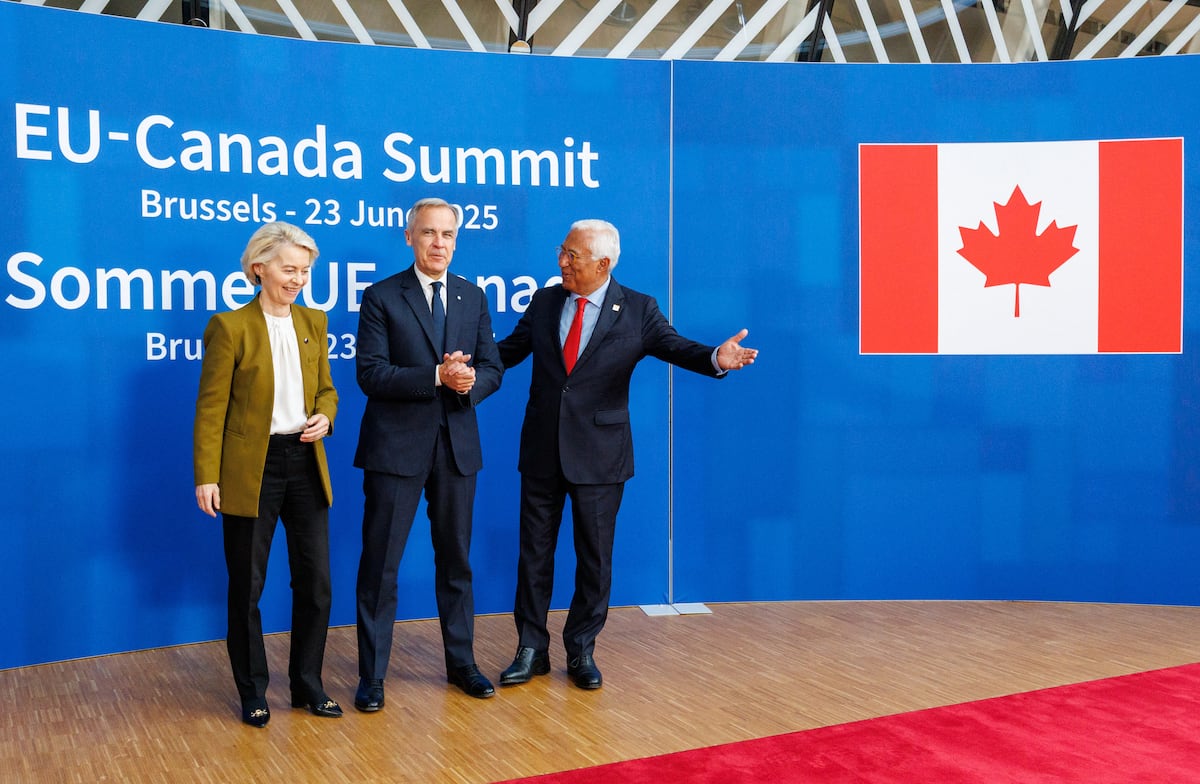
Canadian Prime Minister Mark Carney announced this week that his government struck a deal to join the EU’s €150 billion initiative that provides loans for joint military procurement to boost readiness.
“Participation in SAFE will unlock billions of dollars in potential defense opportunities for Canadian businesses, attract new reliable suppliers for our Armed Forces, and open massive new opportunities for national manufacturers to build and export Canadian-made capabilities,” Carney said in a statement.
Canada is in a review stage of its next-generation fighter jet purchase. It has committed funds for 16 initial F-35s, but is assessing the possibility of a mixed fleet where the Swedish-made Gripen aircraft is also a top contender.
Many details regarding the North American country’s involvement in the SAFE program still need to be hashed out over the coming weeks. Ottawa and the EU are currently working on ratifying a bilateral agreement that will expedite the process and may exempt the country from certain rules.
Under SAFE regulations, no more than 35% of a project’s component costs can originate from outside the European Union, the European Economic Area or Ukraine to be eligible for funding. However, nations can buy their way in, through a financial contribution in exchange for more access.
It remains unclear how much Canada has agreed to provide and whether the entry-fee is a one-time payment or tied to procurement commitments. Issues around this clause were responsible for stalling negotiations for the United Kingdom to join the program last month.
In that case, parties were unable to agree on the size of London’s financial support. The EU’s proposal was that the amount could range between €4 billion and €6.5 billion, while the U.K. was ready to commit only around €200 million to €300 million.
As Ottawa has big-ticket procurement targets underway, Roger Hilton, a Canadian defense fellow at the Bratislava-based think tank GLOBSEC, said financing could extend to next-generation fighter aircraft, conventional submarines and maritime domain awareness systems.
He expects that the country is also likely to explore SAFE options for drones, anti-submarine warfare platforms and secure satellite communications.
SAFE-funded projects also require at least two partners, generally two member-states, or one member country and Ukraine or an EFTA/EEA nation, a pool that includes all EU nations plus Norway, Iceland, Liechtenstein and Switzerland.
According to Hilton, Canada is likely to team up with European partners based on specific considerations, including countries that are ideologically open to its involvement in the program and share overlapping strategic priorities such as Arctic security and North Atlantic defense.
“It is very probable that it will also gravitate towards states with the deepest aerospace and naval industries – notably France, Germany, Italy, Sweden, and Spain, as they have the industrial mass, design authority, and consortium models that SAFE favors,” Hilton said.
Elisabeth Gosselin-Malo is a Europe correspondent for Defense News. She covers a wide range of topics related to military procurement and international security, and specializes in reporting on the aviation sector. She is based in Milan, Italy.
Read the full article here
