

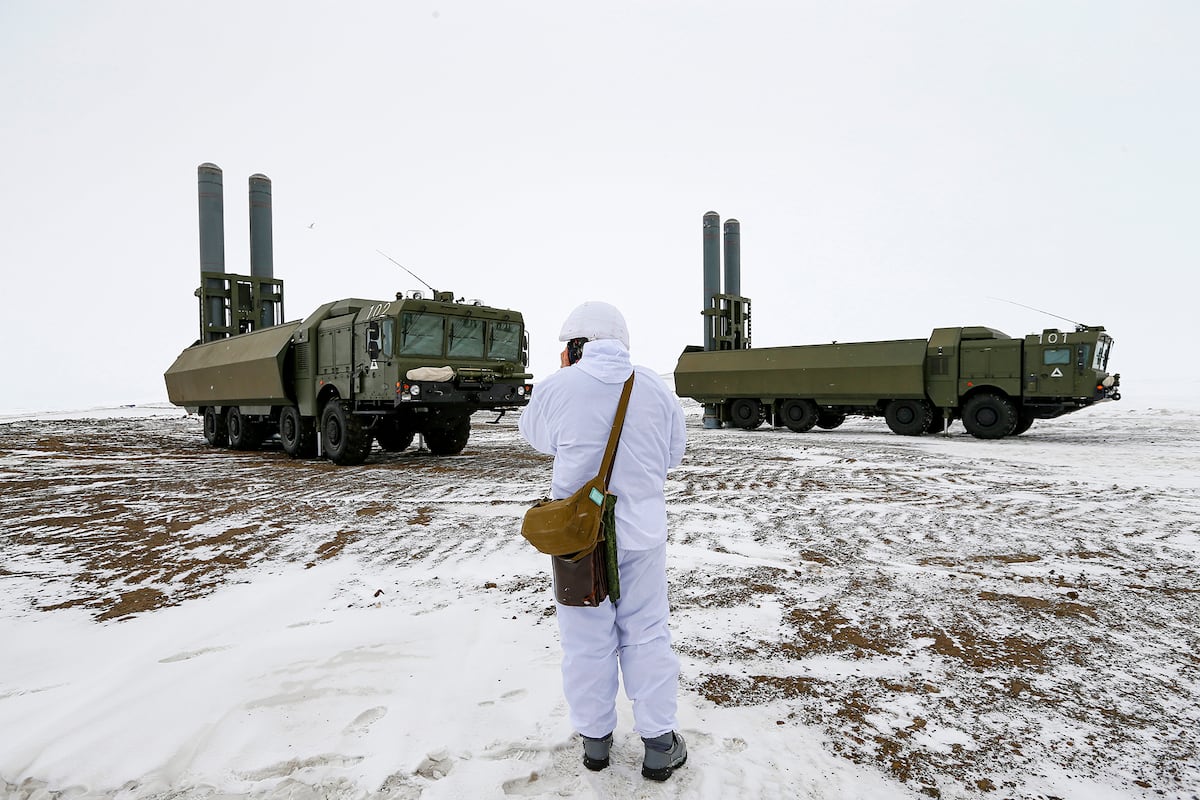
MILAN — The prospect of a conflict in the Arctic is rising, Denmark’s Arctic commander has warned, with the expectation of Russia turning its attention to the High North if and when the Ukraine war ends.
“My expectation is that when the war in Ukraine is over, Russia will devote its efforts to arming itself in the Arctic,” Maj. Gen. Søren Andersen, commander of Denmark’s Joint Arctic Command, said in an interview published this week by the Danish Armed Forces magazine Honnør.
The Arctic has become a geopolitical hotspot, primarily due to the impact of climate change on melting sea ice, which has made the region more accessible for shipping and resource extraction.
The Scandinavian country has ramped up its military presence to defend Greenland, an autonomous territory of the Kingdom of Denmark.
In June, as part of this broader military reinforcement and training exercises, Denmark deployed a frigate and two EH101 Merlin helicopters to Greenland, the aircraft’s first time there.
“Our Armed Forces have shown that we can deploy from Denmark to Greenland at short notice – one example is the Merlin rescue helicopters, which can fly from Karup Air Base to Nuuk in 13 hours. They’ve been absolutely crucial for the training there,” Andersen said.
The Arctic is one of the most challenging operational environments for militaries. The extreme weather conditions make flying and navigation difficult or altogether impossible, and the lack of infrastructure means there are few places to refuel or land in case of emergencies. In some situations, the only travel options are by dogsled or snowmobile.
The Danish commander argued that due to these challenges, more allies need to train in Greenland to gain exposure and grow accustomed to carrying out operations in tough settings.
Another area of concern is the remote Svalbard archipelago, located between mainland Norway, to which it belongs, and the North Pole.
A report published Nov. 27 by the Arctic Institute cautioned that Svalbard’s legal status and strategic position make it vulnerable as a potential site of confrontation if Russia decided to challenge “the status quo.”
The Svalbard Treaty bans the construction of significant military infrastructure or fortifications on the archipelago. The interpretation of this clause has been contested, and not all military activity is forbidden – Norway, for example, maintains a limited presence around Svalbard through its coast guard.
The Arctic Institute report notes that Moscow has amassed sizable combat capabilities relatively nearby.
“Russia has mustered a significant military force merely 260 kilometers from Svalbard, the Nagurskoye air base is its northernmost military base – since 2015, it has been transforming the old Soviet base to increase its capabilities,” the report stated.
Part of this reinforcement has included extending a runway in 2020 to accommodate a variety of military aircraft, such as MiG-31 and Su-34 fighter jets as well as Il-76 heavy transporters.
According to the report, Nagurskoye has shifted from being a seasonal military station to an operational base year-round that has on occasions hosted Moscow’s long-range bombers and served as a base camp for exercises.
Elisabeth Gosselin-Malo is a Europe correspondent for Defense News. She covers a wide range of topics related to military procurement and international security, and specializes in reporting on the aviation sector. She is based in Milan, Italy.
Read the full article here
