

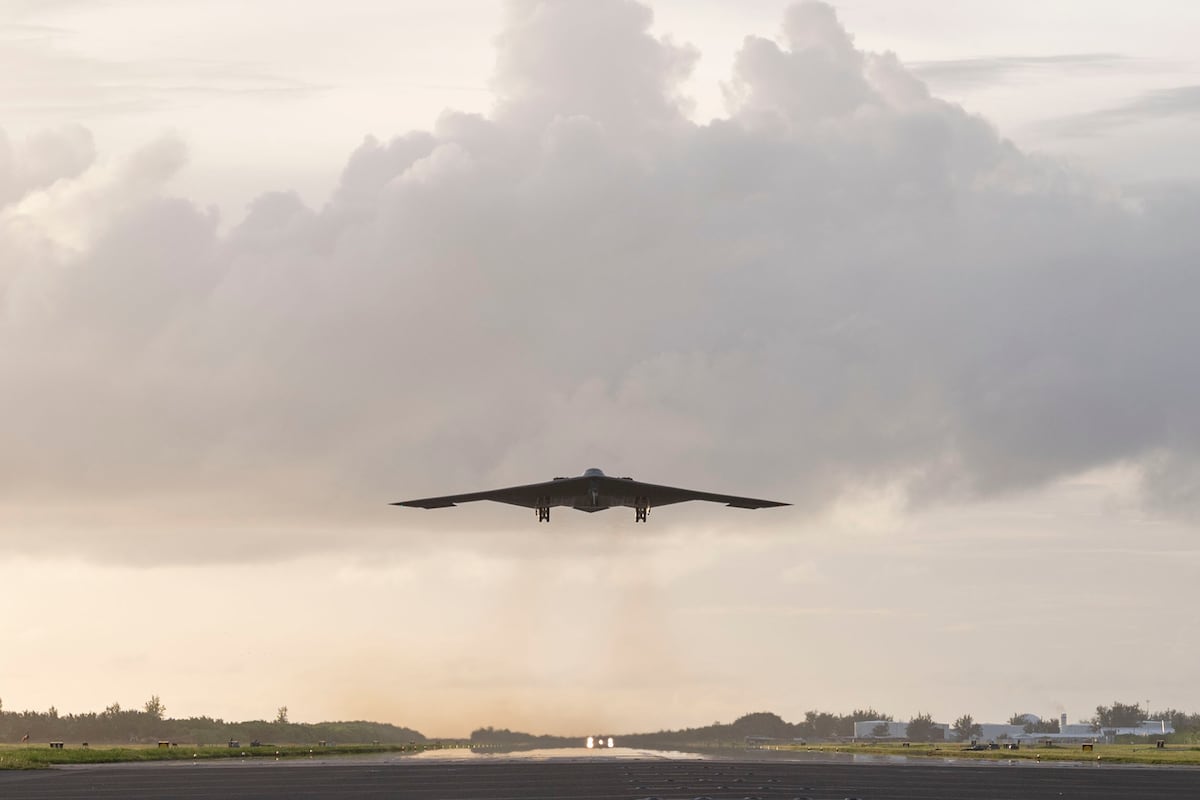
Criticism by both U.S. President Donald Trump and U.K. Prime Minister Keir Starmer about using the Diego Garcia military base for U.S. military operations against Iran has elevated attention to the often-underexamined topic of U.S. security interests in the bustling Indian Ocean region. Vital container, hydrocarbon and bulk shipping transits this body of water, which connects hotspots like the South China Sea and the Middle East. Unfortunately, many analyses of the topic present an incomplete picture of a critical national security priority — how to guarantee access to Diego Garcia.
Unlike in most oceans, the U.S. does not have territory in the Indian Ocean. Therefore, it relies on the U.K. to provide access to Diego Garcia, a centrally located base for military operations both westward to the Middle East and eastward to the Pacific. Mauritius, a small-state former British colony, has waged a longstanding diplomatic and legal campaign contesting the U.K.’s sovereignty over the Chagos Islands, which include Diego Garcia.
Some analyses have framed the debate in partisan terms, with former Trump adviser John Bolton criticizing the Biden administration’s position on the issue as “international law theology overriding legitimate U.S.-U.K. national security interests.”
However, this argument neglects to mention the bipartisan reality: Both the first Trump administration and the Biden administration in 2021 backed the U.K.’s sovereignty over the islands, rather than Mauritius’ claim, due to the importance of Diego Garcia. Importantly, no allied boots on the ground moved despite Mauritius’ successful legal campaign for the islands.
Fast forward to 2024, when the Biden administration announced support for the U.K.’s agreement with Mauritius which permits the use of Diego Garcia, and to 2025 and 2026 when the Trump administration twice endorsed it.
What, then, accounts for the change in the U.S. position? Real-world developments in international law changed the U.K.’s calculus. In a separate case, the International Tribunal for the Law of the Sea resolved the maritime border dispute between Mauritius and Maldives in 2023, while its 2021 Special Chamber judgment recognized the “legal effect” of a non-binding 2019 advisory opinion by the International Court of Justice that the U.K. should vacate Chagos.
Simply put, the U.K. could ignore an advisory opinion, but not binding legal judgments. This was clear motivation for former Conservative Prime Minister Liz Truss who kickstarted discussions with Mauritius in 2022 when it became apparent the winds were changing for the U.K.’s position. Labour Prime Minister Starmer pointed to negative consequences for the U.K. at UN agencies such as electromagnetic spectrum management, while other examples concern overflight rights.
The China card has also been invoked by critics. The assumption that Mauritius could be cajoled by China’s influence indicates little understanding of the multidimensional ties between Mauritius and India, which holds deep threat perceptions of China — seen in border crises this decade resulting in fatalities. Not only are Indian officials involved in Mauritius’ national security establishment, the Indian Navy also conducts operations in Mauritius’ exclusive economic zone. While Mauritius will continue to have economic relations with China, as do most countries, India will ensure that its strategic place for Mauritius remains paramount.
For its part, India is designated as a Major Defense Partner by the United States, and both renewed their 10-year defense framework agreement in October 2025. Furthermore, the U.S. has excellent relations with Mauritius, which had even offered a 99-year lease directly to the U.S. for Diego Garcia.
Certainly, there are legitimate arguments against the Chagos agreement such as its cost and insufficient involvement by displaced Chagossians. There is also criticism that the U.K. should not worry about potential international legal consequences. Is it worth accepting them? If the treaty is not ratified, then such scenarios will be tested and critiques should be evaluated.
Regardless of what happens with the current agreement, Trump reinforced his support of it by stating he’ll secure Diego Garcia in the event of threats to the base. As articulated, his statement will have weight beyond his presidency, similar to the Carter Doctrine prohibiting external interference in accessing the Persian Gulf as a vital U.S. interest. However, misunderstanding legal issues and exaggerating Chinese influence in Mauritius obfuscate what is a clear national security priority — maintaining U.S. access to Diego Garcia for the next century.
The Starmer government’s information-sharing about the U.K.’s calculus has been poor, while misinformation abounds.
There have been many twists and turns over the years in this dispute, including a recent claim by Maldives to the Chagos, and President Trump’s differences with Prime Minister Starmer over Greenland and Iran.
Yet for current transparency and future accountability, what’s required is a better understanding of what will follow after finalizing the treaty — compared with inaction on the issue — and how it preserves U.S. national interests in Diego Garcia and more broadly, the dynamic Indian Ocean region.
Read the full article here
