

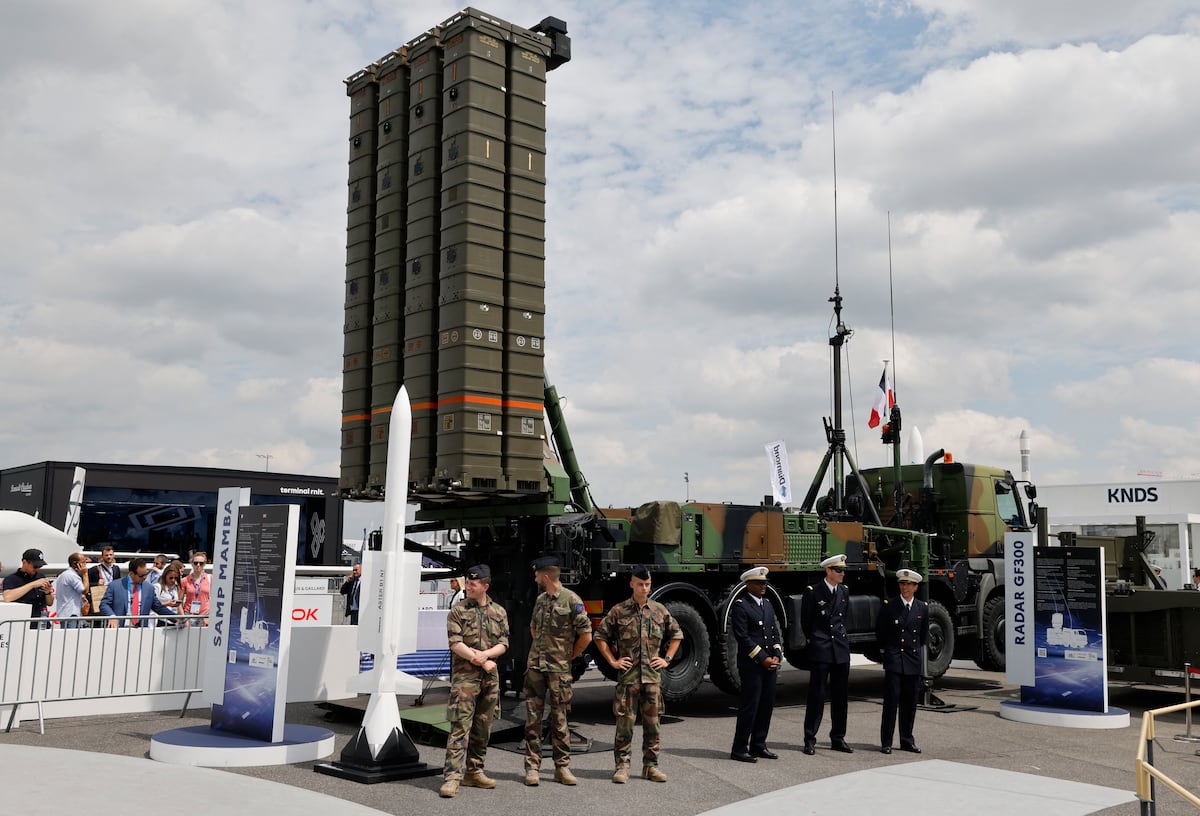
WARSAW, Poland — Estonia is gearing up to acquire a missile defense system, participating in broader efforts by the Baltic States to boost investments in expanding their air-defense network.
The country’s authorities said they plan to select the supplier by the end of March, earmarking up to €1 billion ($1.2 billion) for the purchase. The Estonian Centre for Defence Investments (ECDI), the institution that implements the country’s arms and military equipment procurements, is doing the requisite analytical work for picking the system.
“This means all potential manufacturers have been contacted and provided with detailed information about Estonia’s specific requirements,” Krismar Rosin, a spokesperson for the ECDI, told Defense News.
Tallinn has not disclosed which solutions are currently under evaluation. However, the potential contenders include the Patriot system, a weapon produced by Raytheon, a unit of RTX Corp.; the SAMP/T NG system manufactured by Eurosam, a French-Italian joint venture consisting of Thales and MBDA; and David’s Sling, a solution offered by Israeli defense company Rafael Advanced Systems that was co-developed by Raytheon.
Asked about the expected timeline for the system’s selection, Rosin said that a decision will be made by the end of March 2026 at the latest.
At the same time, “it is very difficult to estimate when a contract might be signed. However, the goal is to conclude the deal as quickly as possible,” the spokesperson added.
Acquisition officials expect that the Estonian Defence Forces could obtain the system in around four years’ time.
“Once the procurement contract is in place, it will still take several years for the air defense batteries to arrive in Estonia” and the system’s delivery in the year “2030 as an estimate seems a feasible deadline,” Rosin said.
With regards to the planned acquisition’s value, the spokesperson said the final cost will depend on the selected system and the number of launchers and missiles to be procured. Estimates range from “few hundred million” to one billion euros, according to the government.
Completing the missile defense acquisition will be one of the main challenges for Elmar Vaher who was appointed in January 2026 as the ECDI’s new director general. Vaher previously served as the head of Estonia’s Police and Border Guard Board.
Speaking on the occasion of Vaher’s appointment to his new role at the ECDI, Estonian Defence Minister Hanno Pevkur said in a statement the “centre today is an organization with a rapidly growing team that manages billions of euros in defense investments”.
Back in 2010, Estonia’s defense-related procurements and investments were worth only around €57.3 million, according to data from the center.
In the aftermath of Russia’s 2022 invasion of Ukraine, Estonia and the remaining two Baltic States, Latvia and Lithuania, have reacted by boosting their military expenditure and accelerating procurements of new weapons and gear. Last year, Estonia spent a total of €1.38 billion on defense, which captured 3.3% of the country’s gross domestic product (GDP). In 2026, the nation’s military expenditure is to pass the 5% threshold for the first time in history.
“In order to strengthen the defense capabilities of Estonia, at least 5% of the GDP will be allocated to national defense in 2026 in accordance with NATO criteria – that is €844.5 million more than this year. Investments in air and missile defense, drone capabilities, as well as long-range and precision strikes are increasing,” the Estonian government said in a statement. “An air defense brigade and new engineer battalions will be established”.
Some of Estonia’s latest defense acquisitions include the December 2025 contract to buy six K239 Chunmoo multiple rocket launchers. The deal to buy the launchers and related equipment from South Korea’s Hanwha Aerospace is worth around €290 million.
In neighboring Latvia, defense spending is also on the rise. Last December, the country’s parliament approved the nation’s record-high 2026 defense budget, which foresees allocating 4.91% of the Latvian GDP, or €2.16 billion ($2.51 billion), to the military. Together with Estonia, Latvia has ordered the IRIS-T medium-range air defense system from Germany’s Diehl Defence.
The third Baltic State, Lithuania, is also increasing its military expenditure, which is to reach almost 5.4% of its GDP in 2026, or close to €4.8 billion. The defense spending hike is facilitating a number of major acquisitions of tanks, infantry fighting vehicles and other equipment. The country’s military modernization push has also triggered the acquisition of the NASAMS mid-range air defense system, a weapon developed by Norway’s Kongsberg Defence & Aerospace.
Jaroslaw Adamowski is the Poland correspondent for Defense News.
Read the full article here
