

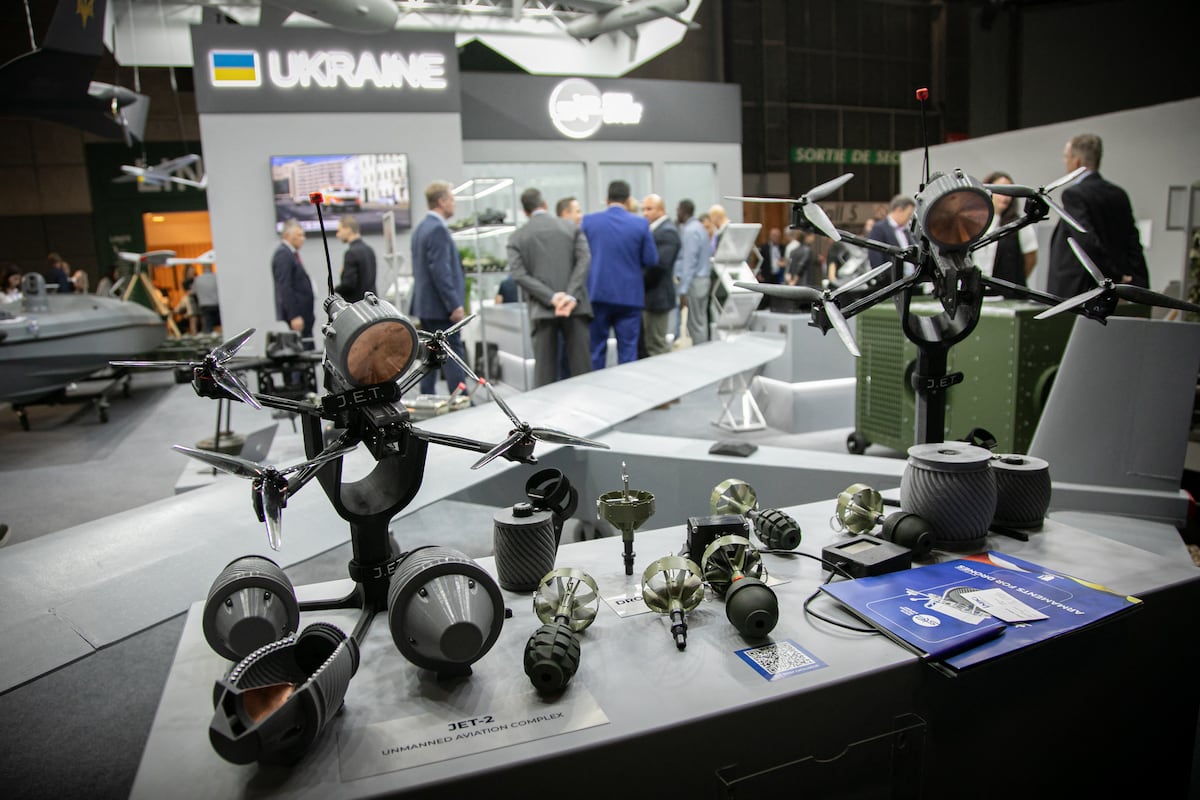
PARIS — It’s a head-scratcher for European governments: getting their defense industries ready to pump out hundreds of thousands of drones or other pieces of armament in case of possible war, without ending up with warehouses full of obsolete kit.
Europe has yet to resolve the conundrum, said Francois Arbault, the European Commission’s director for defense industry, at the Forum Innovation Défense in Paris last week.
“How can we be ready, in that we’re ready to embrace the scale that it takes to be at war, or in a conflict of whatever sort, without actually piling up equipment?” Arbault said. “That’s probably one of the most core questions that we need to be able to answer today. How is it to be defense-ready, when you are not yet at war?”
European leaders have been reluctant to adopt the dramatic rhetoric of French President Emmanuel Macron, who called for a shift to a “war economy” several months after Russia’s invasion of Ukraine in 2022. And while all European NATO members have lifted defense spending, none have retooled their economy to prioritize the war effort – France included.
Ukraine has something “essential and different from us, and that is they have a need to survive,” said Jérôme Cerisier, the chief executive officer of French night-vision equipment maker Exosens, speaking on a panel about future industry and the war economy. “We’re not as confronted as they are by the need to go very, very fast.”
Ukraine as a country at war “has no choice but to frantically scramble” to develop counters and offensive edges, and the same war mode cannot be expected from European countries, the European Commission’s Arbault said.
“But we have to be ready,” Arbault said. “And we see that innovation is going so fast that readiness doesn’t mean piling up thousand or hundreds of thousands of drones in a warehouse, because if one day we’re attacked, those drones will for sure be totally obsolete.”
The drone-development cycle in Ukraine is around eight to ten weeks, while product development in Western Europe is counted in months or years, according to André Loesekrug-Pietri, chairman of the Joint European Disruptive Initiative, a non-governmental organization looking to accelerate European innovation, who cited a recent visit to the country.
A way to circumvent the equipment stockpiling dynamic is having industrial and technological building blocks and components available “from which we’re going to make lots of possible systems,” said Marie Nicod, general partner at investment firm Jolt Capital. “From there, we have a mass of things, but which are not immobilized stock, and which will be used for many different use cases.”
Exosens has been scaling up its production capacity for drone cameras “little by little” in order to be ready to react quickly should the need arise, without taking too much initial risk, Cerisier said.
“We really need to talk about the war economy not necessarily in terms of implementation, but already in terms of preparation,” Cerisier said. He said companies need not just orders but also visibility on future demand to justify investments, something France’s military budget programming can bring.
The defense industry should prepare for a larger conflict by training scenarios of accelerated production to see where processes break down and to identify bottlenecks, said Sylvain Rousseau, CEO of Aresia, which makes aerospace equipment including weapon-release systems for aircraft.
“What’s stopping us from tripling our capacity, maybe it’s just a single machine, maybe just one piece of technology,” Rousseau said.
The European Union in March 2024 presented its first defense-industrial strategy, calling for “defense industrial readiness,” with then-European Commissioner Thierry Breton saying a few months later the European defense industries need to “move into a war economy mode,” one of the rare instances of the term being used at a European level.
Some European governments other than France have recently been pushing the industrial aspect of defense, with Dutch Defence Minister Ruben Brekelmans in March saying the war in Ukraine has become a war between industries, calling a strong defense industry “the backbone of our security.”
Sweden in June announced a new defense-industry strategy that specifically mentioned a goal of high production capacity.
Meanwhile, Polish Prime Minister Donald Tusk said in March that Russia has started an arms race that Europe must win.
The comparison with Russia is problematic, because that country is at war “and that’s not the case for us,” said Olivier Lecointe, in charge of industrial policy at France’s Directorate General for Armament. While speeding up production is part of getting industry war-ready, France isn’t going to build stocks to last through a war, as use would be uncertain and stocks would expire.
“So what matters is ensuring that the industry is able to produce,” Lecointe said. “You can’t go from a few thousand to hundreds of thousands at the snap of your fingers. You have to renovate production facilities, buy machines, hire people. And that, of course, requires investment.”
The defense industry still has many old machines in operation that remain useful, but production rates would be higher with modern tools, according to Lecointe.
“We could obviously imagine putting in place budgets to purchase production capacity, but if we purchase production capacity and then orders don’t come in, it’s actually money down the drain,” Lecointe said. “In terms of public spending, I think no French citizen would appreciate that.
Machinery is expensive, and solutions will have to be found through the business plan, which comes down to companies receiving increased orders, Lecointe said.
The level of production required for a high-intensity conflict will also mean designing new systems that can be mass-produced, according to Lecointe. He said the DGA is working on this particularly in the field of drones, “but there may be other applications.”
The DGA is working with a few companies to look at how civilian industrial manufacturing lines “not at all designed for this” can be adapted to mass produce something else by modifying only a few tools, according to Lecointe. The directorate then acts as a go-between with the weapons industry, which provides a design that can be modified to become mass-producible.
“At some point, we will certainly sign a contract to test it, but again, before buying tens of thousands, we will need the budgets,” Lecointe said. “The goal in this case is to be ready for the day when the crisis level justifies placing this kind of order – today we are not there yet – but we will be able to press the button and start production.”
Shifting civilian manufacturing lines to military production “comes at a huge cost,” which raises the question who will pay for the preparation, which entails significant risk as long as there are no orders, according to Rousseau at Aresia.
While some companies may be willing to take on some of that risk, they will need financial support to prepare for “more significant scenarios,” as the economics won’t motivate firms to sacrifice production capacity for military purposes, according to Rousseau.
Lecointe said that while there are opportunities for automotive suppliers as defense subcontractors to help scale up arms manufacturing, car-industry volumes are typically tens of thousands of vehicles per year, whereas production of for example Caesar cannons is counted in dozens.
“We’re not at all on the same economic models, on the same volumes,” Lecointe said. “So we have to be realistic about what we’re talking about.”
Armed forces are increasingly willing to test new equipment, similar to how Ukraine tests material on the battlefield, according to Lecointe, who said that clashes with some of the habits of France’s defense-capacity programming. He said the testing feedback loop between users and manufacturers needs to become “much faster.”
“Today, we are no longer in a context where we fire a missile once every 10 years. If we are preparing for a high-intensity war, it is not the same thing at all, and so we need to find new ways of working and dialoguing with industry on equipment.”
Rudy Ruitenberg is a Europe correspondent for Defense News. He started his career at Bloomberg News and has experience reporting on technology, commodity markets and politics.
Read the full article here
