

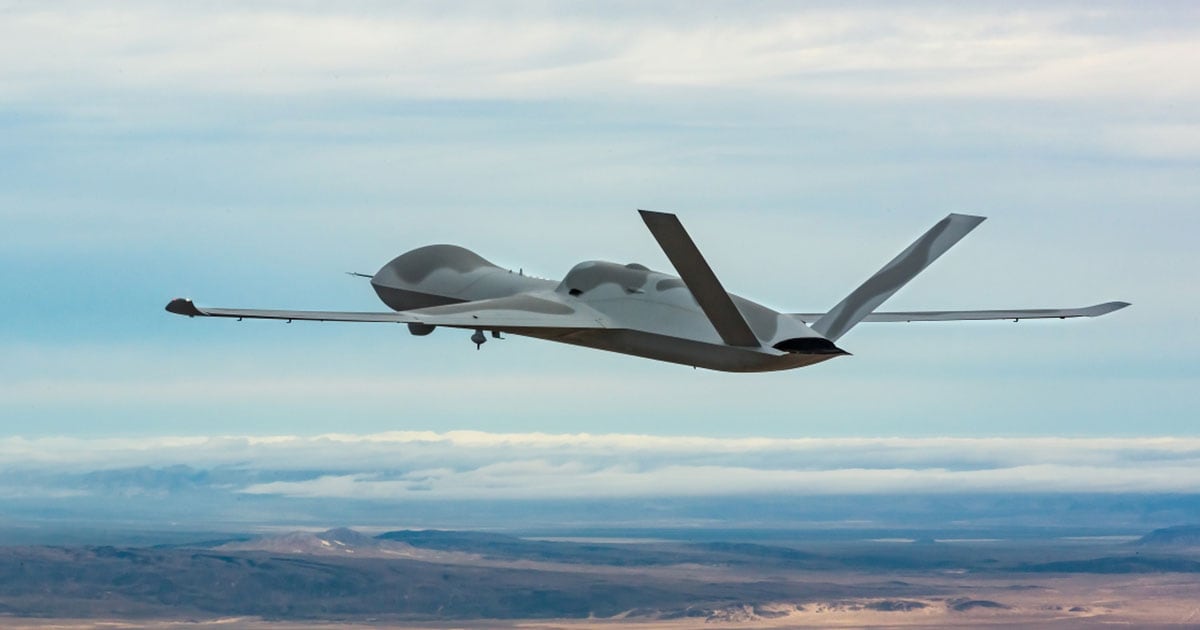
The U.S. Air Force and General Atomics Aeronautical Systems Inc. recently completed a successful manned-unmanned teamed demonstration between an F-22 Raptor and an MQ-20 Avenger unmanned aircraft, advancing the integration of autonomous systems into tactical fighter operations, according to a Feb. 23 company release.
The live-flight exercise, conducted at Edwards Air Force Base in California, featured a human-piloted F-22 issuing real-time commands to the MQ-20 via advanced autonomy software and a tactical data link.
The Avenger drone responded by executing a range of mission tasks, including waypoint navigation, combat air patrol patterns and simulated engagement of airborne threats, functioning as a direct force extender for the manned platform, according to the release.
The demonstration leveraged government-provided reference autonomy software on the F-22 and GA-ASI’s Autonodyne Bashi Pilot Vehicle Interface aboard the MQ-20.
Onboard sensors enabled the unmanned aircraft to process information independently, coordinate maneuvers and exchange tactical messages with the Raptor in a continuous command loop between the two aircraft.
“We appreciate the flawless execution of this mission using the government’s advanced autonomous systems,” said General Atomics President David R. Alexander. “This demo featured the integration of mission elements and the ability of autonomy to utilize onboard sensors to make independent decisions and execute commands from the F-22.”
The demo, meanwhile, builds on General Atomics’ accelerating timeline for the Collaborative Combat Aircraft program.
On Feb. 12, the Air Force announced validation of the Autonomy Government Reference Architecture, or A-GRA, across multiple vendors. This included successful integration of Collins Aerospace’s Sidekick software on the General Atomics YFQ-42A CCA for its first semi-autonomous airborne mission.
The YFQ-42A, officially nicknamed “Dark Merlin” in a separate press release on Feb. 23, executed precise commands for more than four hours under ground operator control, validating reliable data exchange and autonomy execution that support advanced manned-unmanned teaming, such as the recent MQ-20/F-22 demo.
The Edwards demonstration is the latest in a series of tests underscoring the Air Force’s priority on pairing fifth-generation fighters with autonomous unmanned aircraft.
Such teaming concepts aim to boost lethality, extend sensor reach and enhance survivability in contested environments by enabling pilots to delegate tactical tasks to drones while retaining command authority for complex decisions.
Read the full article here
