

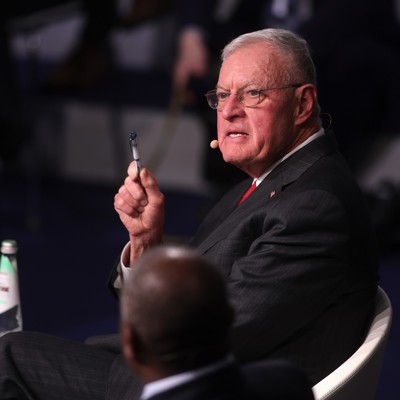
Donald Trump’s former special envoy to Russia and Ukraine, retired Lt. Gen. Keith Kellogg, will join the advisory board of Powerus, a Florida-based startup seeking to build relationships with and acquire technology from Ukrainian drone makers to sell to the U.S. military, the company said in a statement Tuesday. The news signals warming commercial and financial activity between U.S. investors and Ukrainian defense technology entrepreneurs, even as U.S.-led diplomatic talks on ending Russia’s war appear stalled.
Kellogg commanded the Army’s 82nd Airborne Division and served as director of command, control, communications and computers (J6) for the Joint Chiefs of Staff. He was a national security advisor to then-Vice President Mike Pence during Trump’s first term.
The selection of Kellogg as special envoy to Russia and Ukraine in November 2024 won praise from Ukrainians, and seasoned diplomats. His military experience and the consistency of his hawkish views toward Russian President Vladimir Putin contrast with other current and former members of Trump’s cabinet. The Kremlin, naturally, was less enthusiastic about his selection and complained about Kellogg’s presence at peace talks. He stepped down last December, replaced by Steve Witkoff, a real-estate developer with controversial business ties to Russia and who also serves as the U.S. envoy to the Middle East.
The rise of Powerus is an indicator of the growing American interest in Ukrainian defense tech. Based in West Palm Beach, Trump’s sons are among the investors. Fired former Joints Chief Chairman C.Q. Brown also joined the company’s advisory board this month. The company plans to go public this summer after an already-announced merger with Aureus Greenway Holdings.
It also speaks to a disconnect between current White House rhetoric on Ukraine and the actions of those connected to U.S. leadership. On one side is the dismissive White-House line painting Ukraine as a charity case, overly reliant on the United States. On the other are military operators, experienced policy professionals, and, increasingly, the global early-stage investor class urging deeper partnership with a proven ally who is defining the future of defense technology.
Ukraine’s new diplomatic strategy is commercial
As peace talks continue, Ukraine is pursuing a new strategy to build diplomatic relations: commercial links, and co-business development, a group of Ukrainian government and military officials said last week in Washington, D.C.“The political environment is what it is, and so moving from inadequate integration to leading with defense tech integration on a business level with business partners and allies,” one Ukrainian official said during a discussion with a handful of analysts and journalists at the German Marshall Fund.
Signs suggest Ukraine’s strategy is working; the number of U.S. firms that focus on Ukrainian defense technology is growing, as is the number of venture capital outfits, such as Ondas Capital. Eric Brock, Ondas CEO, told Defense One in January that for Ukrainian startups, partnerships with U.S. firms make sense. But such pairings offer important positioning for U.S. investors in terms of accessing future defense markets.
“We’re better able to see where the winners are and layer them into an operating model … We can meet the demand, because [the market for Ukrainian drone and counter-drone tech is] going to be exploding. It’s going to be this market exploding on infrastructure for drone and counter-drone technologies.”
Ukraine this week finalized deals with various Middle Eastern governments for technology sharing. The countries are in urgent need of air defenses against the Russia-launched, Iranian-designed drones that Ukraine has been contending with since 2023.
In March, Ukrainian drone company Swarmer announced an initial public offering on the Nasdaq and saw shares jump in value by a factor of eight.
“Ukraine taught us how big of an advantage drones have been to equalize its defense against what should have been a lopsided victory for the Russians. Small, cheap, mass-produced machines now obliterate state-of-the-art tanks and missile systems worth tens of millions, and intercept waves of kamikaze drones at scale,” Kellogg said in a statement. “Powerus is bringing that equalizing power and the same capabilities to the U.S.”
Read the full article here
