

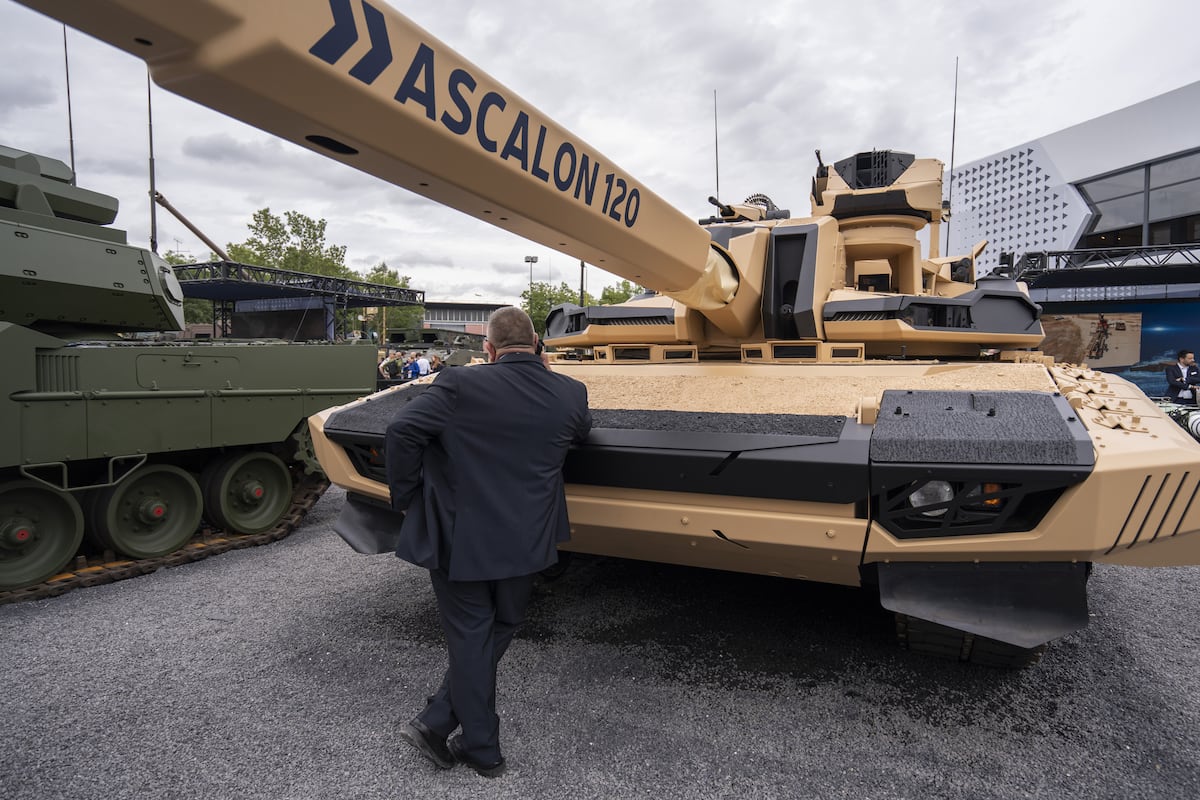
PARIS — France is in talks with manufacturers about an intermediary solution to replace the country’s aging Leclerc main battle tank, as a project with Germany to develop a next-generation tank is delayed, Armed Forces Minister Catherine Vautrin told lawmakers on Wednesday.
The French-German project for the future Main Combat Ground System, which was supposed to produce the Leclerc’s successor, is about a decade behind schedule, Vautrin told lawmakers in a hearing on Wednesday. The minister presented government plans to spend an additional €36 billion ($42 billion) on defense in the 2026-2030 period.
The delay for the MGCS project is due to Germany deciding to start a program for new Leopard 3 tanks, according to Vautrin. That has left France having to bridge the gap between the Leclerc reaching the end of its service life in 2038, and the arrival of the MGCS, which in any case had not been expected before the early 2040s.
“Regarding this intermediate capability, what we want is for it to be the first building block of the MGCS, not the last tank of the old generation,” Vautrin said. The tank would be “the first tank of a new generation of system of systems” with a particular focus on connectivity, according to the minister.
The stopgap tank could be based on a KNDS Germany platform with a KNDS France turret, according to the minister. She said the turret will be French “in any case. Discussions are currently ongoing between France’s Directorate General for Armament and various manufacturers, and are “just getting started,” Vautrin said.
The increased spending is part of an update of France’s military planning law, which had originally budgeted €400 billion for the 2024-2030 period.
With regards to another troubled project, the French-German-Spanish Future Combat Air System, Vautrin said mediation is underway between the two companies developing the next-generation fighter jet at the heart of the program. Work on the fighter jet has ground to a halt amid bickering between Dassault Aviation and Airbus over leadership and work share.
Two “qualified, external individuals” are leading negotiations to address intellectual property, work share and airworthiness certificates, with talks to conclude by the end of April, “which will allow us to see clearly,” the minister said.
Talks with Airbus were to try and reach an agreement that would allow the project to continue, Dassault Aviation Chief Executive Officer Éric Trappier said at an industry conference on April 1, adding that he is “not a man of co-management.”
While FCAS started out as a French-German project, the addition of Spain gave Airbus a bigger share in the pillar working on the next-generation fighter, with Trappier claiming Airbus has been unwilling to accept Dassault Aviation’s originally agreed lead.
Members of parliament noted the Eurodrone project, a long-delayed program led by Airbus to develop a medium-altitude long-endurance drone, is no longer included in the updated budget, with Vautrin responding that “as of now, the project is not progressing satisfactorily.” The government also scrapped plans to buy Safran’s Patroller MALE drone.
France intends to accelerate orders for the SAMP/T NG long-range air-defense system, with the aim of having ten systems in 2030 rather than the originally planned eight, though the goal remains for 12 systems in 2035, according to Vautrin.
The government is sticking to a plan for 225 Rafale fighter jets in 2035, divided between the Air Force and the Navy. Rather than buying additional Rafale jets configured to the F4 standard, the preference is to focus on the purchase of the future F5 standard, which will be able to carry the ASN4G hypersonic nuclear missile under development, according to Vautrin.
The budget includes €3.5 billion to overhaul the combat aviation framework through an approach that combines long-range missiles, escort drones and connectivity, which Vautrin said required to keep the Rafale competitive in export markets. The F5 standard is “truly a mid-life upgrade” that will allow the aircraft to maintain its competitive edge, according to the minister.
The updated military spending plan foresees 30 multiple launch rocket systems in 2030, compared to a previous plan for 16 such long-range strike systems, Vautrin said.
France will test two domestically developed rocket-artillery systems this month, which will allow to decide end-April whether a “sovereign” solution can be considered, or whether the Armed Forces Ministry should look for an off-the-shelf system, according to Vautrin.
Safran together with MBDA as well as Thales in combination with ArianeGroup are each working on their own French-made rocket artillery systems.
The updated budget adds €1 billion to start work on a conventional ballistic long-range strike capability.
The Armed Forces Ministry will order 10,000 combat drones, 43 Proteus anti-drone cannons and four SAMP/T NG air-defense systems this year, as well as €4 billion worth of air-defense systems to counter drones, according to Vautrin. Deliveries in 2026 will include 5,000 combat drones, three anti-drone lasers and two Airbus A400M transport aircraft.
Vautrin noted progress for French arms manufacturers trying to step up production, with the minister saying the firms should “continue the effort.” She said MBDA is increasing production of Mistral 3 short-range air-defense missiles fourfold to reach 800 a year in 2028, while the company aims to increase production of the Scalp cruise missile to 360 in 2027 from 240 in 2025.
Rudy Ruitenberg is a Europe correspondent for Defense News. He started his career at Bloomberg News and has experience reporting on technology, commodity markets and politics.
Read the full article here
