

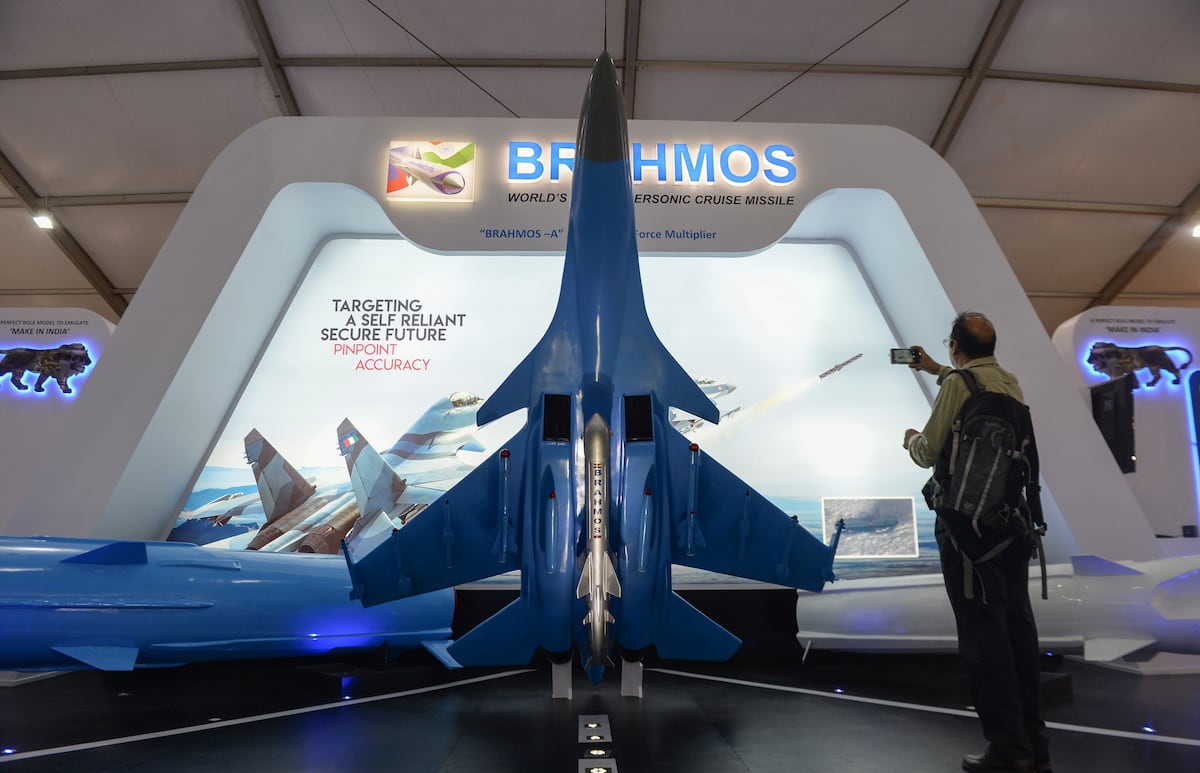
NEW DELHI — India is tightening military ties with Southeast Asian countries with deals to sell advanced missiles and enhancing security cooperation in a region where several countries are involved in maritime disputes with China in the South China Sea.
Analysts say New Delhi’s outreach to countries such as Indonesia, the Philippines and Vietnam marks its growing strategic role in the Indo-Pacific. It also complements the push by the United States and its allies to counterbalance China in the region.
“India is a relatively new player in the region where countries are trying to build up their own capacities,” according to Chintamani Mahapatra, founder of the Kalinga Institute of Indo-Pacific Studies in New Delhi.
“China is an important economic partner for these nations, but at the same time poses a security challenge, so they want to strengthen themselves in handling Beijing,” he said by phone.
Indian Defense Minister Rajnath Singh met with his Indonesian counterpart, Sjafrie Sjamsoeddin, in New Delhi last month on supplying BrahMos supersonic cruise missiles to Jakarta. A deal would make Indonesia the second country to acquire the missiles, produced under a joint venture with Russia in which the Indian side is the majority stakeholder.
Although the BrahMos missile, the centerpiece of New Delhi’s defense sales in Southeast Asia, was developed with Russian collaboration, it will not boost Russia’s role as an arms supplier in Southeast Asia, analysts say.
“Russia has been under sanctions since the Ukraine war, so countries would be extremely wary of any purchases from Moscow,” Rahul Bedi, a defense analyst in New Delhi, said by phone.
India began delivering a shore-based, anti-ship BrahMos missile system to the Philippines under a $375 million deal last year, with deliveries continuing. Manila began procuring the system to boost its maritime defense as its ties with Beijing are strained by frequent clashes with China in the South China Sea, which China claims mostly as its own.
India has upgraded ties with several countries, such as Indonesia and Vietnam, in recent years to a comprehensive strategic partnership, which means deepening ties in a range of areas such as economy, defense and technology. New Delhi has also been helping train troops from several Southeast Asian countries – such as Vietnam, Singapore, Malaysia, Indonesia, the Philippines and Thailand – and conducts joint naval and military drills with them.
India’s increasing role in bolstering small East Asian countries’ military capabilities has also been propelled by its growing defense ties with the United States.
India and the U.S. signed a 10-year defense pact to advance cooperation on the sidelines of the Association of Southeast Asian Nations defense ministers meeting in Malaysia in October.
“This advances our defense partnership, a cornerstone for regional stability and deterrence,” U.S. Defense Secretary Pete Hegseth said in a post on X after the signing.
The U.S.-Indian security partnership has integrated India deeper into the Southeast Asian security architecture, analysts say.
“It is part of a concerted U.S. effort to push its allies and partners to build closer political and security ties to reduce Washington’[s] burden of balancing China in the region,” Ivan Lidarev, a visiting research fellow at the National University of Singapore’s Institute of South Asian Studies, said in emailed comments.
“This ‘latticework strategy’ aims to create an integrated, interconnected network of defense, economic, and supply chain partnerships in the Indo-Pacific. As a geostrategically crucial U.S. partner in balancing China, India is a key element in this,” he said.
He also stressed that the U.S. is not the only factor in the improved ties.
“India and its Southeast Asian partners are pursuing their own strategic interests through their partnerships and not merely responding to American encouragement,” Lidarev said.
India’s deepening role in Southeast Asian security underlines the need of these countries to build their own deterrence capacities, analysts say, which is important given current uncertainty about the U.S. strategy in the Indo-Pacific.
“Due to current geostrategic uncertainties and the need to expand options at a time when China continues to have a bigger hold on the various maritime zones of Southeast Asia, diversification is definitely a practical step and India seems a natural partner. So, we are seeing a lot of effort by New Delhi and the Philippines, for example, to build its resilience,” according to Don McLain Gill, a geopolitical analyst and lecturer at the Department of International Studies, De La Salle University in Manila.
Acquiring weapons and defense technology from India also reflects Southeast Asian countries’ reluctance to depend on the U.S. as the sole security provider or dominant defense supplier in the Indo Pacific. While looking at other options, military hardware purchases from New Delhi pose an attractive option – they avoid the risk of sanctions that could accompany those bought from Russia or China.
The Philippines Armed forces chief of staff, Gen. Romeo Brawner Jr., said in August that Manila will get more military equipment from India, citing affordability and quality, the official Philippine News Agency said Aug. 1.
“The sale of weapons by India is without any strings attached. When the U.S. or Chinese sell weapons, there are tangible or intangible strings attached, so it is easier for Southeast Asian countries to tie up with India than with major powers,” Mahapatra said.
“At the same time, India wants to emerge as a defense exporter, so it is a win-win situation for both sides,” he said.
Read the full article here
