

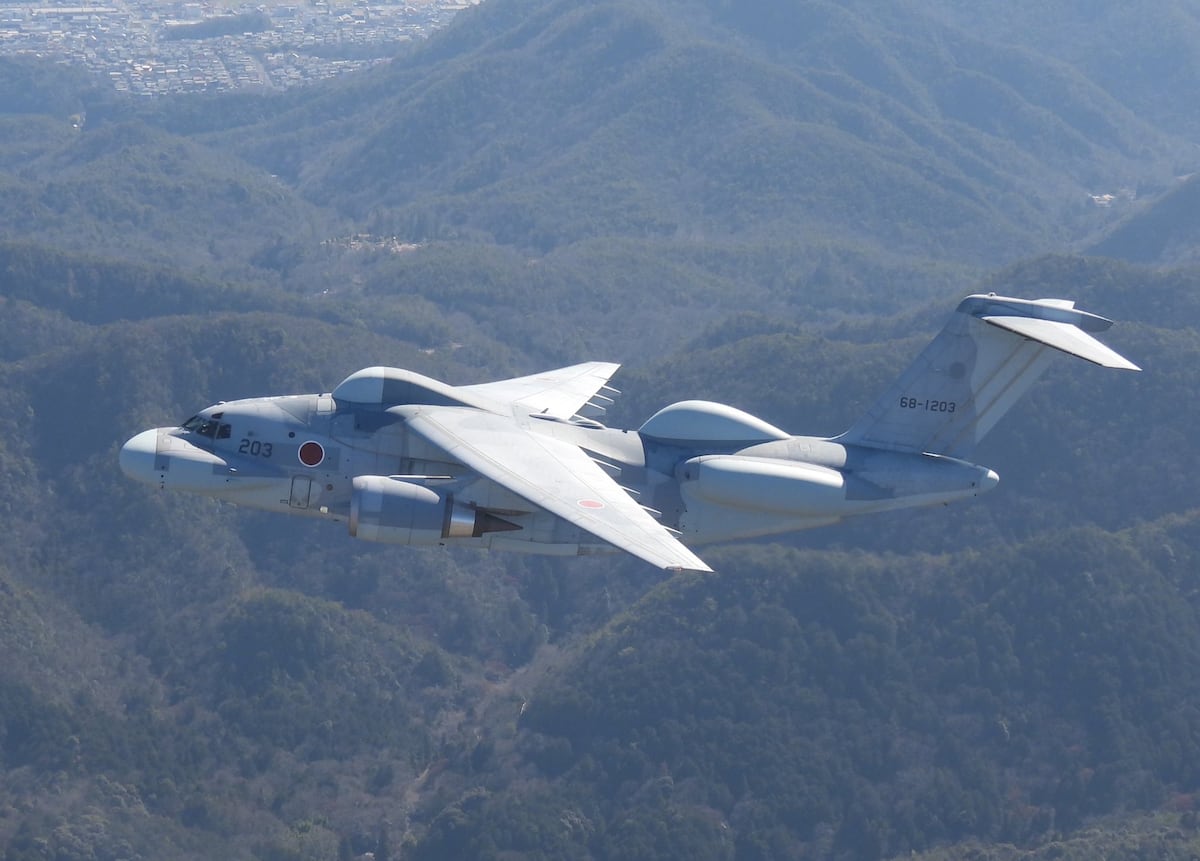
CHRISTCHURCH, New Zealand — Japan’s new electronic-warfare aircraft, converted from a Kawasaki C-2 tactical cargo hauler, took to the sky for its maiden flight this week.
The EC-2 plane, ridiculed by judgy aviation enthusiasts for its bumpy body, took off from Gifu Air Base on March 17, checking a key box in the envisioned plan of fielding the aircraft for operations in March 2027.
The Japan Air Self-Defense Force – or JASDF for short – stated, “We’ll continue working toward its introduction to improve capabilities in the electromagnetic domain, and to strengthen the cross-domain operations capabilities.”
When deemed ready the aircraft will be assigned to the Electronic Warfare Operations Group located at Iruma Air Base, east of Tokyo.
Last year’s defense budget listed funding of 41.4 billion yen – around $262 million – to continue development of the EW aircraft.
Of note, the EC-2 was converted from the first production C-2 transport delivered to the JASDF. The twin-jet C-2 is similar in size to an Airbus A400M, with acquisition officials choosing it for the EW role thanks to its payload capacity and flight performance.
While the aircraft is not expected to win any beauty competition – with its bulbous nose that resembles a platypus, two tandem dorsal humps and protruding lateral fairings – it performs an important mission of disrupting and neutralizing enemy radar and communication systems on the ground and in the air from a safe distance.
Specialized equipment includes jamming technology, electronic countermeasures, electronic support measures and satellite communications. This equipment was developed domestically, including the upgraded J/ALQ-5 jamming system.
Concerned by troublesome neighbors like China, North Korea and Russia, Japan’s fiscal 2026 budget stated: “The electromagnetic spectrum has become the frontline of offense and defense in modern combat. In light of this situation, securing superiority in the domain of electromagnetic spectrum is an urgent issue.”
The question for Japan is how many EC-2s the JASDF should acquire. The defense-acquisition directorate says the number is “currently under consideration,” although officials have previously mentioned a requirement for four aircraft.
The JASDF operated a solitary EC-1 EW aircraft from 1986 until its retirement last year. Moving from one EW platform to potentially four demonstrates the importance Japan is now placing on electronic attack.
Kawasaki has built 18 C-2s for the JASDF so far. With one converted to an EC-2 and another becoming an RC-2 electronic-intelligence platform in 2020, the JASDF currently has 16 in a transport configuration.
Of note, budgets since 2024 have allocated money for additional RC-2 electronic intelligence aircraft.
Incidentally, the JASDF has also tested a C-2 with the American Rapid Dragon palletized weapons module. This system would allow long-range cruise missiles – such as Japan’s upgraded Type 12 weapon – to be launched from the rear of a transport aircraft.
However, defense leader have yet to decide on the future acquisition of such a system.
Gordon Arthur is an Asia correspondent for Defense News. After a 20-year stint working in Hong Kong, he now resides in New Zealand. He has attended military exercises and defense exhibitions in about 20 countries around the Asia-Pacific region.
Read the full article here
