

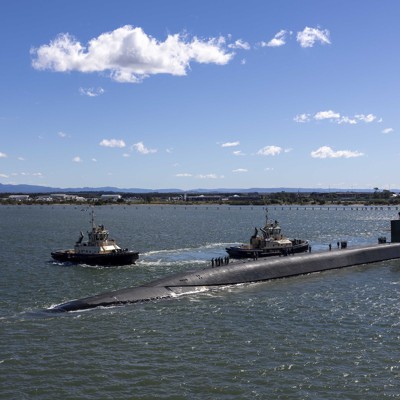
The United States may need more Columbia-class submarines to break even with existing submarine nuclear capabilities in the aging Ohio-class fleet, Adm. Richard Correll, the head of U.S. Strategic Command, said Thursday.
“The existing capability we have includes 14 Ohio-class boats with 20 tubes. So that’s 280 launch tubes. The program of record is a minimum of 12 Columbia with 16 tubes each, and that’s 192. So that’s 280 versus 192,” Correll told the Senate Armed Services Committee.
“Additional capacity and capability is very beneficial from my perspective. There’s ongoing work within the department in terms of force sufficiency, and that work will inform any future budget decisions associated with Columbia. But if you just do the math for what we have and the program of record, I will continue to advocate for additional capability at sea in terms of the Columbia class.”
The first Columbia-class submarine is about a year behind schedule, with expected delivery in 2028. The Navy has a maintenance plan to extend the life of Ohio class submarines so they can last until the Columbia submarines are built.
But at least one senator seems open to adding to the Columbia program.
Correll’s response came after Sen. Tommy Tuberville, R-Ala., asked what STRATCOM would do if Congress could fund more Columbia-class submarines—16 instead of the 12 in the program of record.
“Submarines are the tip of the spear for our nuclear capabilities. The problem is we can’t seem to build them fast enough,” Tuberville said. “What flexibility and capability does STRATCOM gain if we were able to field 16 Columbia class submarines versus 12?”
Senate Armed Services Committee Chairman Roger Wicker said the thrust of the question gets at how much better U.S. defenses would be “if we’re able to reach the goal that he mentioned. And the answer is that we very much need to do that. Is that correct?”
If Congress were to fund four more Columbia-class submarines, “that maximizes flexibility and options to present to the president should the need arise,” Correll said.
“The importance to our deterring capability, I can’t overstate that—all three legs are vitally important. They complement each other, and the sum of the parts are much greater than the whole. For the SSBN, that assured second strike capability that’s always at sea, always ready to respond, deters effectively. And I see that in the intel reporting record.”
Read the full article here
