
The war in Ukraine has made one thing unmistakably clear: drones are no longer a support weapon on the battlefield. They are central to how modern wars will be fought. From reconnaissance and targeting to direct strikes, low-cost, fast-moving drones with powerful payloads are causing massive destruction and racking up kills against traditional armed forces. And that mastery of drone warfare is allowing a smaller country like Ukraine to hold its own on the front lines against a superpower, performing devastating strikes that keep the Russian Army on its back foot.
The world is taking notice. Other countries in the region are already planning to use drones in their defense should war come to their door, while also countering those of their potential enemies. The shift in military thinking was on display earlier this year as Estonia announced plans to build a so-called “drone wall” along its border, a layered defensive system designed to detect and counter unmanned aerial threats. As Estonian defense officials explained to Nextgov/FCW, their goal is not simply to buy more hardware, but to rethink how borders and battlespaces are protected in an era where inexpensive drones can have a large strategic impact.
But that same lesson is not theoretical in Ukraine, where drones have become one of the most decisive tools of the conflict. In Ukraine, small, fast and often expendable drones are now used for everything including reconnaissance, precision attacks in the midst of combat, electronic warfare, air defense interception and even strategic strikes far behind the frontlines. Most of the drones used by Ukraine are FPV, or first person view, models flown by operators who often receive only weeks of training before being sent to the front. In that environment, pilot skill matters a lot. And that is where simulation technology has quietly become just as important as the hardware.
Over the past two years, Ukrainian forces have relied heavily on high-fidelity drone simulators to train operators before they ever touch a real aircraft. According to Simtech Solutions, the developers of one of the main Ukrainian training tools, their platform alone has been used to get over 5,000 military pilots flight ready, capable and certified to perform even the most advanced and critical missions. And the results speak for themselves. The company says that pilots who trained with their simulator have successfully struck over 100,000 real-world targets.
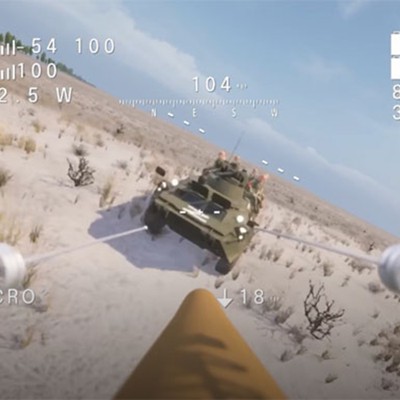
That platform has now been released in a public-facing version called Ukrainian Fight Drone Simulator, which is available on the Steam platform. I was able to experiment with the new simulator, logging in over 100 hours of flight time and training. With real-world physics and battlefield conditions, it was not a walk in the park. I ended up crashing almost 200 drones before I even got through the training academy, much less get anywhere close to an enemy. But even while I was still learning how to fly drones in combat, it was clear how much this technology could dominate the battlefields of the future, perhaps even more so than any other conventional weapon.
Although it’s available on a gaming platform like Steam, calling Ukrainian Fight Drone Simulator a game understates its rich history on the frontlines and its commitment to realism. The developers describe it as a public adaptation of their ultra-realistic trainer, built directly from battlefield lessons. Everything from the physics of flight to the ruthlessness of battlefield opponents are intentionally unforgiving.
You can’t even use a game controller too effectively with it. For a true training experience, you need to have a real RC Controller, just like the pilots in Ukraine. I used my Radiomaster TX16S that controls my personal drone, but almost any other model works just fine. The developer recommends Radiomaster Pocket, Zorro, TX12, Boxer, TX16S or TBS Tango 2 RC controllers.
The simulator includes multiple classes of combat drones, as most of the ones being used in Ukraine are fairly modular in terms of their possible loadouts. You can set them up for bomb drops against infantry, although that technique can also be effective against light vehicles or rear supply areas. More powerful are the kamikaze drones that can lug around huge bombs or artillery shells in their undercarriages. Although this greatly complicates flight physics, direct hits from them can destroy armored vehicles — like fast-moving Russian BMPs — or hardened targets — like earthen bunkers. Even frontline tanks, once the kings of the battlefield, can be damaged or disabled by a hit from a drone in a critical spot, and then destroyed with follow-up strikes.
If you are up for a real challenge, air interceptor drones are also included. If you thought that hitting a moving vehicle or a group of running soldiers was difficult, try chasing down a helicopter or even an enemy drone. It takes a lot of skill and practice.
What really stood out to me during my time on the simulated frontline was how much Ukrainian Fight Drone Simulator emphasizes military elements beyond just flying drones. You actually have to plan your missions, taking into account things like time of day, lines of sight, potential exposure to enemy defenses and whether or not the enemy is operating electronic warfare in the area. I had to learn how to manage things like battery power too, because going around an area with dense anti-air defenses to get at juicy targets sitting behind them might be a great idea, but only if your heavily laden drone has enough juice to make the run and still give you a least a few minutes of time over your target.
Although I had a great experience with Ukrainian Fight Drone Simulator, it was not really about flying for fun. It was more about understanding how drones can be successfully used in modern conflicts. My success in the field really depended on training, discipline and repetition.
And that is where something like Ukrainian Fight Drone Simulator becomes relevant far beyond Ukraine. For defense agencies, allied militaries and even policymakers, tools like this provide insight into why drones are changing warfare so rapidly. They also help explain why training has become such a critical bottleneck. Hardware can be produced quickly. Skilled operators cannot.
What simulations like Ukrainian Fight Drone Simulator ultimately demonstrate is that the drone revolution is not theoretical. It’s operational, and it’s happening now. Armies that go into their next fight without an extremely capable drone wing and a cadre of qualified and experienced pilots are likely to be at a serious disadvantage.
As more agencies track drone developments and consider how to defend against or deploy them, simulations will play an increasingly important role too. They offer a safe way to understand a technology that is anything but safe on the battlefield. And for anyone trying to grasp how modern conflicts are evolving, stepping into a virtual cockpit like the ones that Ukrainian Fight Drone Simulator offers may be the most instructive place to start.
John Breeden II is an award-winning journalist and reviewer with over 20 years of experience covering technology. He is the CEO of the Tech Writers Bureau, a group that creates technological thought leadership content for organizations of all sizes. Twitter: @LabGuys
Read the full article here
