

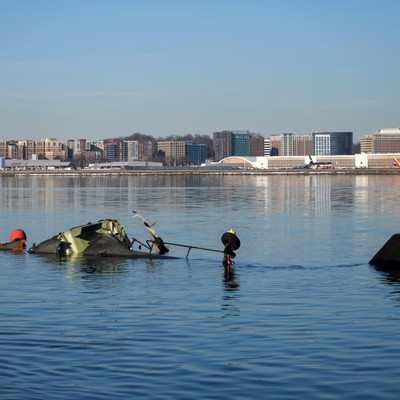
The Pentagon will have to provide summaries of nearly three years’ worth of internal safety investigations under the annual defense policy bill, a provision inserted to force transparency amid a rise in military aviation mishaps.
The provision, contained in a committee report attached to the 2026 National Defense Authorization Act, would give the Pentagon’s Joint Safety Council and the military services an April 1 deadline to give the Senate Armed Services Committee “executive summaries for Safety Investigation Boards conducted from January 1, 2022, to July 1, 2025” and “summaries of any corrective actions implemented in response to the Board’s findings.”
That timeframe would encompass high-profile incidents such as the deadly Jan. 29 collision of an Army UH-60 Black Hawk and a commercial airliner outside Washington, D.C., and several V-22 Osprey crashes that killed a total of 20 service members.
The provision was added by Sen. Elizabeth Warren, D-Mass.
“The Pentagon owes transparency to the families of service members killed in these crashes,” Warren told Defense One in a statement. “I’ll keep fighting for accountability and to make sure the V-22’s safety defects are addressed so no more military families lose their loved ones in preventable accidents.”
The NDAA has passed the House and Senate and is expected to be signed by President Donald Trump. Warren’s win in securing the provision comes after her office raised concerns about the rising rate of military aviation mishaps. Pentagon data reviewed by Defense One shows that deadly and costly “Class A” military aircraft mishaps rose 55 percent from fiscal 2020 to 2024.
“The committee is very concerned that the Army, Air Force, and Navy continue to report near record rates of serious Class A flight mishaps,” the NDAA report language reads.
After aviation mishaps, the Pentagon often creates two reports: a public-facing Accident Investigation Board report and an internal Safety Investigation Board report. The AIB’s purpose is to record “factual information for claims, litigation, administrative or potential disciplinary actions,” the Air Force has explained, while an SIB, however, is “used solely for mishap prevention and is restricted from release outside.”
Details in an SIB include testimony and more detailed information as to what may have led to a mishap. For example, following the crash of an Air Force CV-22 Osprey off the coast of Japan in 2023, an accident investigation report pointed to the fracturing of a high planetary pinion gear. The SIB said that the part failure was “similar to those seen on seven previous failures in low-speed planetary pinion gears” going back to 2013. The Pentagon had reportedly been warned of the potential issue in 2014.
Those longstanding and mechanical issues with the V-22 have been consistently unaddressed by the Pentagon’s Joint Program Office, reports from the Government Accountability Office and Naval Air Systems Command revealed last week. Some recommended mechanical fixes won’t be in place until the 2030s, NAVAIR said.
Read the full article here
