

The Pentagon will nearly double its innovation arm, expand the industrial base for cheap maritime and aerial drones, and develop new ways to ensure supplies of critical minerals, according to an unclassified spending strategy for the $151 billion in funding from last year’s One Big Beautiful Bill Act.
Unlike most spending allocated in the annual defense bills, the reconciliation act does not just suggest the Pentagon spend the money, but requires it. The act gave the Pentagon until September 2029 to spend the money, but the allocation plan, a copy of which was obtained by Defense One, shows a push to put more of the money to work quickly.
Large portions of the plan are classified and hidden from the public, but the biggest group of allocations—some $24.4 billion—is for new missile-defense systems as part of the Golden Dome effort. It includes about $2 billion for ground-based radars and $2.2 billion for the “acceleration of hypersonic defense systems.” Space-based weapons to shoot down hypersonic missiles during the boost phase receive $5.6 billion. The document also allocates $250 million to develop lasers or other directed-energy weapons and $40 million to develop cheaper air- and missile-defense interceptors.
The strategy puts $4.6 billion toward a second Virginia-class submarine and $5.4 billion toward new guided missile destroyers, as expected. It also includes $2 billion to improve the U.S. production of critical minerals.
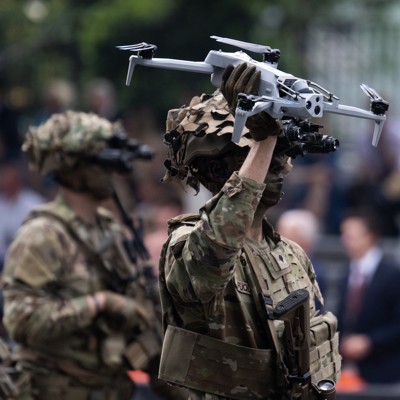
The plan includes multiple measures to address a key shortcoming in the Pentagon’s readiness for high-intensity conflict: getting low-cost, highly autonomous drones to the front lines quickly. The spending plan increases the Defense Innovation Unit’s budget to $2 billion, up from $1.3 billion enacted last year. It also includes $1.4 billion to expand the industrial base for drones, $500 million for the Defense Autonomous Warfare Group to prevent delays in the delivery of critical drones, and $650 million for joint innovation programs, such as multi-domain collaborative autonomy—getting sea, air, and land drones to communicate with one another and execute missions with minimal human involvement.
The document illustrates that the department is looking to fund robots across land, sea, and air. The Army will receive $74 million for its Autonomous Ground Fighting Vehicle program, while the Navy will get $1.5 billion for small surface drones, $2.1 billion to expand the deployment of medium drone boats such as the Sea Hunter, and $1.3 billion to build and buy new underwater drones and payloads for them.
In terms of artificial intelligence, the spending plan shows a $450 million plan to apply autonomy and artificial intelligence to shipbuilding and build out a unified “digital architecture” for shipyards and suppliers. The goal is to make it easier for the Navy to forecast needed materials, predict maintenance, optimize construction, and plan workforces. Additionally, the plan includes $145 million for the “development of artificial intelligence to enable one-way attack unmanned aerial systems and naval systems,” and $1 billion for the X-37B military spacecraft program.
Additionally, the plan allocates $250 million to advance an AI “ecosystem” and $124 million for “Improvements to Test Resource Management Center artificial intelligence capabilities.”
Read the full article here
