

PARIS — Europe will likely need until the early 2030s to develop some of the critical defense enablers needed to deter or defeat Russia without the United States, according to security researchers and experts surveyed by Defense News.
Establishing robust air and missile defenses, a priority for both NATO and the European Union, may still take five to 10 years, according to the analysts. Europe is better positioned in areas such as strategic airlift and aerial refueling, where it has sufficient capability to stand alone or can close the gap within a few years, based on the assessments.
The U.S., through NATO, provides high-end capabilities critical for effective combat operations, such as command and control (C2), satellite intelligence and deep strike, which European allies either lack or field only in a limited capacity. With American security guarantees seen uncertain amid deteriorating trans-Atlantic ties, Europe faces a multiyear effort to address its dependencies.
“There are areas in which the Europeans have zero meaningful capability, there are a few areas in which the Europeans own an arguably adequate capability today but for which the issue is one of replacement, and there some areas in which scale, not quality, is the issue,” said François Heisbourg, special adviser at the Paris-based Foundation for Strategic Research.
Beyond transport and tanker aircraft, the areas where Europe is closest to having sufficient capability are military satellite communications, battlefield C2, unmanned intelligence, surveillance and reconnaissance (ISR), and long-range strike, based on the assessment of 16 experts from European think tanks and institutions. Those capabilities can be in place within five years, a majority said.
With Western military leaders worrying Russia could seek to test NATO resolve in Europe within a matter of years, several analysts highlighted having long-range or deep strike as key to deterrence.
After the end of the war in Ukraine, Russia could in a worst case need less than a year to build up enough capabilities for a military operation with limited geographical objectives, Dutch intelligence services said this month. That would probably not be aimed at militarily defeating NATO, “but at dividing the alliance and forcing concessions with regard to the European security architecture.”
Russia is likely preparing for further conflict even as it continues to fight in Ukraine, Estonia’s Foreign Intelligence Service wrote this month, though it assessed that Russia has no intention to attack a NATO member state in the coming year.
“We need to invest, obviously, in our air defense capabilities and all that, but the notion that you can deter a country like Russia with only defensive capabilities strikes me as a bit naive,” said Guntram Wolff, a senior fellow at Bruegel, a Brussels-based think tank. “So you really have to have offensive capabilities and that means, at the end of the day, deep strike capabilities.”
It’s a view shared by countries including Denmark and Norway, with the former saying in September it needs long-range strike to bolster its deterrence posture, and the latter in January announcing the purchase of Hanwha’s Chunmoo rocket artillery system, including munitions with a range of up to 500 kilometers.
France, Germany, Italy, Poland, Sweden and the United Kingdom said in February some projects within their joint European Long-range Strike Approach, or ELSA, are at a “high level of maturity,” including an air-launched long-range strike capability. The U.K. and Germany announced in May last year they would work on a new long-range strike capability with a range of over 2,000 km.

Europe doesn’t have a lot of systems that can shoot beyond 500 kilometers, said Chris Kremidas-Courtney, a senior visiting fellow at the Brussels-based European Policy Center and NATO advisor. Central Moscow is around 585 kilometers from the eastern-most point of Latvia.
“If we can’t reach out and touch Moscow, then there’s not a lot to give Mr. Putin and his friends a lot of pause,” said Kremidas-Courtney, referring to Russian President Vladimir Putin. “In a multi-polar world, if you can’t touch the other poles, you’re not really a pole. The sooner we have our own deep strike capability, the better.”
Europe needs its own intermediate-range ballistic missiles, and has the know-how to produce them through French rocket maker ArianeGroup, according to Kremidas-Courtney. “There’s not a lot of people making this stuff, at least no one that is friendly to us,” the researcher said. “I’m pretty sure we could figure this out. It’s just a gigantic price tag.”
The surveyed analysts were relatively optimistic about Europe’s long-range strike timeline, with six considering it will take less than two years to have adequate capability, while another six assess it will take between two and five years.
Space-based ISR and integrated air and missile defense are the areas of greatest pessimism, with half of the survey respondents considering Europe will need more than five years to get those enablers in place at a sufficient level.
European air-defense readiness “depends on what we’re taking about,” said Héloïse Fayet, research fellow at the French Institute of International Relations and head of its deterrence and proliferation program. Full strategic integrated air and missile defense for the whole European territory would be “totally impossible to put in place,” she said.
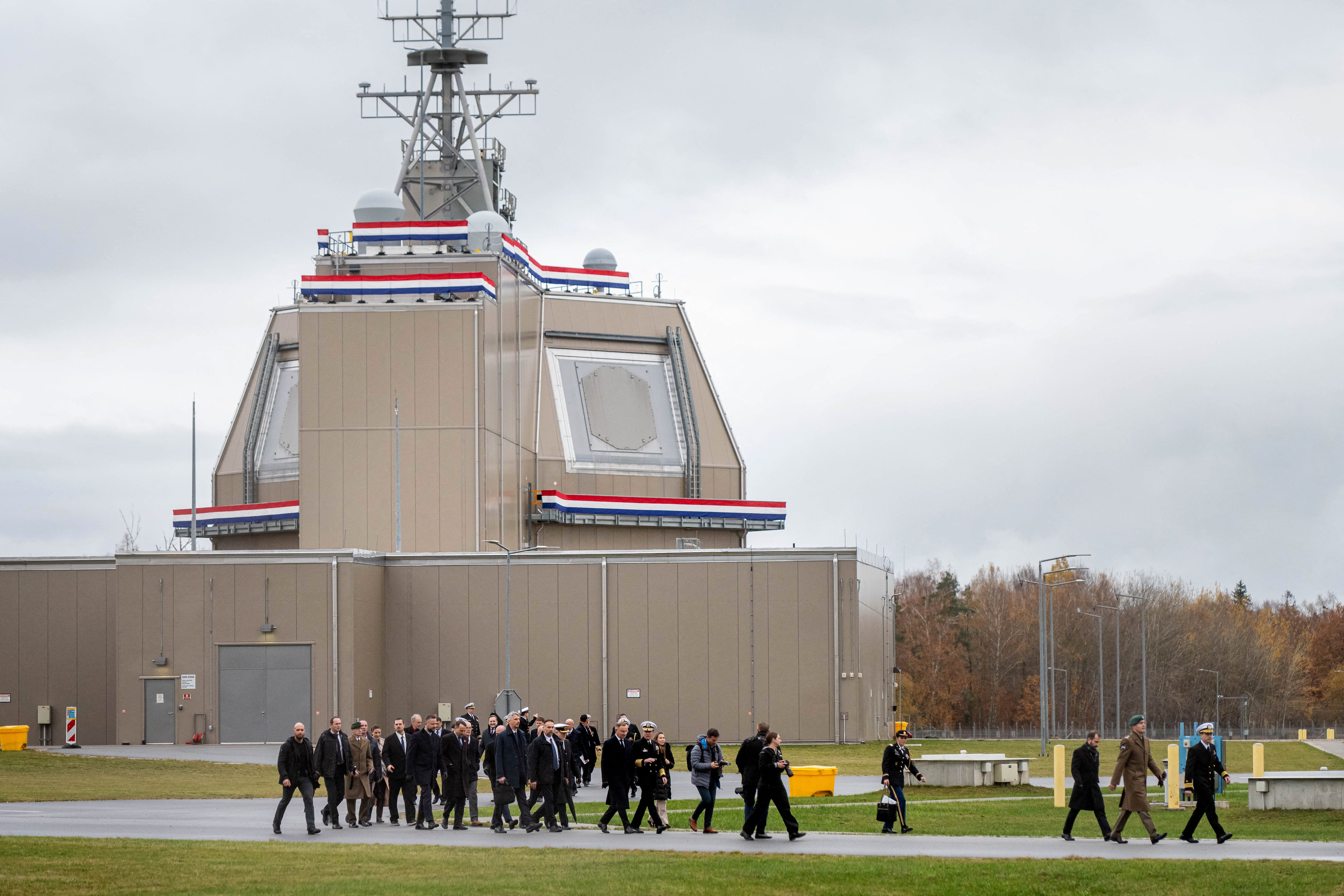
What’s unclear is whether the U.S. recalibrating its presence in Europe would mean withdrawing Aegis Ashore air-defense sites and other systems, according to Fayet. She noted recent progress on the French-Italian SAMP/T system, and said Europe could get more Patriot systems, at the cost of reinforcing dependency on the United States.
Europe will be able to field sufficient air-defense capability within two years to defeat threats such as cruise missiles and Russia’s hypersonic Kinzhal missile, but western systems for now are unable to stop ballistic missiles such as the Oreshnik, said Frédéric Mauro, an associate research fellow at the French Institute for International and Strategic Affairs.
European countries have started to address some of the air-defense gaps, ordering $18 billion worth of short- and very-short-range air defense systems since 2022, compared to $7.5 billion spent on all types of ground-based air defense in the preceding four years, the according to data from the International Institute for Strategic Studies published Feb. 24.
For space-based ISR, the assessment is less stark than a year ago, when a clear majority of respondents expected sufficient capability to be more than five years away. In the latest survey, half of the analysts expect it will take less time.
“I’m a little bit more positive than I was a year ago,” said Wolff at Bruegel. “People have moved, right? You see that investments in satellites are really picking up speed.”
The U.S. halting intelligence sharing with Ukraine in March 2025 brought home the risk to European allies of relying on American space data, prompting a flurry of investment in proprietary capabilities. Poland, Portugal, the Netherlands, Finland, Germany and France all announced plans to acquire satellite-based intelligence in the past year, much of it focused on space-based radar.
Getting systems into orbit isn’t enough, with Europe short of trained personnel with expertise in exploiting signals intelligence, according to Kremidas-Courtney.
“We have to train people in analysis and exploitation of this stuff to convert intelligence into targeting data, something you can make decisions with,” Kremidas-Courtney said. “We’re still failing to recruit enough of the people we need to be trained to run all these things.”
Europe also needs to start coordinating in space-based intelligence if it wants to stop relying on the U.S., according to the EPC researcher. With space-based ISR among the most sovereign capabilities of member states, “that will remain fragmented, but it doesn’t mean we have to be blind.”
Several analysts noted battlefield command and control as another priority. The terms refers to the processes through which commanders coordinate and monitor resources and actions on the battlefield, with modern C2 systems relying on advanced technology to tie it all together.
The European need to build up battlefield command and control “depends on whether NATO operational structures stay once the U.S. is gone, or not willing to intervene,” said Fayet at IFRI. “France has some C2 capabilities when operating in small coalitions, but it might be difficult on a bigger scale.”
Without American command and control, Europe would struggle with things such as coordinated fires and distributed fires through distributed operations, according to Kremidas-Courtney.
“Between the French and the German systems, I think we could cobble together a system to conduct land warfare, defend European territory,” Kremidas-Courtney said. “We would eventually get it right, but from the beginning, it would be a struggle.”
The jury is out on airborne C2 and early warning, with some analysts estimating that NATO’s existing pool of airborne warning and control systems, combined with deliveries of Saab’s GlobalEye, means capacity is sufficient or can be built up rapidly. Others see that taking more than five years.
Opinions also diverged on suppression and destruction of enemy air defenses, or SEAD/DEAD, with three analysts considering Europe may need more than 10 years to put that in place, and others saying it will take less than two years.
“After speaking with air force officers from several European countries, it appears that this is a domain Europeans have quite simply abandoned and must now rebuild from scratch, something that is particularly critical and concerning in the current context,” said Alain de Neve, a researcher at Belgium’s Royal Higher Institute for Defence.
Missile early warning is another critical capability Europe lacks, according to Heisbourg at the FRS, who considers that will take two to five years to put in place.
France and Germany are working on a project called Joint Early Warning for a European Lookout project, combining satellites to detect missile launches with ground-based radars to track ballistic and cruise missiles. The project is pitched as a European capability to complement U.S. assets, with an initial operating capability by the early 2030s.
Some analysts leaned more optimistic about Europe’s ability to provide defense critical enablers without the United States.
“I’m generally unsympathetic to scare stories about the scale or imminence of the Russian threat,” said Nick Witney, a senior policy fellow at the European Council on Foreign Relations. “Ukraine has shown what you can achieve in months if you put your mind to it.”
“That said, air and missile defense is a huge lacuna, and C2 and long-range strike need urgent attention,” according to Witney, who estimates getting those to adequate levels will take less than two years. “The rest is in place. We could defend or deter with what we have, if we had to.”
Below are the results of the survey asking how much time Europe will need to ensure an adequate capacity in ten critical defense enablers to deter or fight Russia without U.S. help.
Satellite communications
Provides secure voice and data links for military forces across large areas without relying on local infrastructure, connecting commanders with deployed units worldwide.
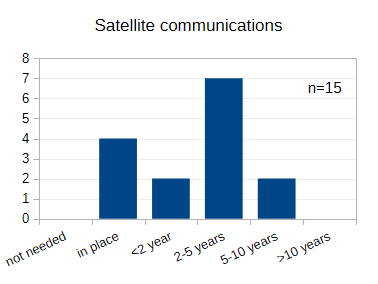
The U.S. had 108 communication satellites for military use in 2025, according to IISS data. That compares with six for the U.K., five for France, three for Italy and two for both Germany and Spain.
Space-based ISR
Uses satellites to collect intelligence, conduct surveillance and perform reconnaissance, delivering critical information about enemy forces, terrain and activity to support military decision-making and operations.
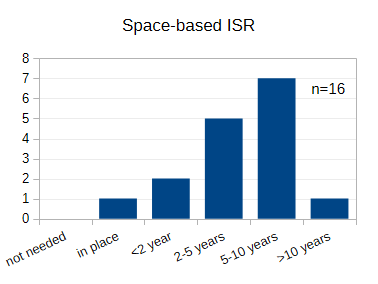
Europe had deployed 36 ISR and electronic/signals intelligence satellites as of 2025, compared with 14 in 2015, according to IISS data.
Battlefield C2
The system and processes military commanders use to direct and coordinate forces during operations, enabling timely and synchronized execution of missions.
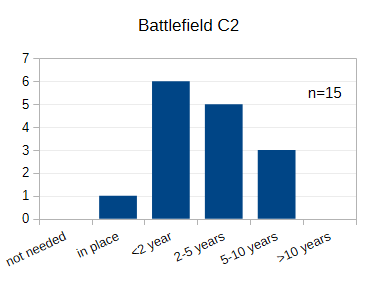
Progress in battlefield C2 will depend on the speed and scope of U.S. withdrawal from Europe “and how much it pushes Europeans to step up.”
— Giuseppe Spatafora, research analyst at the EU Institute for Security Studies
We need people, not only commanders, but staffs who are trained and exercise in high-intensity combat. If you want to defend Europe, we need to conduct multi-corps operations on the ground with air and maritime support and space.
— Kremidas-Courtney, EPC
Airborne C2
Uses aircraft equipped with sensors and communication systems for a comprehensive view of a battle space, tracking aircraft, ships and other assets to enhance situational awareness and operational control.
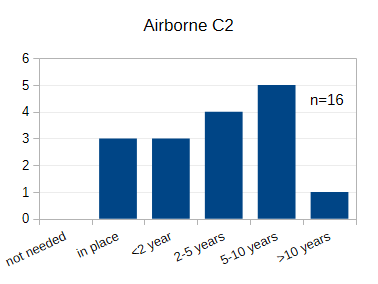
NATO operates a fleet of 14 E-3As from Geilenkirchen in Germany that represents Europe’s primary AWACS capacity. Sweden and France have ordered Saab’s GlobalEye, with NATO, Germany and Denmark also interested in buying the aircraft.
Aerial reconnaissance/unmanned ISR
The use of manned and unmanned aircraft to gather visual, electronic or signals intelligence about enemy forces, terrain, and areas of interest.
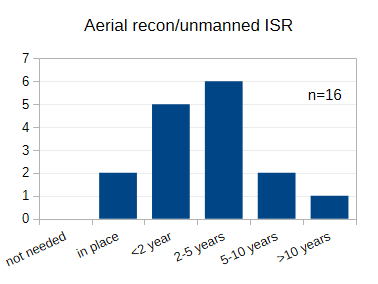
We have signals intelligent aircraft, we have balloons. So the things that are in the atmosphere, we could do a lot in the next two to three years.
— Kremidas-Courtney, EPC
Integrated Air & Missile Defense
The integrated network of sensors, interceptors, and command systems used to detect, track, and defeat air and missile threats against forces and populations.
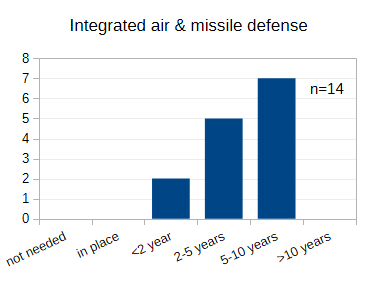
We don’t have enough of it. We can protect some key places, but protecting Rotterdam and Rome and population centers, I think we would have a big problem with that.
— Kremidas-Courtney, EPC
A lot of our effort has been at the lower altitudes, stopping swarms of drones and things like this. We’re catching up there, we have some really good directed energy systems coming online. The reason I like directed energy and cheap missiles is because it returns the cost symmetry.
— Kremidas-Courtney, EPC
SEAD/DEAD
Operations to suppress or destroy enemy air-defense systems to create a safer operating environment for friendly aircraft and open the way for long-range munitions.
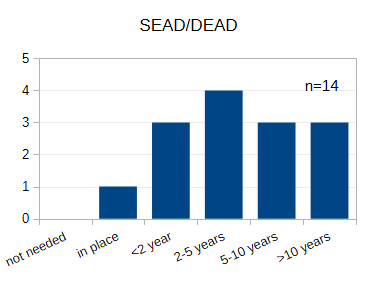
MBDA is developing the high-supersonic maneuverable Status RS missile, whose roles will include taking on enemy air defenses, though that capability may not arrive until 2033.
Long-range strike
The use of stand-off, precision weapon systems to strike strategic or operational targets at extended range, for example to destroy critical infrastructure or high-value targets.
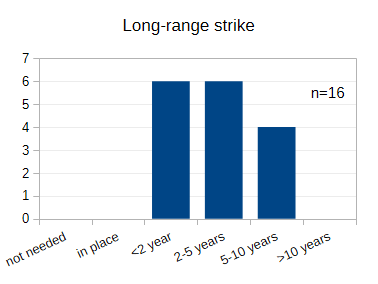
The ELSA group of nations is working on areas including an air-launched long-range capability, a European multi-missile launcher and low-cost 500 km-plus capabilities based on one-way-attack effectors. MBDA last year presented a one-way effector dubbed Crossbow, with a range of more than 800 kilometers.
Capabilities in the 500-1,000 kilometer range could be available within two years, “but not on the scale that would be really useful to achieve an operational effect against Russia.”
— Fayet at IFRI
Some European countries already possess the necessary expertise and know-how, the question essentially comes down to determining how much time would be required to ensure a more substantial production.
— de Neve, Royal Higher Institute for Defence
Aerial refueling
Using tanker aircraft to provide fighter jets and other aircraft with fuel in flight, extending their range and loiter time, and allowing for long-duration missions such as keeping a persistent presence over an area.
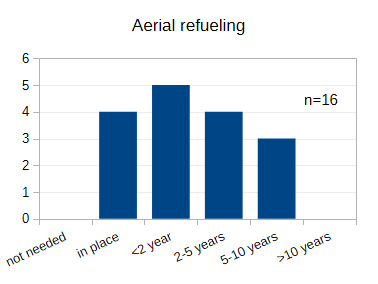
European countries operate 38 Airbus A330 Multi Role Transport Tankers, four more than a year ago, with another six on order, according to Airbus numbers at the end of December.
The MRTT is a great tanker aircraft, just need to get more.
— Fayet, IFRI
Airbus tankers are a lot better than the U.S.’s, but need to scale up numbers in a busy industry.
— Heisbourg, FRS
Strategic airlift
Using transport aircraft for rapid and large-scale movement of personnel, equipment and supplies over long distances, supporting operations far from home bases.
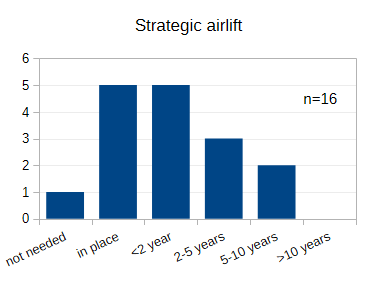
Europe operated 131 Airbus A400M heavy transport aircraft at the end of 2025, with 39 more ordered, according to Airbus.
We have the capabilities, just need to get the mass.
— Fayet at IFRI
Transport aircraft we have largely in place, and we can do what is necessary.
— Wolff at Bruegel
Rudy Ruitenberg is a Europe correspondent for Defense News. He started his career at Bloomberg News and has experience reporting on technology, commodity markets and politics.
Read the full article here
