

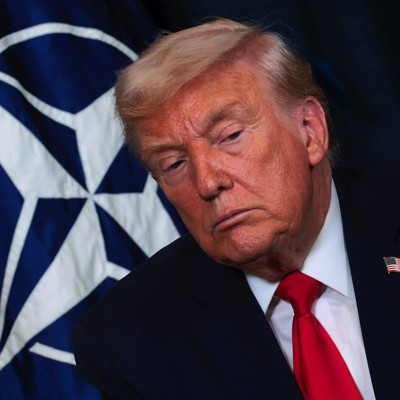
President Trump’s threats about Greenland have already wounded American security. Annexation or a forced sale of the island would inflect grievous self-harm—far greater than his administration appears to grasp.
There is, to begin with, no compelling strategic case for an American takeover of Greenland. Whatever the United States seeks there—overflight rights, basing rights, intelligence access, or mineral exploration—Denmark and Greenland have long been willing to provide. This cooperation is grounded in the 1951 Danish-American Defense Agreement and the 1949 NATO Treaty. Denmark and the United States are allies. The very essence of an alliance is to deter threats collectively.
It was, moreover, the United States’ own decision to reduce its military footprint in Greenland from several tens of thousands of service members during the Cold War to only a few hundred today. Were Washington to reverse course and increase troop levels in response to heightened threat perceptions, NATO allies would broadly support such a move. Indeed, they would likely contribute resources of their own—as demonstrated by the exploratory military mission conducted by European NATO members just last week.
However, if this issue is not about shared security within NATO but instead about American ownership and territorial expansion, the calculus changes fundamentally—for Greenlanders, for Danes, for NATO allies, and ultimately for the United States itself.
An alliance consists of both hardware and software. The hardware is made up of ships, aircraft, and tanks. The software is the political commitment: “one for all, all for one,” the principle of collective defense enshrined in Article 5 of the NATO Treaty. If one NATO member threatens the territorial integrity of another—or seeks to coerce or seize its territory—the alliance’s founding promise loses credibility.
In recent years, many Americans have come to believe that the United States is present in Europe to defend the continent from external threats, while Europeans have been unwilling to invest adequately in their own security. While there is some truth to this perception, it is not the complete story. The United States is also in Europe to serve its own strategic interests. Much of its global power projection—particularly toward Africa, Central Asia, and the Middle East—depends on its military presence in Europe. European allies provide the United States with extensive access, basing, and overflight rights as well as intelligence cooperation. Without this forward presence, the United States would be far less a global power and far more a regional one with an impressive navy.
If the options are framed as “NATO or Greenland,” as President Trump has suggested, this is not a favorable choice for the United States. Fortunately, it is an entirely self-constructed dilemma—and therefore avoidable.
Nevertheless, President Trump has further raised the stakes by threatening punitive tariffs against European countries that oppose his plans for Greenland, once again mixing security and trade policy in trademark fashion. Last year, the Trump administration already pushed the European Union into a trade agreement widely viewed in Europe as highly favorable to the United States. The deal still requires ratification by the European Parliament. This weekend, as a response to President Trump’s threats, parliamentary leaders have agreed not to take up the issue in the plenary. Therefore, there will not be duty-free access to the European market for American goods for now.
To date, the EU has been reluctant to deploy its most powerful trade defense tool: the so-called Anti-Coercion Instrument, against the United States. European leaders have sought to avoid escalation at a moment when, given Russia’s aggression in Europe, NATO unity remains vital. Yet if the credibility of NATO’s defense commitment were undermined by a U.S. takeover of Greenland, such restraint on the European side would likely evaporate.
Some in Washington appear to believe that the United States, as a global power, can have it both ways—territorial expansion on the one hand, and alliance cohesion and support on the other. That is a gamble. Escalation would almost certainly harm Europe, but it would damage the United States just as much.
Norbert Röttgen is the deputy leader of the Christian Democrats in the German Bundestag.
Thomas Kleine-Brockhoff is the director of the German Council on Foreign Relations.
Read the full article here
