

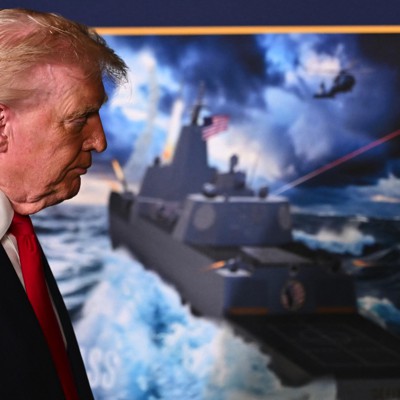
Among the eye-opening details of President Trump’s plans for an eponymous class of giant warships is one that appears to contravene an earlier policy position: these “battleships” are to be armed with a new nuclear-armed cruise missile.
Back in February, however, the president told reporters: “There’s no reason for us to be building brand-new nuclear weapons. We already have so many.” I agreed with President Trump then on this point, and I still do.
We have history to learn from regarding nuclear-armed, sea-launched cruise missiles, known as SLCM-N. In 1991, President George H.W. Bush ordered all nuclear-armed Tomahawk cruise missiles removed from our Navy surface ships and submarines. He deemed forward deployment of this small, “tactical” nuclear weapon uniquely destabilizing, and opted to put them into storage. Twenty years later President Obama, with prodding from U.S. Navy leaders, had them removed from storage and permanently dismantled.
This limiting of the Navy’s nuclear mission to strategic missiles on certain submarines has long been seen as a stabilizing strategy—one that recognized the clear conventional advantages of the U.S. Navy and the unique risks posed by a reliance on tactical nuclear weapons.
Then came a surprise. In 2018, President Trump’s defense secretary, James Mattis, and Joint Chiefs chairman, Gen. Mark Milley signed off on a Nuclear Posture Review that called for developing a new SLCM-N. President Biden rightly cancelled this nascent program in 2021 but did not drive the issue actively enough to prevent Congress from overruling this decision and continuing to fund the project. Rarely, if ever, in our history has the Congress forced the executive branch to start a new nuclear weapon program.
Having served for five and a half years as Assistant Secretary of Defense for Nuclear, Chemical, and Biological Defense Programs, I strongly support modernization of our triad of strategic nuclear weapons. The “tactical” SLCM-N, however, is different. In addition to agreeing with President Trump that we don’t need additional new nuclear weapons, I oppose this specific one for three reasons.
I don’t want our adversaries to think that if they use a “small, tactical nuclear weapon,” as President Putin has recklessly threatened, that our response would be to retaliate with a similarly small one. I’d rather our adversaries fear an overwhelming retaliation, and building our strategic deterrent to maximize that mission also shifts the parameters of any imagined battle onto our clear conventional advantages. The United States already has weapons that fit this need, and the current nuclear modernization program is bolstering that.
Second, I’m concerned that such types of nuclear weapons are more likely to be used in a regional conflict, or a so-called limited nuclear war. Once the nuclear threshold is crossed, escalation to an all-out nuclear exchange becomes chillingly likely.
Third, such weapons increase the potential for miscalculation or accidental nuclear war. This is because the same weapons exist in commonly used conventional, or non-nuclear variants. In a contested environment with degraded intelligence and sensing capabilities, an adversary would have no way of knowing if any given weapon flying towards its territory were armed with a nuclear or conventional warhead, and may well decide to reach for its own nuclear weapons rather than risk losing them.
So let’s not undermine our formidable strategic weapons triad with pursuit of this small, “tactical” nuclear weapon. In his effort to drive a new battleship program, President Trump has an opportunity to also stick to his past statements and make America stronger and safer by investing in capabilities that are more important than building this new nuclear weapon.
Andrew C. Weber, a Senior Fellow at the Council on Strategic Risks, previously served as U.S. Assistant Secretary of Defense for Nuclear, Chemical and Biological Defense Programs.
Read the full article here
